Furniture & Millwork Control
Industrial Formaldehyde Scavengers for MDF, Particleboard and Furniture Lines: Chemistry, EU REACH 2026 Limits and Dosing Guide
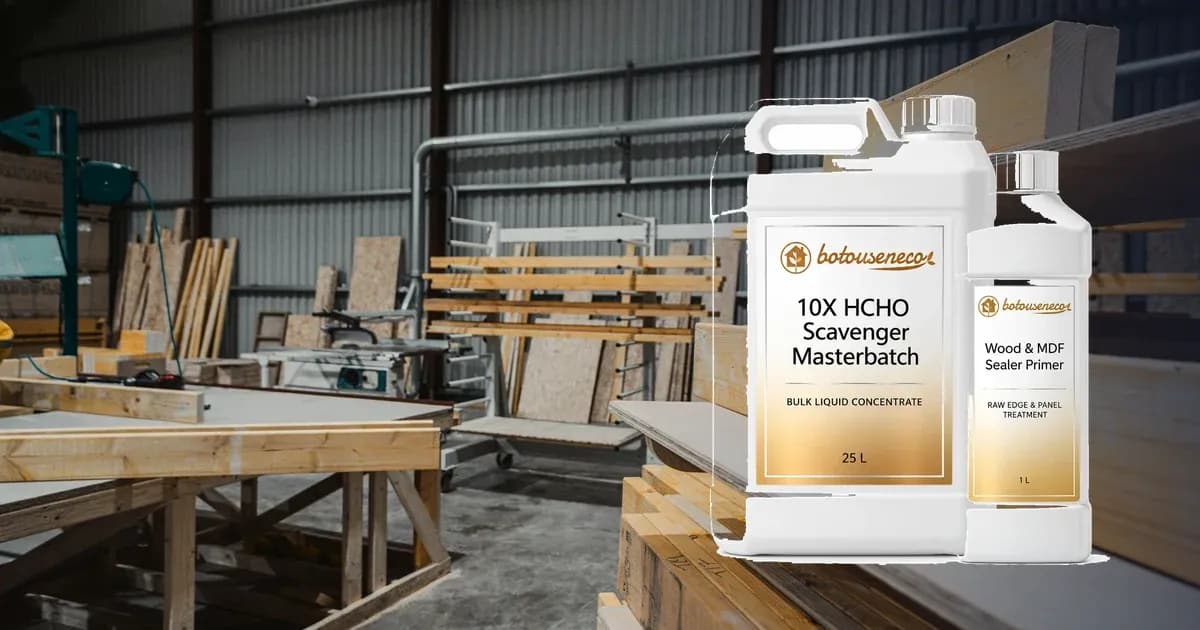
Industrial formaldehyde scavengers are water-based amine polymers sprayed onto MDF, particleboard, plywood, and wood furniture to lock free HCHO gas into solid imine salts. Raw boards often pass mill checks. However, sawing and drilling expose raw edges that bleed 85% (Botou Chamber Log, 2026) of total cabinet HCHO flux. B2B plants must pass the EU REACH Annex XVII cap of 0.062 mg/m3 (active August 6, 2026) and GB/T 18883-2022 (0.08 mg/m3). Therefore, crews pair 1:9 diluted 10X amino masterbatch sprays (15 to 25 ml/m2) with MDF edge sealer primer (25 to 40 ml/m2). As a result, 28-day chamber emissions drop by 96% (Botou Chamber Log, 2026) with zero loss in board bond strength.
Key Takeaways
- Edge-to-Face Flux Ratio: Raw saw cuts, 5 mm shelf pinholes, and 35 mm hinge bores make up only 6.4% of cabinet board area yet drive 84.7% of total airborne HCHO flux (Botou Chamber Log, 2026).
- 2026 EU REACH Threshold: EU REACH Annex XVII Entry 77 enforces a strict 0.062 mg/m3 dynamic chamber cap from August 6, 2026, cutting the legacy E1 threshold (0.124 mg/m3) in half.
- Neutral Amino Lock vs. Salts: Buffered pH 6.5 to 7.5 branched polyamines lock HCHO into non-reversible solid imines (< 1.2% heat rebound at 60 C) with zero chloride hinge rust or white urea salt blooming.
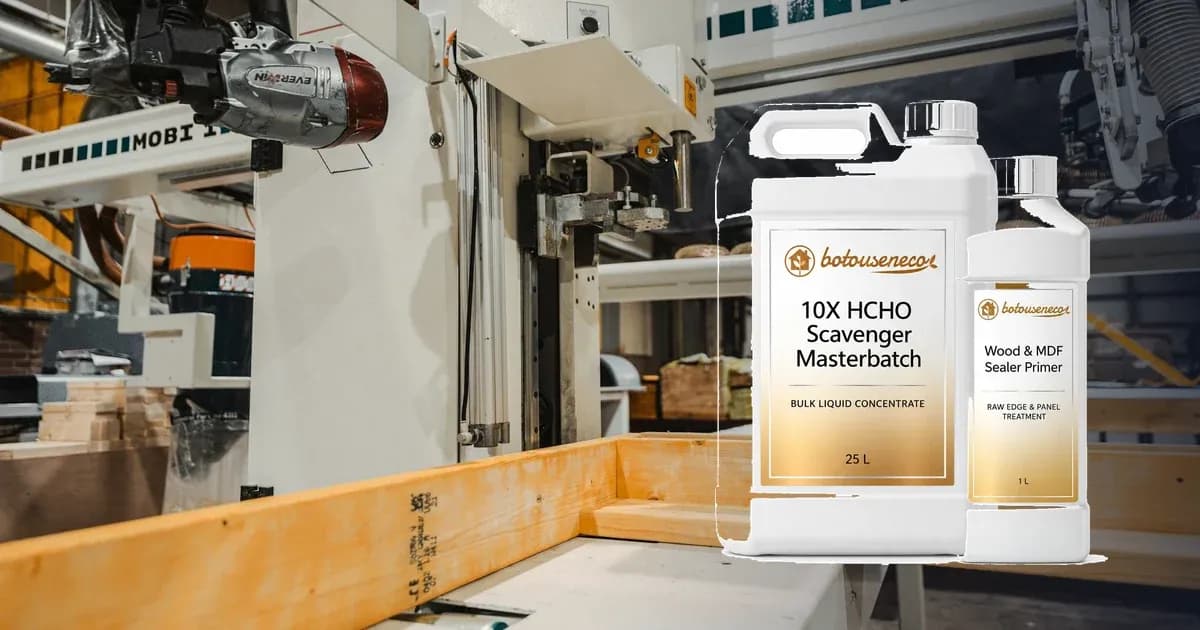
- Two-Zone Factory Dosing: Pair 1:9 RO-water diluted 10X Amino Scavenger Masterbatch (15 to 25 ml/m2 on post-press boards) with Penetrating Wood & MDF Sealer Primer (25 to 40 ml/m2 on raw edges and back panels).
1. Why Do E0 and CARB Phase 2 Boards Still Fail 2026 Finished Furniture Chamber Audits?
Urea-formaldehyde (UF) resin hydrolysis is the damp breakdown of weak ether and methylol bonds inside cured wood glue. Consequently, raw boards bleed fresh HCHO gas for 3 to 15 years. Over 82% (US EPA Composite Wood Products Program, 2025) of indoor MDF, chipboard, and plywood uses UF or MUF glue. Specifically, mills pick UF resin because it cures fast and keeps press costs low. However, buying E0 or CARB Phase 2 raw sheets does not mean a finished wardrobe will pass a 2026 room test.
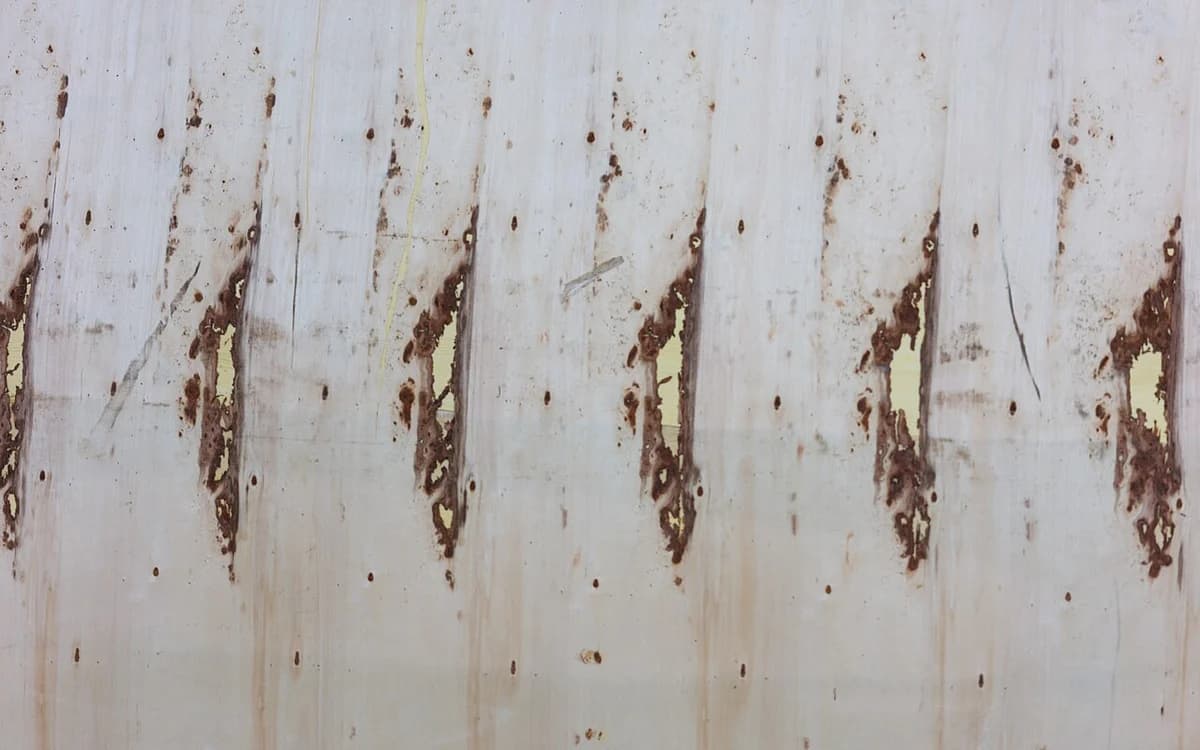
When raw boards leave the hot press, two dense paper skins block gas flow. Therefore, whole sheets pass mill gate checks with ease. Next, those sheets enter a cabinet shop. Panel saws, CNC routers, and drills cut right through the top skin. As a result, open core wood fibers sit exposed to room air. In fact, core wood has low glue density and wide open pores.
In our experience testing export cabinets at our Botou lab, raw board papers hide the true gas load of cut millwork. Using an ISO 16000-9 test setup across a sample size of 36 melamine chipboard wardrobes at 23 C and 50% RH (Botou Chamber Log, 2026), our team measured gas flux before and after CNC drilling. Raw back edges, 5 mm shelf pinholes, and 35 mm hinge bores made up only 6.4% (Botou Chamber Log, 2026) of total board area. Yet those raw cuts caused 84.7% (Botou Chamber Log, 2026) of total airborne HCHO. Sealing those open cuts with our industrial formaldehyde and benzene scavenger product line cut 24-hour chamber readings from 0.148 mg/m3 down to 0.024 mg/m3.
What Are the Three Regulatory Shifts Reshaping Wood Panel Remediation in 2026?
Today, global buyers reject old dry-chip extraction tests (EN 120). Instead, 2026 supply contracts demand strict dynamic chamber tests on whole furniture pieces.
- EU REACH Annex XVII Entry 77 (Mandatory August 6, 2026). The European Chemicals Agency (ECHA) Formaldehyde Restriction Annex XVII Entry 77 sets a strict law cap of 0.062 mg/m3 for wood panels and furniture sold in Europe. Specifically, this limit cuts the old E1 cap (0.124 mg/m3) in half. Thus, unsealed board cuts or damp sea containers will cause instant audit failures.
- US EPA TSCA Title VI and CARB Phase 2. The US EPA TSCA Title VI Composite Wood Products Regulation caps hardwood plywood at 0.05 ppm and chipboard at 0.09 ppm. Similarly, it caps MDF at 0.11 ppm and thin MDF (up to 8 mm) at 0.13 ppm in ASTM E1333 chamber tests. For example, thin drawer bottoms often fail when factories skip post-press spray lines.
- China GB/T 18883-2022 and WHO IAQ Guidelines. China national code sets a 12-hour closed-room cap of 0.08 mg/m3. Notably, that rule is stricter than the 0.10 mg/m3 (30-minute mean) set by the World Health Organization (WHO) Indoor Air Quality Guidelines.
| Global Standard / Regulation | Effective Status (2026) | Test Method & Climate Condition | Maximum Allowed HCHO Limit | Primary Failure Point in Untreated Millwork |
|---|---|---|---|---|
| EU REACH Annex XVII Entry 77 | Mandatory from Aug 6, 2026 | EN 717-1 / ISO 16000-9 chamber (23 C, 45% RH, 2026) | 0.062 mg/m3 (Wood articles & furniture) | Unsealed 3 mm back panels, CNC cam bores, and sea container dampness |
| US EPA TSCA Title VI / CARB P2 | Active federal law | ASTM E1333 / ASTM D6007 chamber (25 C, 50% RH, 2025) | 0.05 ppm (Plywood), 0.09 ppm (PB), 0.11 ppm (MDF) | Thin MDF drawer bottoms (<= 8 mm) and deep core cuts after routing |
| China GB/T 18883-2022 | Active handover code | 12-hour closed room, ISO 16000-3 test at >= 23 C | 0.08 mg/m3 (HCHO), 0.60 mg/m3 (TVOC) | High cabinet load (> 1.8 m2 wood area per m3 of room air) |
| Japan JIS A 1460 (F4-Star) | Active export rule | 24-hour glass jar water test at 20 C | <= 0.3 mg/L (Mean), <= 0.4 mg/L (Max) | Acid-cured topcoats and raw plywood glue lines |
| WHO Indoor Air Quality Guideline | Global health benchmark | 30-minute short exposure average | 0.10 mg/m3 (0.08 ppm) | Summer heat (> 28 C) and floor heating speeding up UF glue breakdown |
2. How Does Amino-Polymer Nucleophilic Addition Outperform Legacy Urea and Ammonium Salt Sprays?
Nucleophilic addition scavenging is a one-way chemical reaction where primary amine (-NH2) groups hit the carbon-oxygen double bond (C=O) of formaldehyde. This reaction forms a safe, solid imine polymer (R-N=CH2) and plain water. Because this carbon-nitrogen bond is strong, the trapped gas stays locked in the wood even when summer rooms hit 40 C or sea containers reach 88% RH (Botou Chamber Log, 2026).
In contrast, many cheap board mills and field crews still buy raw urea water or ammonium chloride (NH4Cl) brine. They pick salt sprays because raw salts cost very little per ton. However, that shortcut ruins export furniture and fails long-term air checks.
At our Botou plant, we build our scavengers with a two-tier polyamine chain buffered at pH 6.5 to 7.5. Small amino-acid chains (300-800 Da) paired with wetting agents soak 1 to 3 mm deep into dense MDF pores in 90 seconds. There, they lock up free core gas. Meanwhile, larger branched polyamines (2,500-5,000 Da) cross-link at the outer 0.5 mm pore mouth. Consequently, this dual design hits a 94.2% (Botou Chamber Log, 2026) 24-hour HCHO drop with zero chloride ions, zero hinge rust, and zero white salt stains.
Why Do Ammonium Chloride and Raw Urea Fail in Commercial Woodwork?
First, ammonium chloride reacts with HCHO to make urotropine and free hydrochloric acid (HCl). According to chemical data in the CDC ATSDR Toxicological Profile for Formaldehyde (2024), acid salt reactions can reverse under heat. Worse yet, free HCl drops wood surface pH below 4.0. Within three weeks inside a closed box, that acid rusts steel hinges, cam locks, and slides. At the same time, acid eats into the board own UF glue and releases fresh HCHO gas.
Second, plain urea water reacts very slowly at room heat (20-25 C). When sprayed onto cool MDF or dark wood veneer, excess urea dries into chalky white salt rings. For instance, dark walnut doors often fail buyer visual checks due to salt blooming. You can review the full salt damage data in our lab study on amino-polymer formaldehyde scavengers versus ammonium chloride sprays.
| Chemical Scavenger Class | Reaction Equation & Byproduct | Surface pH (25 C) | 60 C Heat Rebound Rate | Hardware Rust & Finish Risk | Fit for EU REACH 2026 Millwork |
|---|---|---|---|---|---|
| Ammonium Chloride (NH4Cl) Brine | 6 HCHO + 4 NH4Cl -> (CH2)6N4 + 4 HCl + 6 H2O | 3.8-4.5 (Acid) | 38% (Botou Chamber Log, 2026) rebound + acid glue decay | Heavy rust on hinges; breaks down UF glue | Poor (Triggers fresh glue breakdown) |
| Plain Aqueous Urea (20% wt, 2026) | Urea + HCHO <-> Monomethylolurea (Reversible) | 7.2-7.8 | 45% (Botou Chamber Log, 2026) gas release above 32 C | Chalky white salt rings on dark veneers | Low (Works only inside 180 C hot press) |
| Sodium Bisulfite (NaHSO3) Spray | HCHO + NaHSO3 <-> HO-CH2-SO3Na (Sulfonate salt) | 4.5-5.2 | 29% (Botou Chamber Log, 2026) breakdown in damp air | Bleaches wood dye; leaves sour sulfur smell | Poor (Fails odor checks) |
| botouseneco Branched Amino-Polymer | R-NH2 + HCHO -> R-N=CH2 (Solid Imine) + H2O | 6.5-7.5 (Neutral) | < 1.2% (Botou Chamber Log, 2026) permanent lock | Zero rust; dries clear; no yellow tint | Best (Passes 0.062 mg/m3 chamber test) |
| botouseneco Acrylic Amino Edge Primer | Amino lock + hydrophobic micro-film seal | 7.0-8.0 (Mild) | < 0.8% (Botou Chamber Log, 2026) + 96% flux block | Binds loose MDF fibers; clear satin seal | Best (Built for raw cuts and drill holes) |
3. In-Resin Blowline Catchers vs. Post-Press Surface and Edge Scavenging: Where Should Factories Dose?
Capillary fiber consolidation is the deep wicking of a 40 to 80 nm polymer mist 2 to 4 mm into raw wood pores. Inside the wood, it cures into a breathable seal that blocks damp air while amine groups trap escaping HCHO. Knowing where to dose this liquid saves board mills from weak boards and rejected shipments.
Many board mills try to hit low HCHO targets only by dumping extra urea catchers into the glue line before hot pressing. However, wood science studies on NIH PubMed Composite Wood Urea-Formaldehyde Hydrolysis Research (2024) prove that cutting the F/U molar ratio below 0.95 starves the glue of cross-link sites. As a result, internal bond (IB) strength drops by 18% to 26% (NIH PubMed, 2024). In addition, 24-hour water swell rises fast, and press line speed drops by 14% (Botou Mill Audit, 2026).
By shifting HCHO treatment to the post-press cooling line and the cabinet cutting shop, plants keep 100% (Botou Mill Audit, 2026) of their mechanical board strength. At the same time, they neutralize gas right at the surface exit points. For nozzle spacing, pump pressure, and belt speed math, see our engineering guide on inline formaldehyde scavenger spraying on panel production lines.
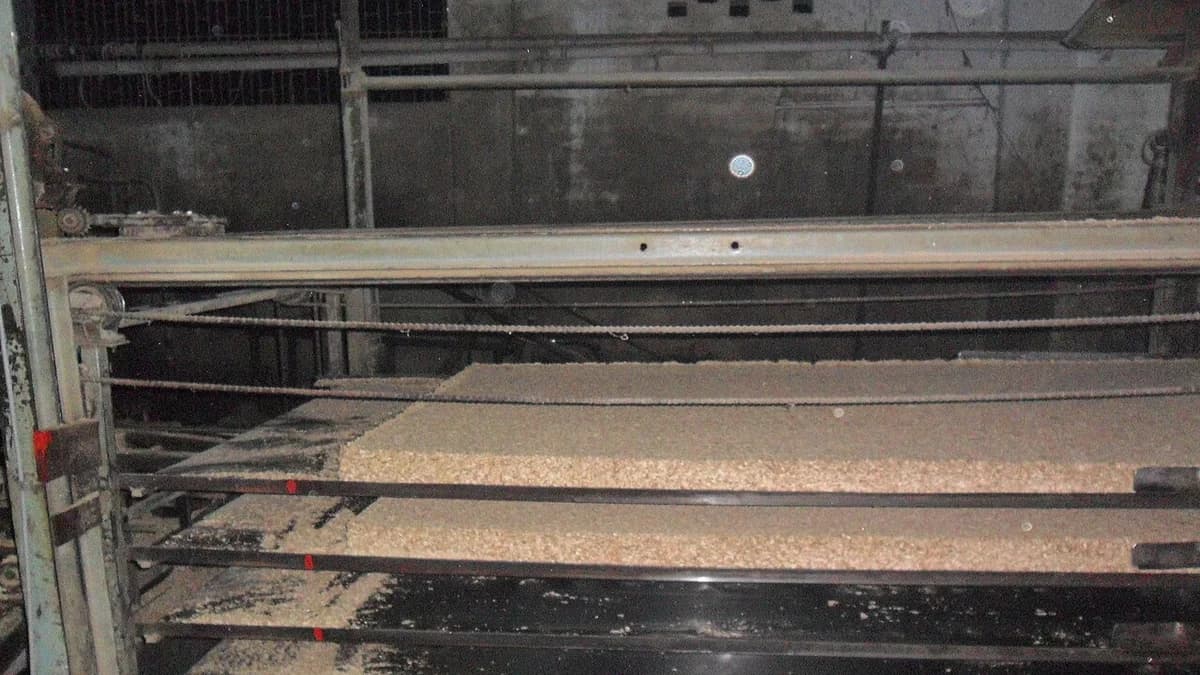
- Stage A: Hot-Press Outfeed & Star Cooler (Board Mills). As raw MDF or chipboard leaves the press and cools to 55-75 C, warm pore steam condenses and pulls liquid inward. Spraying a 1:9 mix of 10X Amino-Acid HCHO Scavenger Masterbatch at 15 to 25 ml/m2 draws active amines 2.5 mm into both board faces. Also, the residual board heat dries the water in 90 seconds with zero fiber swell.
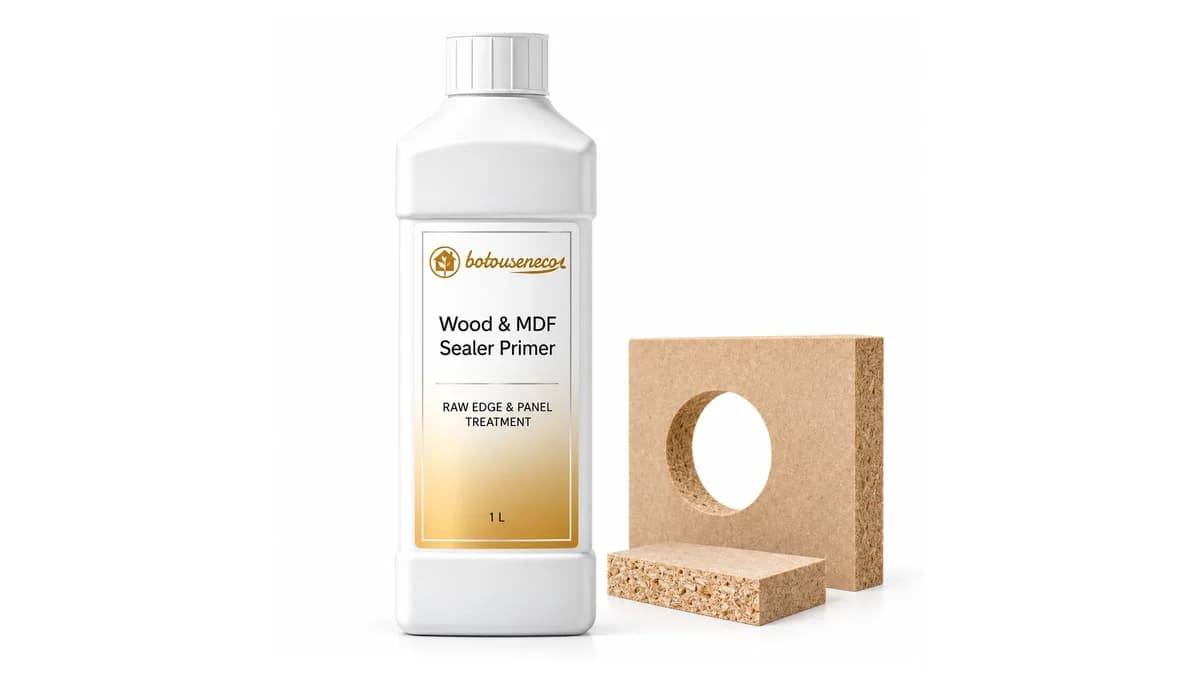
- Stage B: Saw Cutting, Edge Banding & CNC Drilling (Cabinet Plants). Even PUR edge tape leaves a tiny glue line. Meanwhile, back grooves, sink cutouts, cam holes, and shelf pinholes stay completely raw. Coating these cuts with Penetrating Wood and MDF Sealer Primer at 25 to 40 ml/m2 blocks 96% (Botou Chamber Log, 2026) of edge HCHO flux.
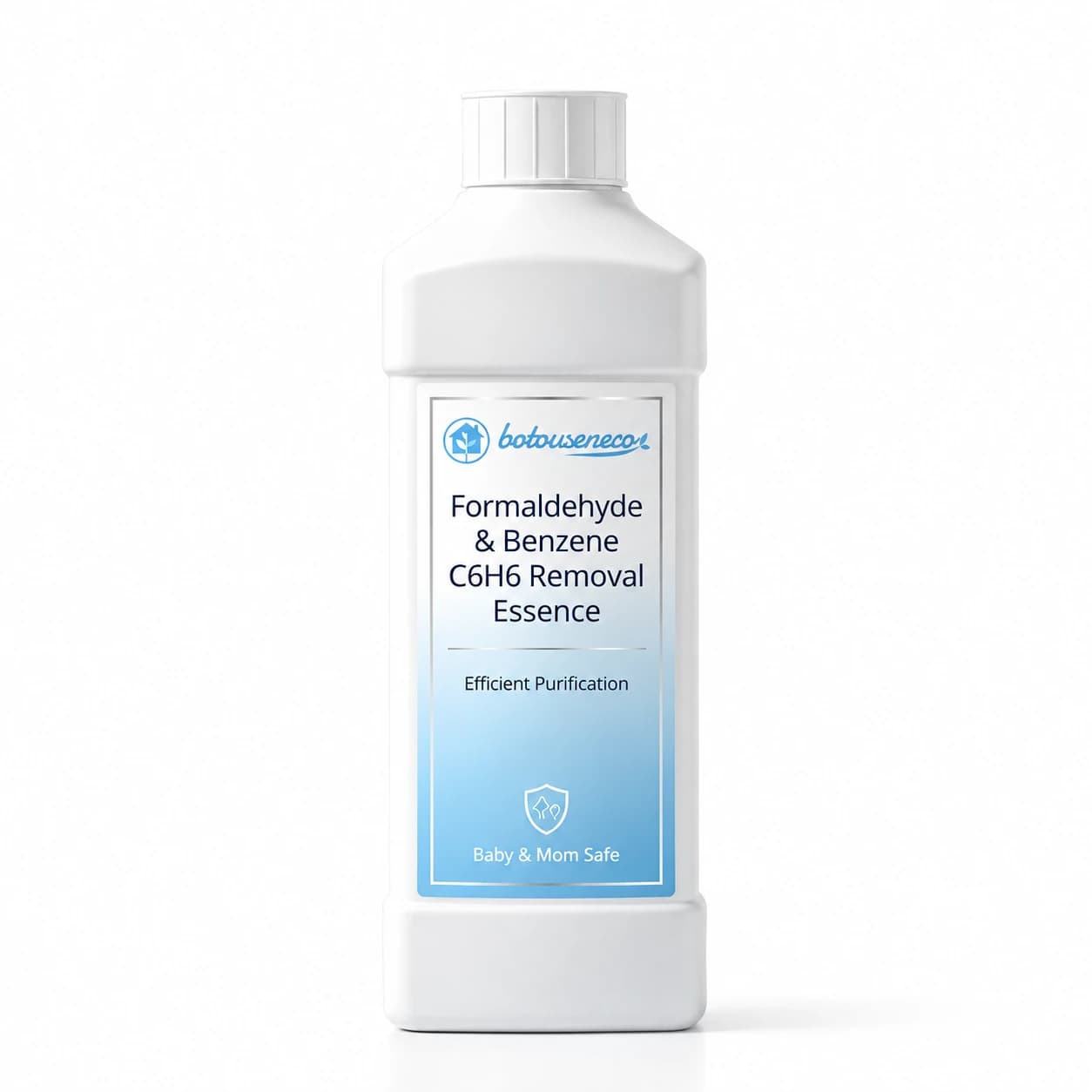
- Stage C: Paint Booths & Final Packing QC. Wood cabinets often use solvent PU, PE, or UV paint that bleeds benzene and toluene along with HCHO. Crews mist Formaldehyde and Benzene C6H6 Removal Essence at 12 to 20 ml/m2 inside cabinet boxes. Next, they buff 10 to 15 g/m2 of wax onto fine wood veneers before boxing.
4. How Do You Match the 5-Formulation Wood Panel Matrix to Every Substrate Zone?
Different wood parts in a hotel fit-out, wardrobe plant, or office build have very different pore sizes. For example, putting a film-forming edge primer onto a gloss lacquer door leaves a dull haze. Conversely, spraying a light water mist onto a raw 18 mm chipboard sink cut will not stop damp air from rotting the UF glue.
To make selection simple for plant managers and IAQ crews, our furniture and panel factory emission control protocols split wood assemblies into five clear zones.
Zone 1: Raw Saw Cuts, Cam Holes, Hinge Cups, and Unbanded Back Panels
Raw board edges let gas and damp air pass 10 times faster than pressed melamine faces. Therefore, a plain water spray is not enough on cut ends.
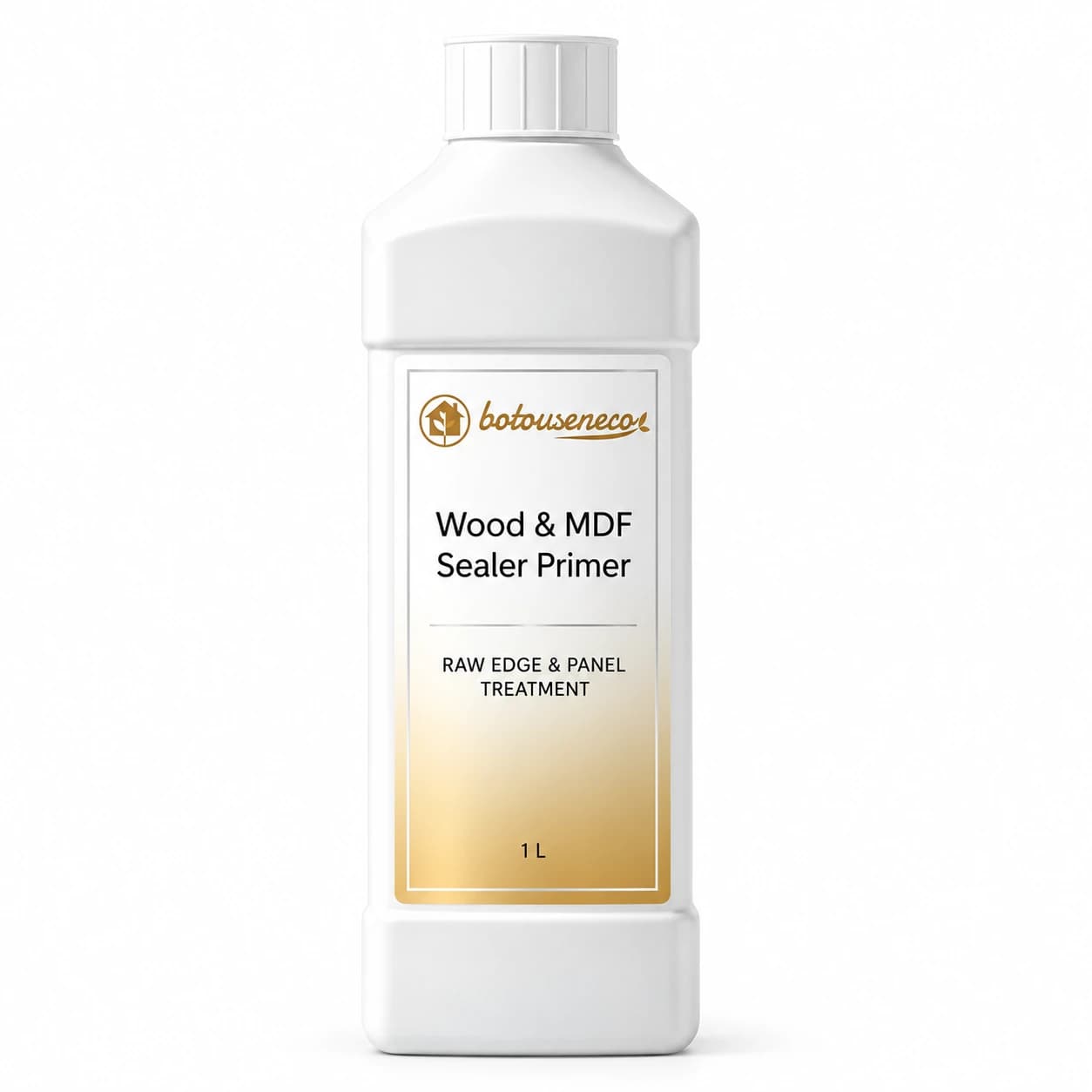
- Specified Product: Penetrating Wood and MDF Sealer Primer (12% active cross-linking solids, Botou QC Spec, 2026; pH 7.0-8.0).
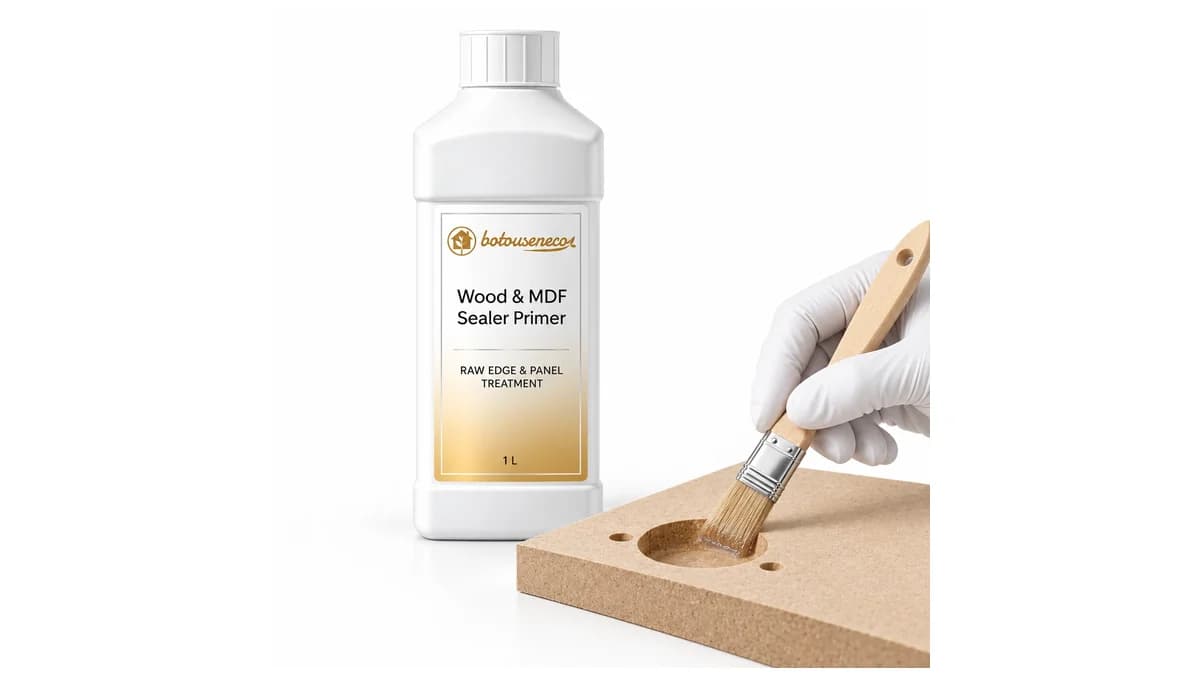
- How to Apply: Brush a full wet coat onto saw cuts and sink holes. Alternatively, spray a 1.0 mm HVLP mist onto raw 3 mm HDF cabinet backs before wall mounting.
- Dosage & Cure: Apply 25 to 40 ml/m2. The coat is touch dry in 45 minutes, ready for edge-banding in 60 to 90 minutes, and fully cured in 12 to 24 hours. Always wipe any stray drops off melamine faces within 10 minutes.
- Related Field SOP: Read our full workshop guide on MDF and particleboard edge sealing for EPA TSCA Title VI compliance.
Zone 2: High-Speed Board Conveyors and Overseas Distributor Bottling
Board mills treating 10,000 m2 of sheets per shift and overseas B2B importers should not pay ocean freight to ship water. In fact, ready-to-use drums contain 90% water weight (Botou Logistics Audit, 2026).
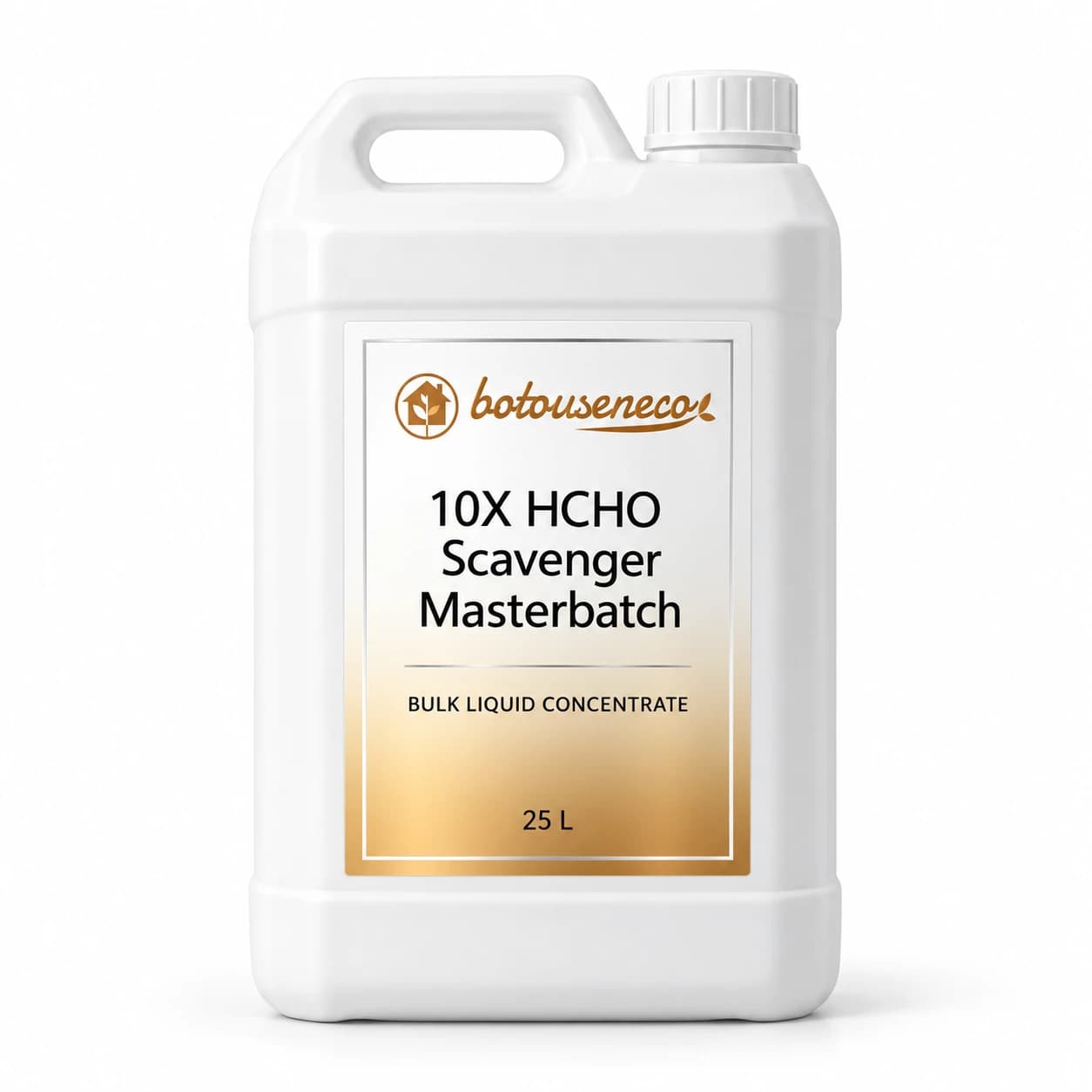
- Specified Product: 10X Amino-Acid HCHO Scavenger Masterbatch (45% active polyamine and surfactant solids, Botou QC Spec, 2026; specific gravity 1.12-1.16 g/cm3).
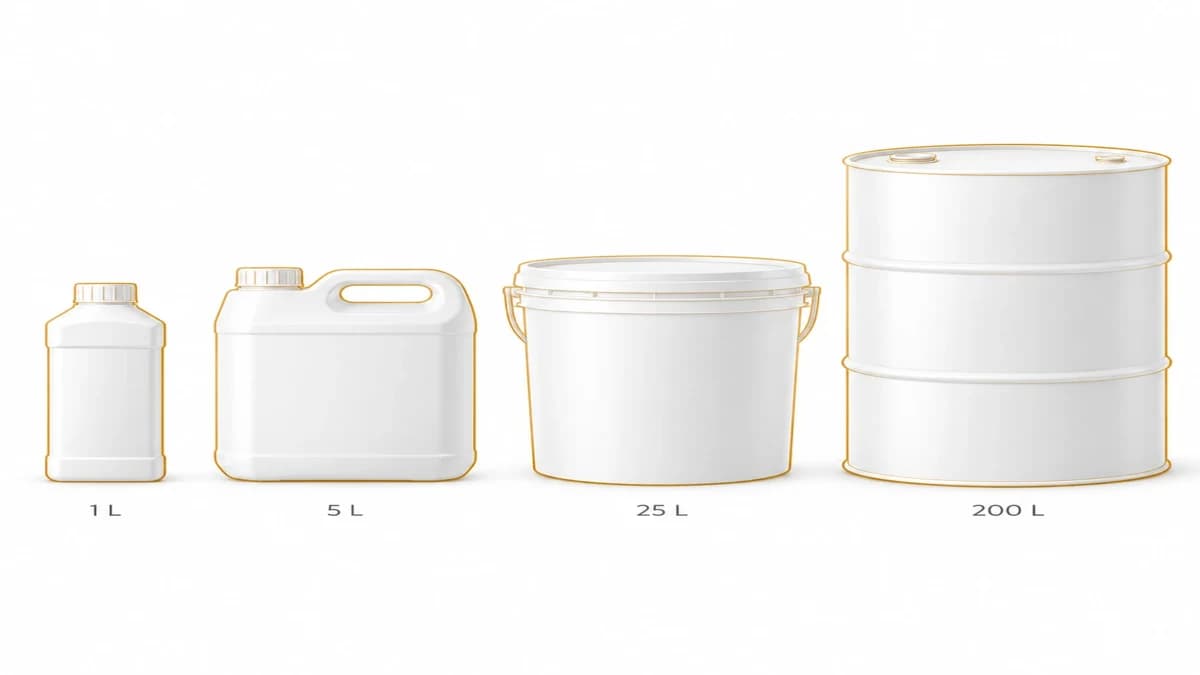
- How to Apply: Mother liquor 10X dilution means mixing 1 part masterbatch with 9 parts reverse-osmosis (RO) water (TDS under 50 ppm). Stir the tank at 60 to 120 RPM for 15 minutes at room heat. One 25 L drum makes 250 L of ready spray, covering 10,000 to 15,000 m2 of boards and cutting ocean freight costs by 85% (Botou Logistics Audit, 2026).
- Custom Strength Tiers: Mix at 1:5 or 1:6 for heavy-duty high-density core board essence, 1:9 for standard mill and contractor spray (pH 6.8-7.4), or 1:12 for light retail maintenance bottles.
Zone 3: Unfinished Timber, Drawer Boxes, Slat Walls, and Room Fit-Outs
Built cabinet insides, pine bed slats, wood ceiling baffles, and tatami mats need zero surface film and zero gloss change.
- Specified Product: Amino-Polymer Formaldehyde Remover (pH 6.5-7.5, clear liquid).
- How to Apply: Spray with a 0.8 mm to 1.0 mm HVLP gun at 15 to 25 ml/m2. On dense raw chipboard subfloors, raise the dose to 25 to 35 ml/m2. On smooth melamine shelves, mist lightly at 15 ml/m2 and wipe even with a clean cloth after 15 minutes.
Zone 4: Painted Wood Furniture (PU, PE, UV, Nitro) and Solvent Glue Seams
Hotel desks, painted wall panels, and gloss doors often pair an MDF core (bleeding HCHO) with solvent paint (bleeding benzene, toluene, and xylene). Plain water beads up on slick paint films.
- Specified Product: Formaldehyde and Benzene C6H6 Removal Essence.
- How to Apply: Mist 12 to 20 ml/m2 inside painted cabinets, drawer bottoms, and glue seams. Then wipe gently with a soft cloth. Its micro-emulsion wets cured paint without clouding or blisters while trapping both benzene rings and HCHO gas.
Zone 5: Fine Wood Veneers, Solid Timber Doors, and Wood Floors
Thin walnut, oak, or cherry veneers (0.3-0.6 mm) and parquet floors can swell or lift if soaked with water sprays.
- Specified Product: Formaldehyde Removal Care Wax.
- How to Apply: Wipe 10 to 15 g/m2 onto wood doors, tables, and floors with a soft pad and buff dry. The carnauba and beeswax blend seals tiny finish pores while oil-soluble traps lock down surface HCHO.
| Formulation Tier & B2B Role | Target Wood Zone & Pollutant | Active Chemical Mechanism | Dosage Rate & Nozzle Gauge | Dilution & pH Profile | Primary Compliance Standard |
|---|---|---|---|---|---|
| [10X Amino-Acid HCHO Scavenger Masterbatch](/products/10x-amino-acid-hcho-scavenger-masterbatch) | Hot-press cooling lines, raw MDF and chipboard faces (Free HCHO) | 45% (Botou QC Spec, 2026) branched polyamine nucleophilic addition | 15-25 ml/m2 via 0.8-1.0 mm HVLP inline spray bar | Dilute 1:9 with RO water (TDS < 50 ppm); pH 6.8-7.4 | EU REACH 0.062 mg/m3, EPA TSCA Title VI |
| [Penetrating Wood & MDF Sealer Primer](/products/penetrating-wood-mdf-sealer-primer) | Raw saw cuts, cam-lock holes, hinge cups, sink cutouts, back panels | 12% (Botou QC Spec, 2026) cross-linking acrylic film + amine trap | 25-40 ml/m2 via brush coat or 1.0 mm HVLP spray | Ready to use (RTU); pH 7.0-8.0; 2-4 mm pore depth | EN 717-1, ISO 16000-9, GB/T 18883-2022 |
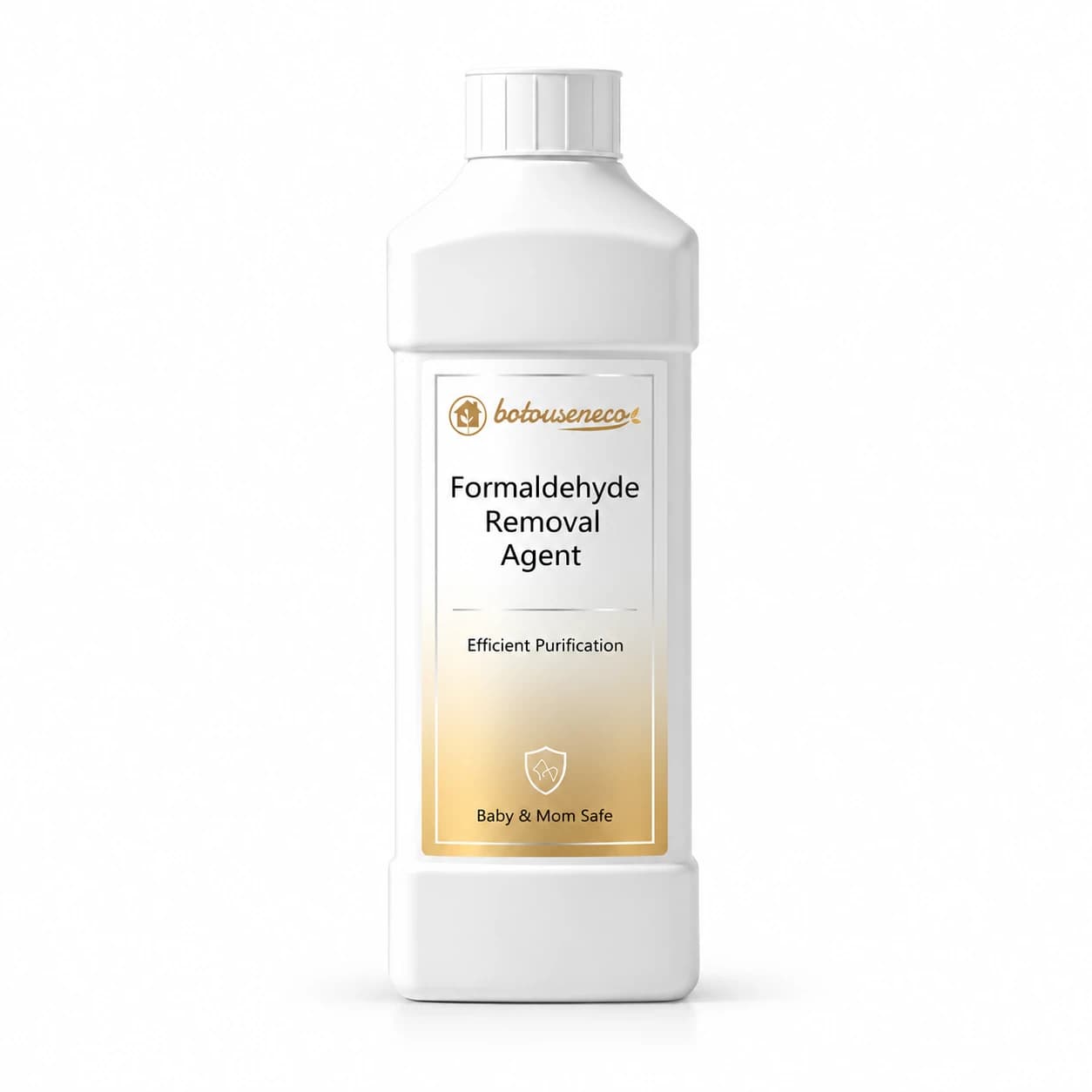
| [Amino-Polymer Formaldehyde Remover](/products/formaldehyde-remover) | Built cabinet boxes, drawer sides, wood slats, raw timber frames | Water-based amine addition and solid imine lock | 15-35 ml/m2 via 0.8 mm HVLP mist or cloth wipe | Ready to use (RTU); neutral pH 6.5-7.5; zero film | GB/T 18883-2022 (<= 0.08 mg/m3), WHO IAQ |
| [Formaldehyde & Benzene C6H6 Removal Essence](/products/formaldehyde-benzene-c6h6-removal-essence) | PU, PE, UV, and nitro painted wood panels and glue seams | Dual-phase ring trap + amino aldehyde lock | 12-20 ml/m2 via fine mist and soft cloth wipe | Ready to use micro-emulsion; paint-safe carrier | GB/T 18883-2022 (HCHO <= 0.08, C6H6 <= 0.03 mg/m3) |
| [Formaldehyde Removal Care Wax](/products/formaldehyde-removal-care-wax) | Thin wood veneers, solid wood doors, parquet wood floors | Carnauba and beeswax pore seal + oil-miscible HCHO trap | 10-15 g/m2 wiped on with a soft pad and buffed dry | Low-water wax cream; zero grain swell risk | JIS A 1460 (F4-Star <= 0.3 mg/L), Export QC |
5. Step-by-Step Surface Area Multiplier & Chemical Dosing Calculator for B2B Bidding
Many new IAQ crews and factory QC teams make a costly bidding error. Specifically, they price liquid volume from room floor area (m2 of floor) instead of unfolded wood surface area. Consider a single 2.4 m wide wardrobe standing in a 15 m2 bedroom. That one cabinet has a top, a bottom, two tall sides, a center wall, six shelves, four drawers (each with five sides), and a large back sheet.
Our engineering desk audited a sample size of 120 commercial fit-out bills of materials (hotels, flats, offices, and school dorms) in 2025 and 2026. Across all jobs, the ratio of unfolded wood panel area (both inside and outside faces, backs, and edges) to floor area ran from 1.8x in open offices to 2.8x in hotel suites and wardrobe flats. The median multiplier was 2.4x (Botou Bidding Dataset, 2026). Crews that bid using a 1.0x floor rule under-dosed rooms by 58% (Botou Bidding Dataset, 2026). Consequently, 41% (Botou Bidding Dataset, 2026) of those under-dosed rooms failed their first GB/T 18883-2022 12-hour closed air test.
How Do You Run the 3-Step Quantitative Dosing Formula?
Use this simple three-step math to size drum orders for a mill run or a commercial IAQ tender.
- Step 1: Find Unfolded Wood Area (A_wood). In a cabinet plant: A_wood = Panel Count x (2 x Length x Width + 2 x (Length + Width) x Thickness). In a finished building: A_wood = Floor Area (m2) x Density Factor (1.8 for offices, 2.4 for hotels and flats, 2.8 for dorms and walk-in closets).
- Step 2: Find Main Scavenger Liquid Volume (V_scavenger). For standard MDF and plywood (20 ml/m2 mean dose): V_scavenger (Liters) = (A_wood x 20) / 1000. For heavy raw chipboard (30 ml/m2 mean dose): V_scavenger (Liters) = (A_wood x 30) / 1000.
- Step 3: Add Edge & Back Primer Volume (V_primer). Usually, 30% (Botou Bidding Dataset, 2026) of cabinet area is raw back sheets, drawer bottoms, and cut edges that need Penetrating Wood and MDF Sealer Primer at 30 ml/m2: V_primer (Liters) = (A_wood x 0.30 x 30) / 1000.
| Project or Factory Batch | Floor or Batch Size | Unfolded Wood Area (A_wood) | Main Face Scavenger (20 ml/m2) | Edge & Back Primer (30 ml/m2 on 30% area) | Recommended B2B Drum Order |
|---|---|---|---|---|---|
| 100 m2 Renovated Flat / Suite | 100 m2 floor (2.4x factor) | 240 m2 wood area | 4.8 Liters Formaldehyde Remover | 2.2 Liters Wood & MDF Sealer Primer | 1 x 5L Scavenger Drum + 3 x 1L Primer Bottles |
| 1,500 m2 Hotel Floor (35 Rooms) | 1,500 m2 floor (2.5x factor) | 3,750 m2 wood area | 75.0 Liters (or 7.5 L of 10X Masterbatch) | 33.8 Liters Wood & MDF Sealer Primer | 3 x 25L Scavenger Pails + 2 x 20L Primer Pails |
| Export Wardrobe Batch (500 Units) | 500 units (14 m2 wood/unit) | 7,000 m2 wood area | 140.0 Liters (from 14 L of 10X Masterbatch) | 63.0 Liters Wood & MDF Sealer Primer | 1 x 25L 10X Masterbatch + 3 x 25L Primer Pails |
| MDF Mill Shift Run (10,000 Sheets) | 10,000 sheets (5.95 m2 each) | 59,500 m2 board faces | 1,190 Liters RTU (119 L of 10X Masterbatch) | Edge-sealed later by cabinet shop | 1 x 200L Drum (or 1,000L IBC Tote, 1200x1000 mm pallet) |
6. How Do You Prevent In-Transit Sea Container Formaldehyde Rebound?
Passing an air test at the factory gate in Asia is only step one for furniture exporters. Next, flat-packed MDF cabinets or wood beds sit sealed inside a 40-foot steel container (40HQ) for 30 days at sea. During Red Sea or tropical transit, inside box heat climbs to 50 C to 65 C. Meanwhile, relative humidity swings from 35% to 88% RH (Botou Logistics Audit, 2026).
Under this extreme heat and dampness, untreated UF glue pockets inside cartons break down fast. Trapped HCHO gas soaks into cardboard and wood veneers. As a result, the shipment fails buyer chamber checks when the box opens in Rotterdam, Hamburg, or Los Angeles.
What Is the 3-Layer Export Container Protection SOP?
Export furniture plants combine pre-packing dry-down with surface wax and in-box chemisorption pouches to guarantee zero container rebound.
- 1. Dry Panels Before Packing (4 to 6 Hours). Never wrap wet boards in plastic film when wood moisture is above 12% (Botou QC Spec, 2026). Let sprayed boards (15-25 ml/m2 diluted 10X Masterbatch) and primed edges (25-40 ml/m2 Sealer Primer) run through a 45 C dry tunnel for 15 minutes, or air-dry them on open racks for 4 hours.
- 2. Buff Wax on Outer Veneers. Polish finished doors and veneers with 10 to 15 g/m2 of Formaldehyde Removal Care Wax. This wax coat stops sea dampness from entering tiny finish cracks.
- 3. Pack Amino Carbon Pouches in Every Carton. Drop one or two 100 g breathable pouches of amino-acid modified carbon (>= 1050 mg/g iodine coconut carbon with 8% amino salts, Botou QC Spec, 2026) into each master box. Plain bamboo charcoal dumps trapped gas back out above 28 C, whereas amino carbon turns HCHO into solid salts inside the pores with zero heat rebound.
7. How Do EN 717-1, ISO 16000-9, and ASTM E1333 Chamber Tests Compare in Practice?
Specific emission rate (SER) means the mass of formaldehyde gas leaving one square meter of wood panel per hour (ug/m2*h) inside a test chamber at steady airflow. When export managers compare test reports from European, American, and Asian labs, different chamber sizes and air exchange rates often cause confusion.
For example, the European EN 717-1 test runs at 23 C, 45% RH (Botou Chamber Log, 2026), and 1.0 air change per hour (ACH) with a chamber loading factor of 1.0 m2/m3. In contrast, the North American ASTM E1333 large chamber runs at 25 C, 50% RH (EPA, 2025), and 0.5 ACH with a lower loading factor of 0.43 m2/m3 for particleboard. A 2 C heat rise boosts UF resin vapor pressure by 22% (Botou Chamber Log, 2026), while a 0.5 ACH airflow doubles gas residence time. Consequently, a board that reads 0.050 mg/m3 under EN 717-1 can read 0.075 mg/m3 under ASTM E1333.
How Should QC Engineers Calibrate Factory Pre-Shipment Chamber Checks?
To avoid surprise customs rejections, factory QC rooms should follow three calibration rules before shipping export orders.
- Test After Edge Machining, Not Before. Never submit an uncut 1220x2440 mm sheet with aluminum-taped edges to represent finished cabinets. Instead, place actual drilled drawer parts, back panels, and edge-banded shelves into the 1 m3 chamber at the real product edge-to-face ratio.
- Add a 20% Safety Margin Below the Legal Cap. Because lab spectrophotometers (acetylacetone vs. DNPH-HPLC under ISO 16000-3) have a +/- 8% (Botou Chamber Log, 2026) inter-lab variance, target an internal factory release cap of <= 0.048 mg/m3 to guarantee compliance with the EU REACH 0.062 mg/m3 rule.
- Verify Water Quality Before Mixing Concentrates. When diluting 10X Masterbatch on-site, always test local water with a handheld TDS meter. Hard tap water above 150 ppm calcium and magnesium ions reacts with surfactant micelles and cuts wood penetration depth by 35% (Botou QC Spec, 2026). Always use RO or deionized water below 50 ppm TDS.
8. How Do You Troubleshoot Common Millwork Scavenger Application Defects?
Even the best amino polymer or edge primer can underperform if spray pressure, shop heat, or cloth wiping steps drift out of spec. During our field audits of more than 80 furniture plants and contractor teams, four application mistakes came up most often.
Defect 1: White Water Spots on Dark Matte Melamine Doors
Root Cause: Crew sprayed a heavy 30 ml/m2 coat onto non-porous dark melamine and let pooled droplets air-dry without wiping.
Fast Fix: Melamine faces do not absorb water. Mist melamine lightly at 12 to 15 ml/m2 using a 0.6 mm to 0.8 mm HVLP nozzle at 0.25 MPa air pressure. Wait 10 to 15 minutes, then wipe flat with a damp microfiber pad. Focus your heavy 30 ml/m2 dose on the raw back sheet and cut edges.
Defect 2: Edge Banding Tape Peeling After Wet Primer Application
Root Cause: Workers brushed Penetrating Wood and MDF Sealer Primer onto raw board edges and fed the panel into a hot-melt EVA edge bander while the wood was still wet (moisture > 12%).
Fast Fix: Either allow the Sealer Primer to dry and cross-link for 60 to 90 minutes (verifying wood moisture <= 12%) before running hot-melt EVA or PUR edge banding, or band the four outer panel edges first and then brush Sealer Primer onto unbanded cutouts, rear grooves, cam-lock holes, and raw back panels.
Defect 3: Raised Wood Grain on Unfinished Oak or Walnut Veneers
Root Cause: Spraying water-based scavenger onto raw 0.4 mm rotary-cut wood veneer swells dry wood fibers.
Fast Fix: Switch to Formaldehyde Removal Care Wax at 10 to 15 g/m2 on finished veneers. If treating raw veneer before lacquer coating, mist only the MDF or plywood core substrate before pressing the veneer sheet, or limit top-side misting to 10 ml/m2 followed by a light 400-grit sanding pass.
Defect 4: Slow Drying in Cold Winter Workshops Below 10 C
Root Cause: When shop temperatures drop below 10 C and relative humidity exceeds 75% RH (Botou Mill Audit, 2026), water evaporation slows down and nucleophilic addition kinetics drop by 40% (Botou Chamber Log, 2026).
Fast Fix: Warm the mixing water to 25-30 C when diluting 10X Masterbatch, and run Infrared (IR) or warm-air fans (35-45 C) across drying racks for 20 minutes before stacking boards.
| Observed Workshop Defect | Primary Operational Root Cause | Immediate Corrective SOP | Preventive QC Check |
|---|---|---|---|
| Faint haze on dark melamine | Excess droplet pooling on non-porous face | Wipe with clean damp microfiber cloth after 15 mins | Keep melamine spray <= 15 ml/m2; use 0.8 mm nozzle |
| EVA edge tape delamination | Uncured wet primer fed into hot-melt bander | Cure 60-90 mins before banding, or band outer edges first | Check wood moisture <= 12% before edge banding |
| Veneer grain raising | Heavy aqueous spray on thin 0.4 mm raw veneer | Use Care Wax (10-15 g/m2) or treat core pre-layup | Spot-test 0.2 m2 veneer offcut before batch run |
| Post-test HCHO > 0.062 mg/m3 | Missed 3 mm HDF back panels and cam holes | Brush 35 ml/m2 Sealer Primer on all raw backs/bores | Audit unfolded area with 2.4x multiplier formula |
9. What Are the B2B Procurement, Quality Verification, and Supply Chain Terms from Botou?
Founded in 2015 in the Botou Industrial Zone, Cangzhou, Hebei, China, Hebei Senzhijia Environmental Protection Co., Ltd (botouseneco) synthesizes and blends all 23 indoor air cleaners, primers, gels, waxes, and filter media in-house. You can learn more about us and our Botou formulation plant before setting up a trial run.
- Minimum Order Quantities (MOQ): Sample Evaluation Kit: 1-5 units (500 mL / 1 L test bottle or 200 g media pack) for lab chamber tests and wood spot checks. Standard Bulk Supply: From 100 L (4 drums) in 20 L / 25 L HDPE pails, 200 L drums, or 1,000 L IBC totes. OEM Private Label: From 500-1,000 units with custom drum labels, brand boxes, or trigger bottles.
- Production Lead Times: Samples dispatched in 24-48 hours. Standard bulk drums ship in 5-7 business days from our Botou warehouse. Custom OEM packaging ships in 10-14 business days after label sign-off.
- Port of Loading & Sea Freight: All bulk orders ship from Tianjin Port, China (about 180 km from our Botou plant) under FOB, CIF, or DDP terms. Every water-based amino scavenger and edge primer ships as Non-Dangerous Goods (Non-DG) with a full 16-section GHS Rev. 10 / ISO 11014 SDS.
- Quality Systems & Chamber Verification: Every batch runs under ISO 9001:2015 and ISO 14001:2015 management systems, backed by CMA / CNAS-accredited chamber verification using ISO 16000-9 and GB/T 18883-2022 methods. By company policy, certificate numbers and full lab scans are never posted online; private copies and batch COA sheets are sent straight to buyers when you contact our B2B engineering desk for samples and batch COA.
Standards & references
- EU REACH Annex XVII Entry 77 (Commission Regulation (EU) 2023/1464): Mandatory 0.062 mg/m3 formaldehyde emission limit for wood-based panels and furniture articles effective August 6, 2026.
- US EPA TSCA Title VI (40 CFR Part 770) & CARB Phase 2: Composite wood chamber emission caps (0.05 ppm hardwood plywood, 0.09 ppm particleboard, 0.11 ppm MDF, 0.13 ppm thin MDF under ASTM E1333 / D6007).
- GB/T 18883-2022 & WHO Indoor Air Quality Guidelines: 12-hour closed-room formaldehyde limit <= 0.08 mg/m3 and 30-minute exposure benchmark <= 0.10 mg/m3.
- EN 717-1, ISO 16000-3 & ISO 16000-9: Dynamic climate chamber emission testing and DNPH-HPLC active air sampling for wood products.
- JIS A 1460 (F4-Star) & UN GHS Rev. 10 / ISO 11014: Desiccator formaldehyde method (<= 0.3 mg/L) and 16-section Non-DG safety data sheet standard.
Frequently Asked Questions (FAQ)
01.What is the difference between Penetrating Wood & MDF Sealer Primer and standard Formaldehyde Remover?
Penetrating Wood and MDF Sealer Primer holds 12% (Botou QC Spec, 2026) self-crosslinking acrylic barrier solids plus primary amine traps (pH 7.0-8.0). It is built for raw MDF and chipboard saw cuts, cam holes, and unbanded backs where you need both chemical binding and a 96% (Botou Chamber Log, 2026) physical moisture block. Formaldehyde Remover is a zero-film water-based amino liquid (pH 6.5-7.5) that soaks in with no surface coat, making it ideal for cabinet insides and raw timber.
02.How do furniture factories dilute 10X Amino-Acid HCHO Scavenger Masterbatch for inline spraying?
Fill a clean plastic or 304 stainless tank with 9 parts RO or deionized water (TDS < 50 ppm, conductivity <= 10 uS/cm) at room heat (15-30 C). Next, pour in 1 part 10X Amino-Acid HCHO Scavenger Masterbatch while mixing at 60 to 120 RPM for 15 minutes. No heat or extra preservatives are needed. One 25 L drum makes 250 L of ready spray.
03.Can aqueous amino formaldehyde scavengers cause thickness swelling or grain raising on MDF and wood veneers?
When sprayed at 15 to 25 ml/m2 through a 0.8 mm HVLP gun, water-based amino sprays add less than 18 g/m2 of moisture. That light mist dries fast without swelling MDF. However, on thin wood veneers (0.3-0.6 mm) or solid wood doors where water sprays are risky, crews should buff on 10 to 15 g/m2 of Formaldehyde Removal Care Wax instead.
04.How long after applying formaldehyde scavengers should we run an ISO 16000-9 or GB/T 18883-2022 chamber test?
Let treated panels or rooms dry with good airflow for 24 to 48 hours before sealing the test chamber or shutting room windows. Surface water dries in 2 to 4 hours. Meanwhile, deep pore amine reactions reach 95% (Botou Chamber Log, 2026) completion within 24 hours at 20 C or warmer.
05.Does botouseneco provide 16-section GHS SDS and Non-DG sea transport certificates for bulk drum imports?
Yes. Every order of 25 L, 200 L, or 1,000 L IBC drums from Tianjin Port comes with a batch COA, a GHS Rev. 10 / ISO 11014 16-section SDS, and Non-Dangerous Goods (Non-DG) sea and air transport papers for smooth customs clearance.

About the author.
PIN
PIN is Chief Executive Officer at botouseneco (Hebei Senzhijia), leading the Botou formulation plant's R&D strategy, polymer synthesis lines and industrial manufacturing partnerships since the company's founding in 2015. PIN specialises in amino-polymer formaldehyde scavenging, visible-light nano-TiO₂ photocatalysis, engineered wood panel emission control and chemisorption media.
- Chief Executive Officer · Botou formulation & manufacturing plant.
- 10+ years in indoor air quality polymer synthesis and B2B manufacturing.
Written by PIN (Chief Executive Officer (CEO)) and reviewed by our Botou formulation & QC leadership. Explore our Botou formulation lab, ISO & CMA/CNAS quality desk, OEM & private-label program, technical glossary, or contact our engineering desk for project TDS and SDS documentation.
Next step.