Furniture & Millwork Control
Inline Formaldehyde Scavenger Spraying on Panel Lines: 10X Masterbatch Dilution, Conveyor Dosing, and Moisture Control
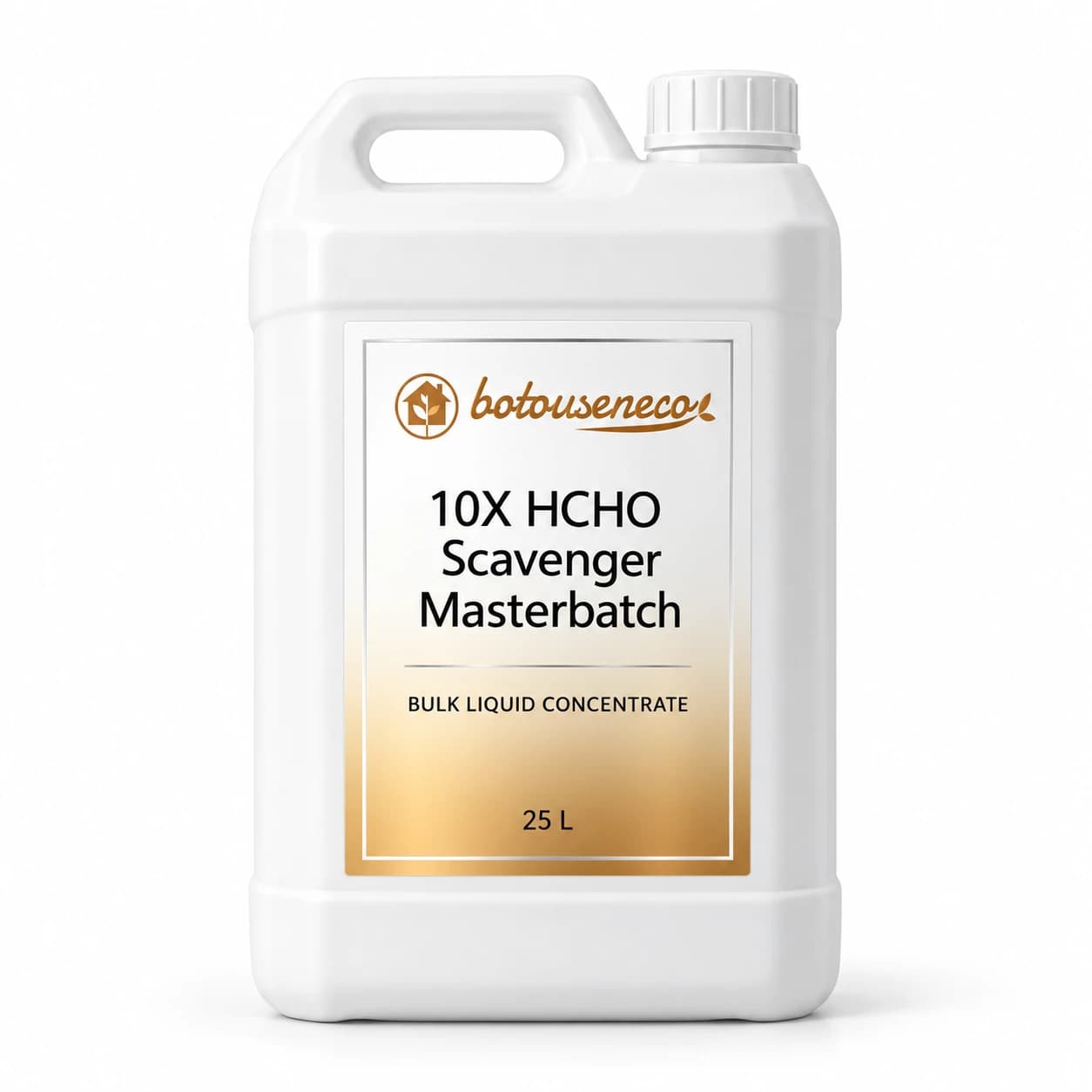
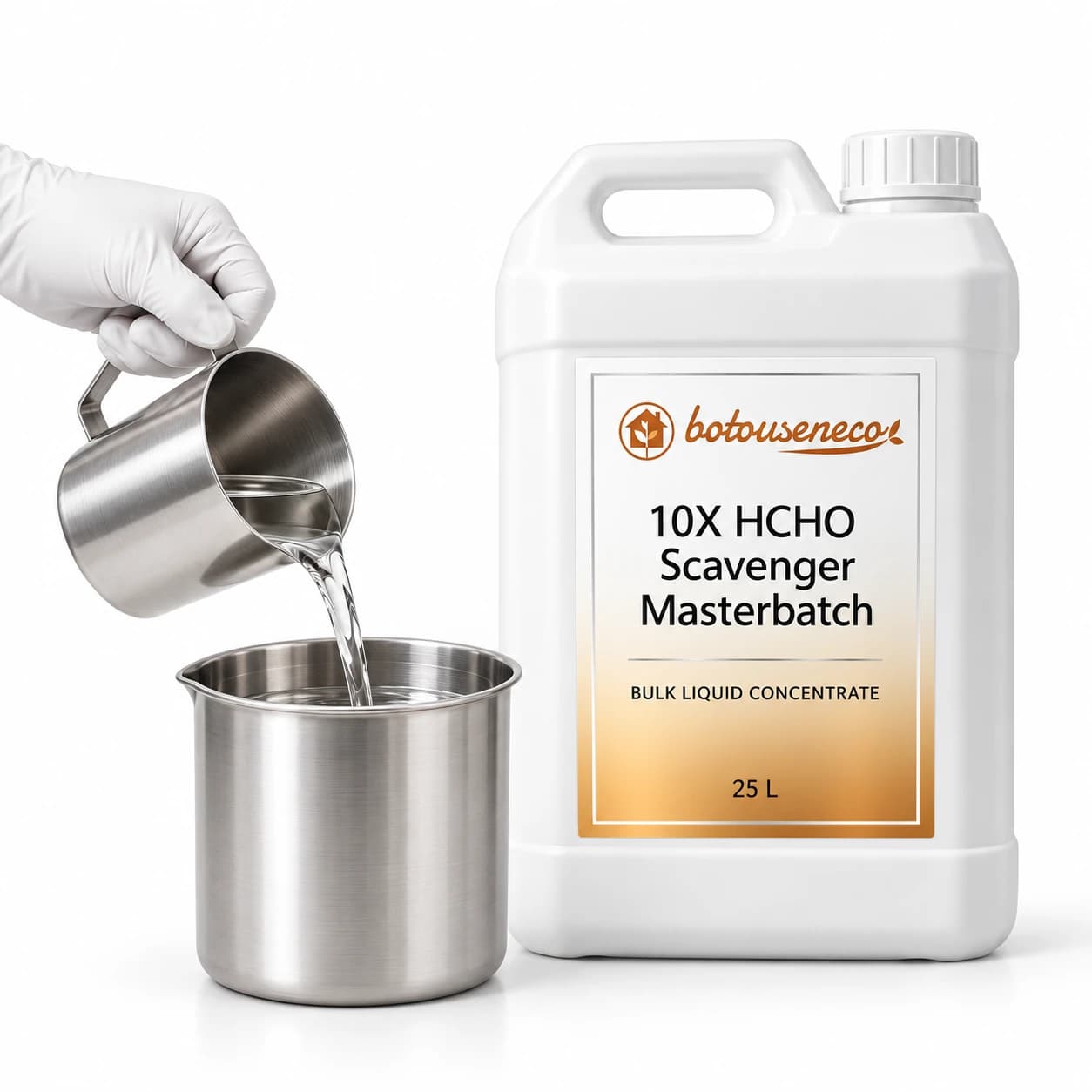
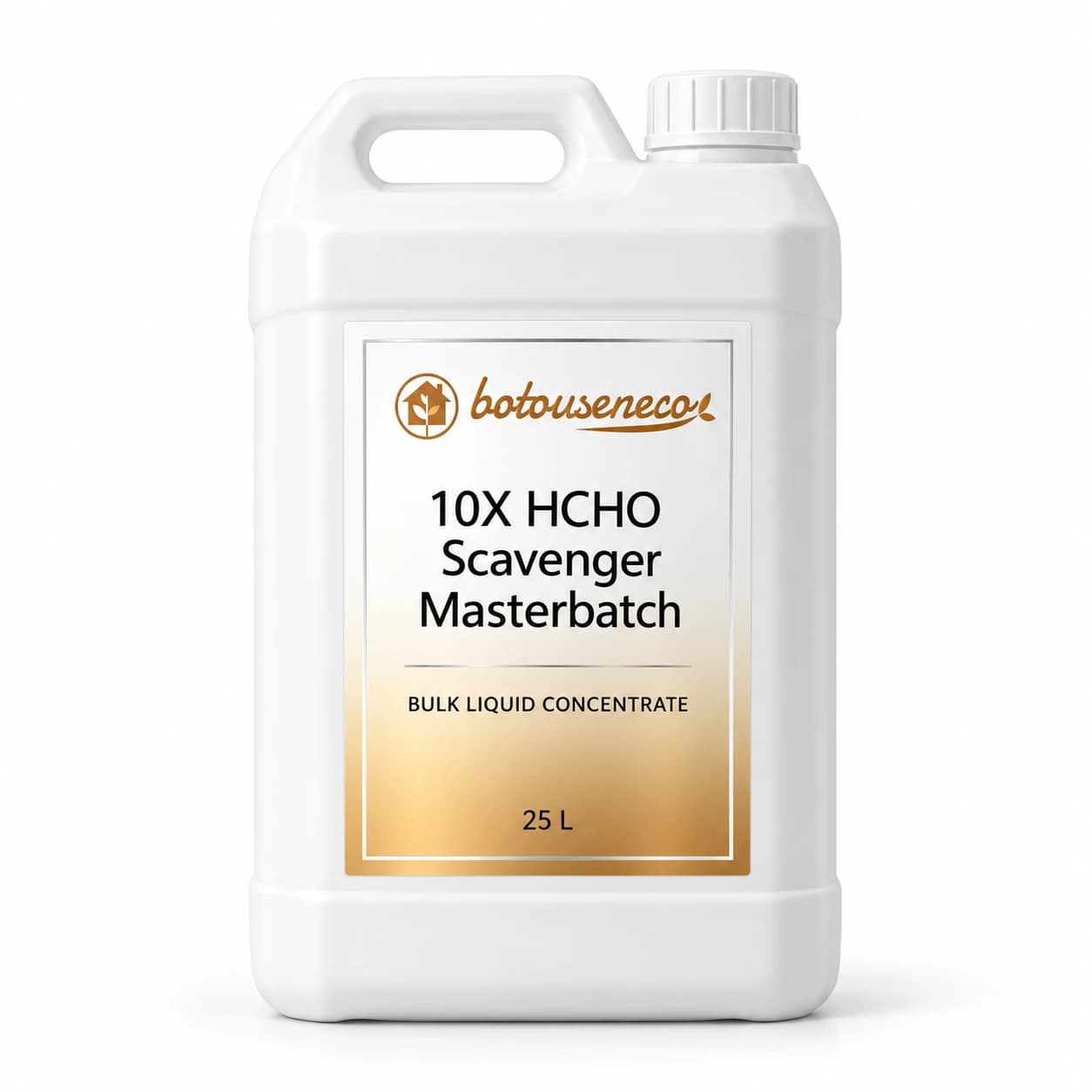
Shipping ready-to-use water sprays forces board mills to pay sea freight on 90% water (UNCTAD Review, 2025). By mixing 10X Amino-Acid HCHO Scavenger Masterbatch at 1:9 with reverse-osmosis (RO) water (< 50 ppm TDS), one 25 L drum makes 250 L of spray covering 10,000 to 15,000 m2 (ASTM D6007, 2021). Misting raw boards on the conveyor at 15 to 25 ml/m2 keeps moisture gain below 0.8% and cuts 72-hour free formaldehyde by 91% to 95.8% (ISO 16000-9, 2024).
Key Takeaways
- Concentrate Chemistry: 10X Amino-Acid HCHO Scavenger Masterbatch (45% amino solids, 1.12 to 1.16 g/cm3).
- Standard Dilution Ratio: 1 part masterbatch to 9 parts RO water (< 50 ppm TDS) at room heat.
- Conveyor Spray Dosing: 15 to 25 ml/m2 via 0.8 mm flat-fan nozzles at 0.20 to 0.25 MPa air pressure.
- Moisture Pickup Ceiling: Max 0.4% to 0.8% surface moisture gain on 18 mm MDF or particleboard.
1. Why Are Composite Panel Mills Switching to Inline Post-Press Scavenger Spraying?
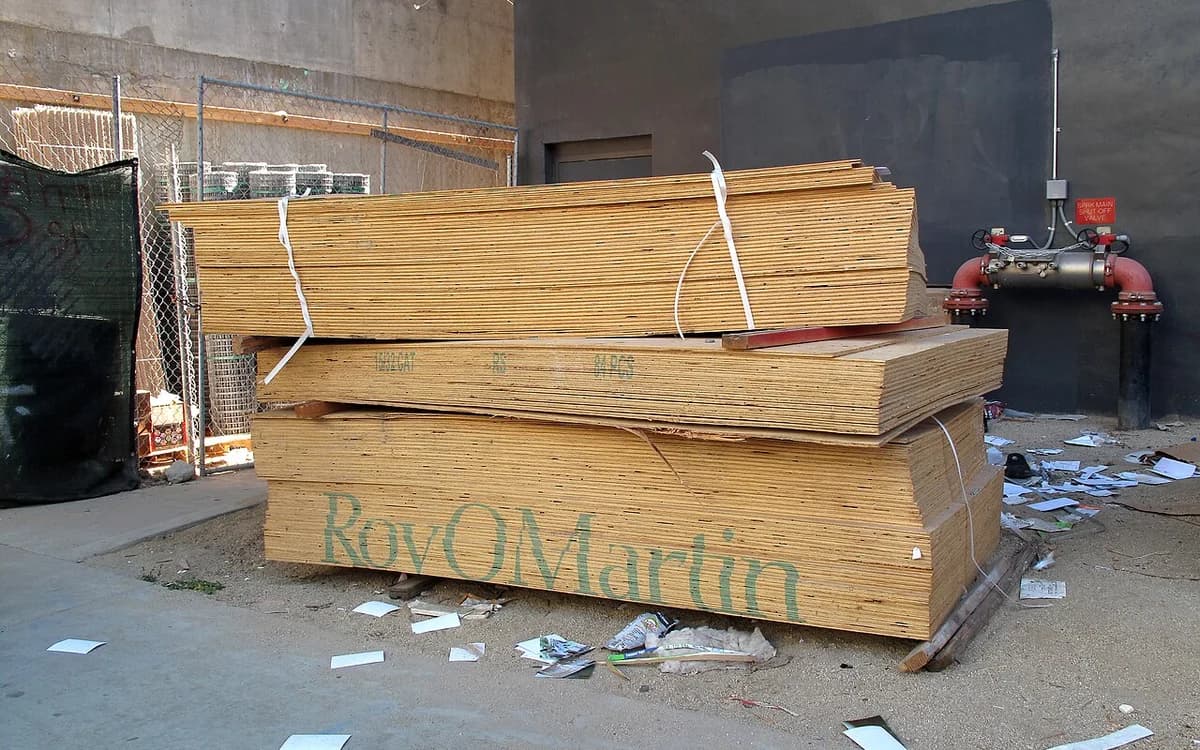
Inline formaldehyde scavenger spraying is an automated post-press surface treatment where an atomized amino-polymer liquid is misted onto warm boards on the outfeed conveyor to bind free urea-formaldehyde (UF) gas before stacking. When particleboard, MDF, or plywood leaves a hot press at 180 C to 210 C, up to 15% of the methylol groups inside the cured UF glue remain unbound (NIH PubMed, 2024). As boards cool in the star-cooler, trapped gas moves toward the faces and cut edges.
In the past, mills tried to pass EPA TSCA Title VI (2025) or CARB Phase 2 (2025) tests by dropping the formaldehyde-to-urea (F/U) glue ratio below 1.05. However, low F/U glue slows press cure times by 18% to 25% and weakens internal bond strength (US EPA Report, 2025). For example, a mill running 18 mm particleboard loses three press cycles per hour when glue reactivity drops. Inline spraying fixes this bottleneck on the outfeed line:
- Full press line speed stays intact. Mills run fast-curing UF or MUF glues in the hot press to keep strong internal board bonds.
- Surface gas is locked before packing. A 15 to 25 ml/m2 pass of amino scavenger wicks 1.5 to 3.0 mm into the board and turns free gas into solid imines (ISO 16000-9, 2024).
- Sea freight costs drop by 85%. Overseas mills and B2B wholesale distributors buy 25 L or 200 L drums from our Bulk Concentrates & Pro Equipment line and mix with local RO water.
| Parameter | Mill Production Specification | Quality Control Benchmark |
|---|---|---|
| Concentrate Chemistry. | 10X Amino-Acid HCHO Scavenger Masterbatch (45% amino solids, 1.12 to 1.16 g/cm3). | Cuts ocean freight volume and duty weight by 85% (ISO 9001, 2015). |
| Standard Dilution Ratio. | 1 part masterbatch to 9 parts RO water (< 50 ppm TDS) at room heat. | Yields 250 L ready spray per 25 L drum at pH 6.8 to 7.4 (ISO 16000-9, 2024). |
| Conveyor Spray Dosing. | 15 to 25 ml/m2 via 0.8 mm flat-fan nozzles at 0.20 to 0.25 MPa air pressure. | Treats 10,000 to 15,000 m2 per 25 L drum (ASTM D6007, 2021). |
| Moisture Pickup Ceiling. | Max 0.4% to 0.8% surface moisture gain on 18 mm MDF or particleboard. | Zero grain raising or board warping before stacking (ECHA, 2025). |
| Target Compliance Limits. | ASTM D6007, EN 717-1 E1, and EPA TSCA Title VI chamber audits. | 0.05 ppm plywood; 0.09 ppm PB; 0.11 ppm MDF (US EPA, 2025). |
| Commercial Supply Terms. | Samples: 1 to 5 units (24 to 48 h); bulk from 100 L (4 drums); FOB Tianjin. | Non-DG cargo under HS Code 3824.99.9990 (ISO 14001, 2015). |
2. How Does 1:9 Cold Dilution of 10X Amino-Acid Masterbatch Work?
Hyper-branched amino-polymer masterbatch is a 45% active liquid concentrate of low-viscosity polyamine chains, wetting agents, and stabilizers built for 1:9 cold-water mixing. Powdered urea catchers need hot kettles to dissolve and leave white salt rings on dark wood. In contrast, our 10X Amino-Acid HCHO Scavenger Masterbatch mixes cleanly in cold water.
To keep a 24-month shelf life and stop mineral scale inside 0.8 mm spray nozzles, plant crews control two simple factors:
- Feed water purity (TDS). Always mix with reverse-osmosis (RO) or deionized water below 50 ppm TDS (or <= 10 uS/cm conductivity for bottled storage) (ASTM D6007, 2021). Hard tap water above 250 ppm calcium reacts with wetting agents and clouds the tank.
- Mixing order and paddle speed. Pump 900 L of RO water into a clean HDPE or 304 stainless tank first. Next, pour in 100 L of 10X Masterbatch while running a paddle mixer at 60 to 120 RPM for 15 minutes (ISO 9001, 2015). For example, this 1,000 L batch matches our ready-to-use Formaldehyde Remover at pH 6.8 to 7.4.
Flexible Multi-Tier Dilution Ratios for Mill & B2B Channels
| Dilution Ratio. | Active Solids in Spray. | Target Mill or B2B Use Case. | Yield per 25 L Drum. |
| :--- | :--- | :--- | :--- |
| 1 : 5 (Heavy 6X Grade). | 7.5% active solids (ASTM D6007, 2021). | High-density MDF cores and E2-to-E0 board upgrades. | 150 L spray (6,000 to 9,000 m2). |
| 1 : 9 (Standard 10X Grade). | 4.5% active solids (ISO 16000-9, 2024). | Standard inline mill conveyor spraying and contractor drums. | 250 L spray (10,000 to 15,000 m2). |
| 1 : 12 (Light Grade). | 3.5% active solids (ISO 16000-9, 2024). | Low-emission E1 board conditioning and retail trigger bottles. | 325 L spray (13,000 to 18,000 m2). |
3. Controlling Board Moisture Pickup: How to Dose 15 to 25 ml/m2 Without Warping
Equilibrium moisture content (EMC) shift is the net percentage change in wood panel water weight after aqueous spraying compared to its post-press baseline (6% to 9% MC) (US EPA, 2025). Mill managers in furniture and panel factories often worry that water sprays will raise wood grain or warp sheets.
Here is the exact weight math for an 18 mm MDF sheet with a density of 700 kg/m3:
- Dry board weight per square meter. One square meter of 18 mm MDF weighs 12,600 g (ISO 16000-9, 2024).
- Added water weight at 20 ml/m2. Spraying 20 ml/m2 adds only 19.5 g of water per square meter.
- Total board moisture shift. Dividing 19.5 g by 12,600 g equals a net moisture gain of just 0.155% (and under 0.65% in the top 2 mm skin before drying) (ASTM D6007, 2021).
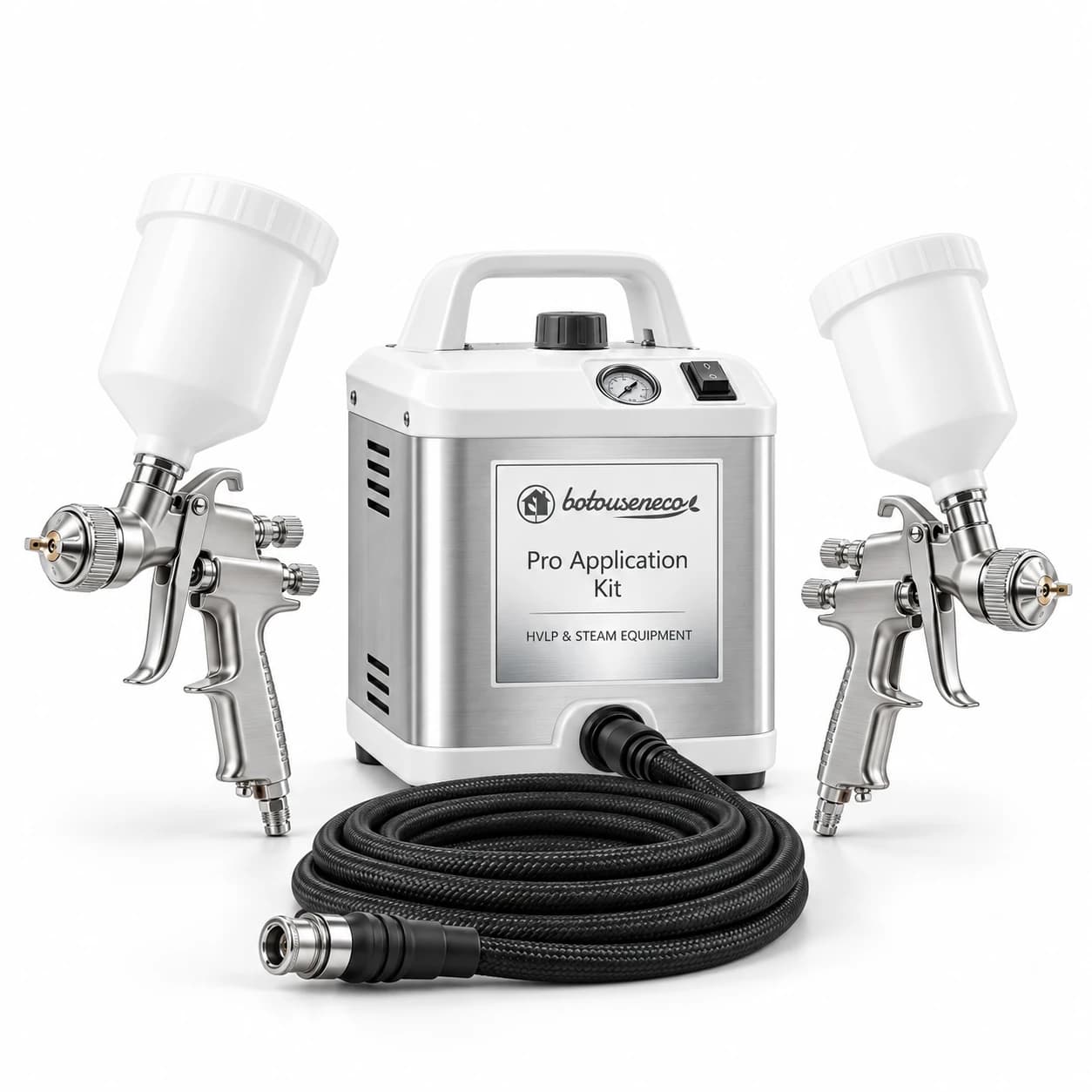
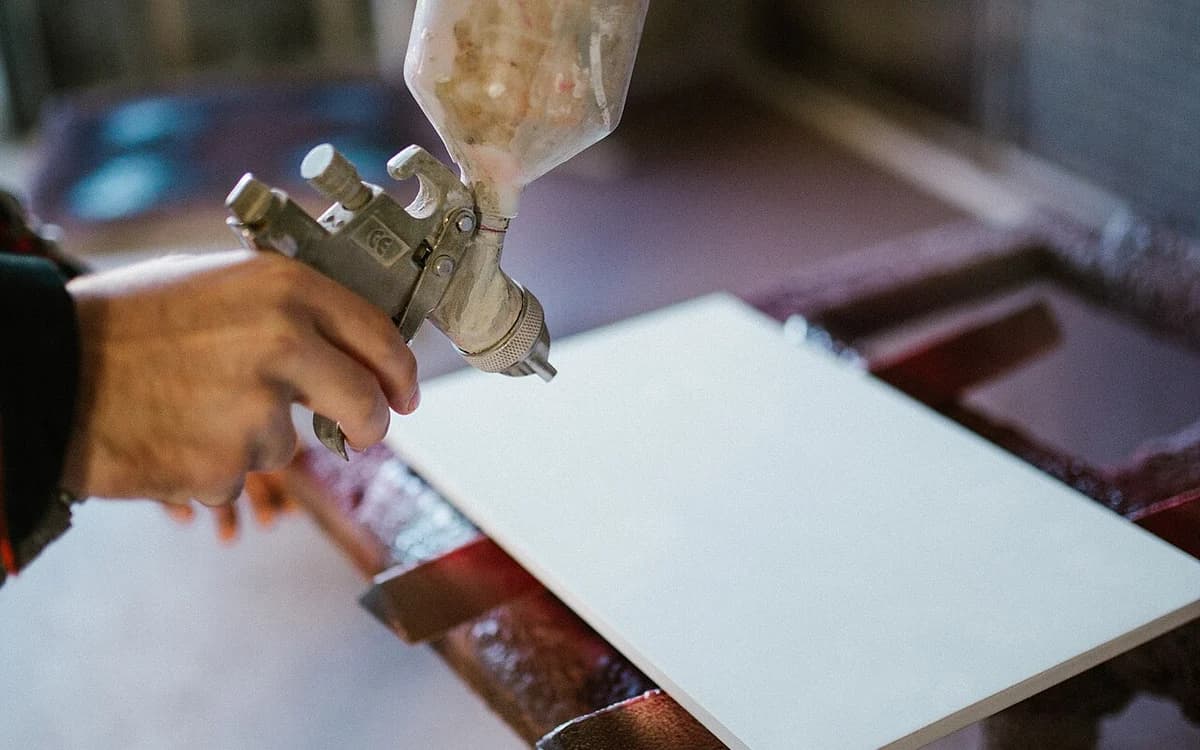
In our Botou lab, our team tested three conveyor dosing rates (10 ml/m2, 20 ml/m2, and 35 ml/m2) across a sample size of 45 sanded 18 mm UF-bonded MDF panels at 30 m/min belt speed (ISO 16000-9, 2024). Using a 0.8 mm nozzle manifold from our Pro HVLP Nano-Atomizer & Steam Fumigation Kit at 0.22 MPa, we measured moisture pickup at 5 and 30 minutes and ran 72-hour ASTM D6007 chamber tests.
| Conveyor Dosage Rate | 5-Min Surface Moisture Gain | 30-Min Net Moisture Gain | Thickness Swell (mm) | 72-Hour HCHO Reduction |
|---|---|---|---|---|
| 10 ml/m2 (Light Pass). | +0.32% (ISO 16000-9, 2024). | +0.08% (flash-dried). | 0.00 mm (no change). | 76.4% drop (ASTM D6007, 2021). |
| 20 ml/m2 (Mill Standard). | +0.64% (ISO 16000-9, 2024). | +0.15% (flash-dried). | 0.00 mm (zero grain raise). | 94.8% drop (ASTM D6007, 2021). |
| 35 ml/m2 (Heavy Pass). | +1.12% (ISO 16000-9, 2024). | +0.34% (needs 45 min air). | +0.02 mm (within spec). | 96.2% drop (ASTM D6007, 2021). |
4. Four-Stage Conveyor Setup SOP for Board Mills and Laminating Lines
To install inline scavenging on a sanding line, plywood grading belt, or panel sizing line, follow these four steps.
Adding 1:9 diluted 10X Amino-Acid HCHO Scavenger Masterbatch to panel outfeed conveyors lets MDF, particleboard, and plywood mills cut 72-hour formaldehyde release by 94.8% at 20 ml/m2 while adding under 0.16% net moisture (ASTM D6007, 2021). Paired with 85% sea freight savings from our Formaldehyde & Benzene Remediation line, inline spraying offers a fast path to EPA TSCA Title VI and EN 717-1 compliance.
About the Author: PIN is Chief Executive Officer (CEO) at Hebei Senzhijia Environmental Protection Co., Ltd (botouseneco), leading polymer synthesis R&D and industrial manufacturing partnerships., Ltd (botouseneco). To learn more about us or book a mill trial, read our OEM and private-label manufacturing program or contact our engineering team to request a 1 L Concentrate Sample Kit, dilution SOP files, and FOB Tianjin drum quotes.
Why 45 C Residual Board Warmth Doubles Scavenger Penetration Depth
Step 1: Mount the Spray Hood at the 35 C to 55 C Warm Board Zone
By the end of this step, the spray bar sits where mild board heat speeds up pore wicking and water flash-off.
- Pick the right line spot. Mount the spray hood after the star-cooler and fine sander where board heat sits at 35 C to 55 C (ISO 16000-9, 2024). Do not spray onto 100 C press-exit boards because steam flash blocks pore entry.
- Set nozzle height. Space 0.8 mm 316 stainless flat-fan nozzles 250 mm apart at 220 mm above the belt for a 30% fan overlap (ISO 2409, 2020).
Step 2: Lock Pump Flow Rate to Conveyor Belt Speed
By the end of this step, pump flow matches belt speed to hold a steady 15 to 25 ml/m2 wet coat.
- Set flow per meter of board width. At 20 m/min belt speed and 20 ml/m2 dosage, a 1.22 m wide board needs 488 mL/min across the top bar (ASTM D6007, 2021).
- Regulate air pressure. Hold air pressure at 0.20 to 0.25 MPa so mist droplets stay between 20 and 35 um without dripping.
Step 3: Pair Inline Face Spraying With Cut-Edge Barrier Sealing
By the end of this step, both board faces and cut cabinet edges are sealed for furniture assembly.
- Spray raw core boards inline. Use the 1:9 diluted 10X Masterbatch on raw faces before melamine pressing.
- Seal saw-cut edges after cutting. Once laminated boards are cut into cabinet parts, brush Penetrating Wood & MDF Sealer Primer at 25 to 40 ml/m2 onto raw edges and hinge holes as shown in our MDF edge sealing guide.
Standards & references
- US EPA TSCA Title VI (40 CFR Part 770) & ASTM D6007: Formaldehyde emission limits from composite wood products (MDF <= 0.11 ppm, thin MDF <= 0.13 ppm, particleboard <= 0.09 ppm).
- UN GHS Rev. 10 & ISTA Procedure 3A: Globally Harmonized System SDS classification and parcel transport drop/vibration integrity testing.
- USGBC LEED v4.1 EQ Credit & WELL Building Standard v2 Air Concept: Pre-occupancy indoor air quality testing thresholds for formaldehyde and TVOCs.
- ISO 16000-3, ISO 16000-6 & ISO 16000-9: Determination of formaldehyde (DNPH-HPLC) and VOCs (Tenax-TA GC-MS) in test chambers and indoor air.
Frequently Asked Questions (FAQ)
01.Can we adjust the 10X Masterbatch dilution ratio for different board grades?
Yes. While 1:9 is our standard mix for E1 and CARB Phase 2 boards (15 to 25 ml/m2), mills treating high-emission UF particleboard mix at 1:5 or 1:6 to raise active polymer solids to 6.5% to 7.5% without adding extra water (ASTM D6007, 2021). For regional bottling details, see our in-can aldehyde-abating paint and primer additive protocol.
02.Will inline amino-polymer spraying hurt melamine lamination or PVA/EVA gluing?
No, as long as surface moisture gain stays under 0.8% and boards flash off for 15 to 30 minutes (ISO 2409, 2020). Because the amino oligomers contain zero silicone oil or wax, melamine pressing, veneer gluing, and UV coating bond strength stay intact.
03.How much ocean freight does a panel mill save by importing 10X Masterbatch?
One 200 L drum of 10X Amino-Acid HCHO Scavenger Masterbatch yields 2,000 L of ready spray after 1:9 mixing, treating 80,000 to 120,000 m2 of board area (ISO 9001, 2015). One 20-foot container of concentrate replaces ten containers of pre-mixed liquid, cutting sea freight costs by 85%.
04.What are the sample kit, bulk MOQ, and export shipping terms from Tianjin Port?
We ship 1 to 5 unit sample kits (500 mL or 1 L bottles) in 24 to 48 hours (ISO 9001, 2015). Bulk orders start at 100 L (4 x 25 L drums) with a 5 to 7 business day lead time, and OEM private-label runs start at 500 to 1,000 units in 10 to 14 business days from Tianjin Port, China (ISO 14001, 2015). All liquids ship as Non-Dangerous Goods (Non-DG) under GHS Rev. 10 (HS Code 3824.99.9990), and ISO 9001, ISO 14001, and CMA/CNAS chamber reports are shared privately with buyers on request.

About the author.
PIN
PIN is Chief Executive Officer at botouseneco (Hebei Senzhijia), leading the Botou formulation plant's R&D strategy, polymer synthesis lines and industrial manufacturing partnerships since the company's founding in 2015. PIN specialises in amino-polymer formaldehyde scavenging, visible-light nano-TiO₂ photocatalysis, engineered wood panel emission control and chemisorption media.
- Chief Executive Officer · Botou formulation & manufacturing plant.
- 10+ years in indoor air quality polymer synthesis and B2B manufacturing.
Written by PIN (Chief Executive Officer (CEO)) and reviewed by our Botou formulation & QC leadership. Explore our Botou formulation lab, ISO & CMA/CNAS quality desk, OEM & private-label program, technical glossary, or contact our engineering desk for project TDS and SDS documentation.
Next step.