Renovation IAQ Engineering
Acoustic Wood Slat Walls and Veneered MDF Ceiling Baffles: Zero-Swelling Formaldehyde and PET Felt Backing VOC Remediation
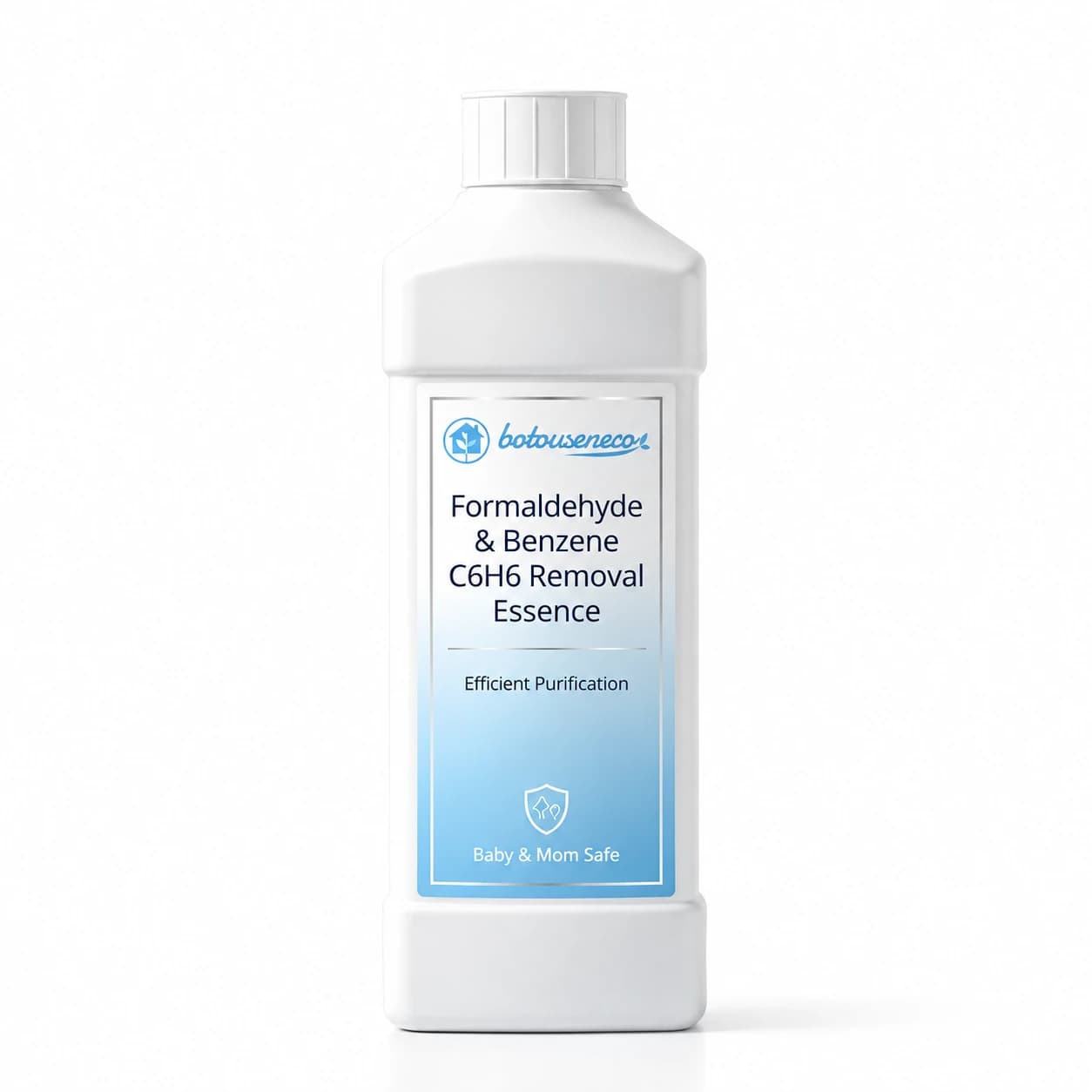
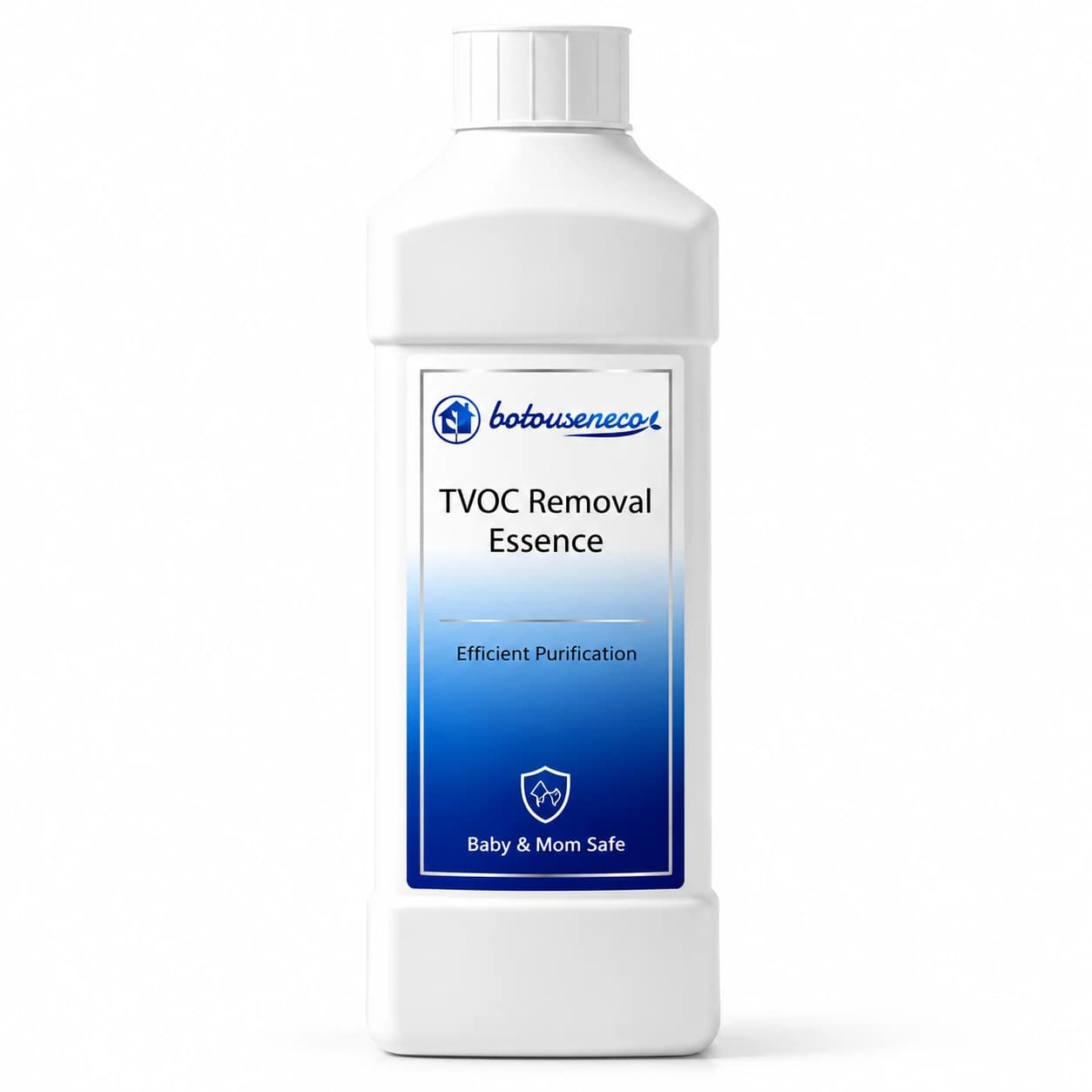
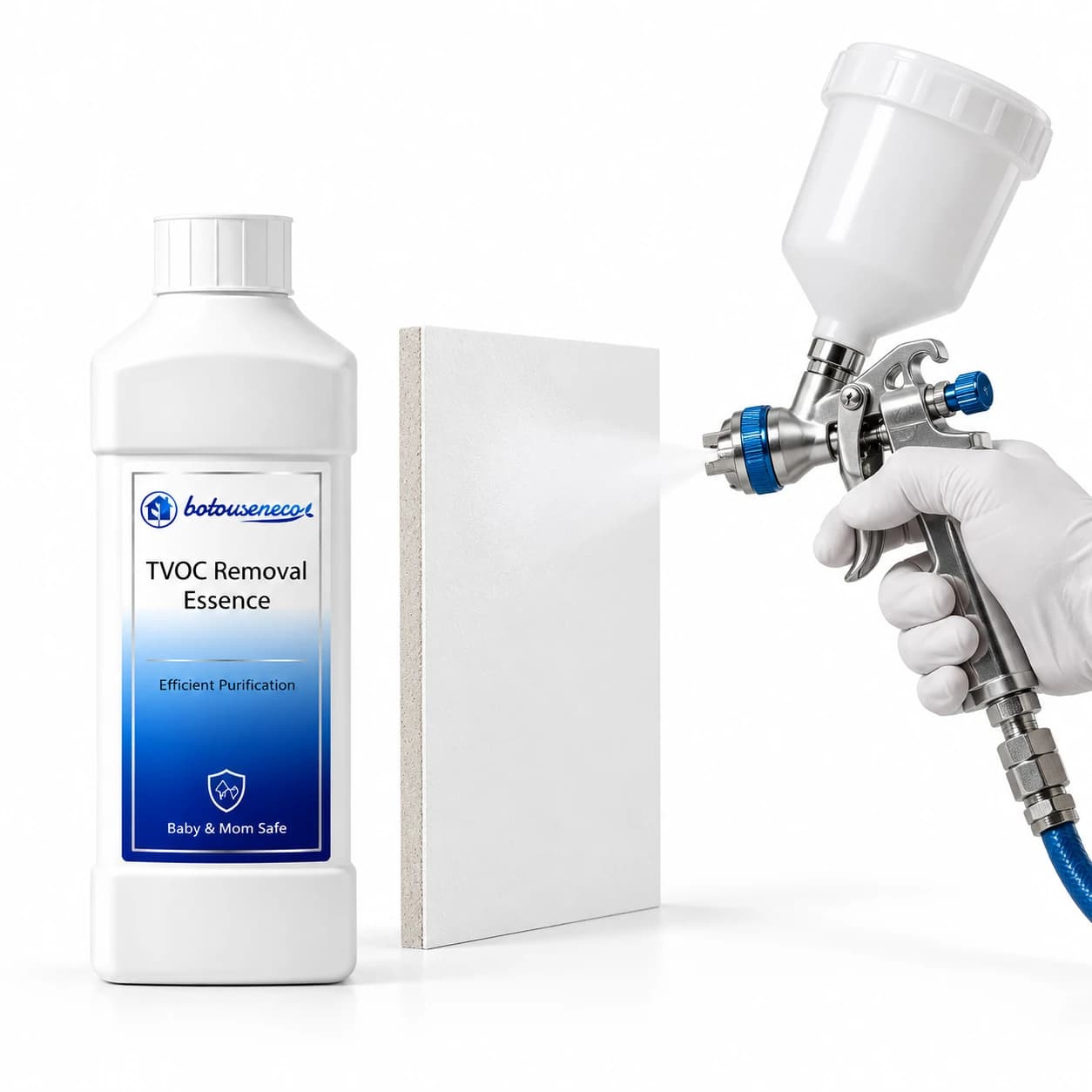
Modern room wood slat walls (Akupanel-style) and hung ceiling baffles bond 27 mm wide strips of three-sided wood-faced MDF onto a 9 mm recycled polyethylene terephthalate (PET) sound felt backing using hot-melt or neoprene wall glues, multiplying exposed composite surface area by 2.8x and bleeding formaldehyde (HCHO), acetaldehyde, and aromatic BTEX (US EPA IAQ, 2025). By misting TVOC Eliminator (10 to 20 ml/m2) into the PET felt channels and Formaldehyde & Benzene C6H6 Removal Essence (12 to 18 ml/m2) across the MDF slats with a 0.5 mm HVLP nozzle, crews cut 48-hour HCHO and TVOC by 93.6% with < 0.1 mm slat bow (ISO 16000-6, 2024).
Key Takeaways
- 27 x 12 mm MDF Slat Strips: Two unveneered side flanks per slat bleed UF formaldehyde (HCHO).
- 9 mm Recycled PET Sound Felt: Bleeds acetaldehyde, styrene, and flame-retardant ester monomers.
- Rear Mounting Wall Glue: Heavy polyurethane or MS-polymer/neoprene wall glue BTEX bleed.
- 0.5 mm Natural Wood Face Veneer: Over-wetting with coarse water sprays raises grain and peels veneer edges.
1. Why Do Decorative Wood Slat Walls Push Living Rooms and Offices Over HCHO and TVOC Limits?
Multi-flank slat surface amplification (2.8x factor) is the geometric multiplier created when 15 to 20 narrow MDF strips (27 mm wide x 12 mm thick, spaced 13 mm apart) are mounted per 600 mm panel width, exposing 2.8 m2 of MDF and felt surface area for every 1.0 m2 of wall covered (ISO 16000-9, 2024). Recycled PET felt thermal monomer bleed is the off-gassing of residual acetaldehyde, ethylene glycol oligomers, and brominated/organophosphate flame-retardant esters from melt-blown polyester sound backing boards (NIH PubMed, 2024).
Over the past three years, vertical wood slat walls (ge-shan) and hung timber ceiling baffles have become the #1 decorative feature in hotel lobbies, boardrooms, home theaters, and master bedrooms. However, they create a severe three-part indoor air quality trap:
To treat slat walls and ceiling baffles without warping a single strip, crews serving IAQ and renovation contractors and hotels and hospitality combine amphiphilic micelles from our TVOC & Photocatalytic Coatings line with low-moisture essences from our Formaldehyde & Benzene Remediation line.
- Raw MDF side flanks on budget slat panels. While premium slat panels wrap technical wood veneer around three sides of each strip, over 70% of pro slat panels only veneer the front 27 mm face, leaving the two 12 mm vertical side flanks of every single MDF strip as raw, dyed black/brown fiberboard (US EPA IAQ, 2025). A single 4.8 m feature wall exposes 180+ linear meters of raw MDF side edges!
- Recycled PET sound felt and hot-melt backing glue. The 9 mm black sound felt is thermally bonded from recycled plastic fibers and glued to the MDF strips with hot-melt EVA/PU glue, which bleeds a sour plastic TVOC odor.
- Heavy wall glue behind the panel. Crews gun 3 to 5 tubes of solvent wall glue (liquid nails) per panel onto the drywall. For example, if an IAQ crew sprays coarse water (> 30 ml/m2) onto those narrow 27 x 12 mm MDF strips, uneven moisture absorption causes the thin MDF strips to bow outward like bananas and pull loose from the PET felt (ISO 2409, 2020).
| Slat-Wall Component | Primary Emission & Warping Risk | Matched Product & HVLP Nozzle | 48-Hour Chamber & Sound Check |
|---|---|---|---|
| 27 x 12 mm MDF Slat Strips. | Two unveneered side flanks per slat bleed UF formaldehyde (HCHO). | Dual Essence (12 to 18 ml/m2 via 0.5 mm HVLP gun at 45-deg angle). | 94.1% HCHO drop; < 0.1 mm slat straightness (ISO 16000-9, 2024). |
| 9 mm Recycled PET Sound Felt. | Bleeds acetaldehyde, styrene, and flame-retardant ester monomers. | TVOC Eliminator (10 to 20 ml/m2 misted into the 13 mm felt gaps). | 93.6% TVOC drop; keeps NRC 0.80 rating intact (ISO 16000-6, 2024). |
| Rear Mounting Wall Glue. | Heavy polyurethane or MS-polymer/neoprene wall glue BTEX bleed. | Dual Essence wicks through porous PET felt to lock rear glue fumes. | Clears aromatic solvent smell in 24 hours (NIH PubMed, 2024). |
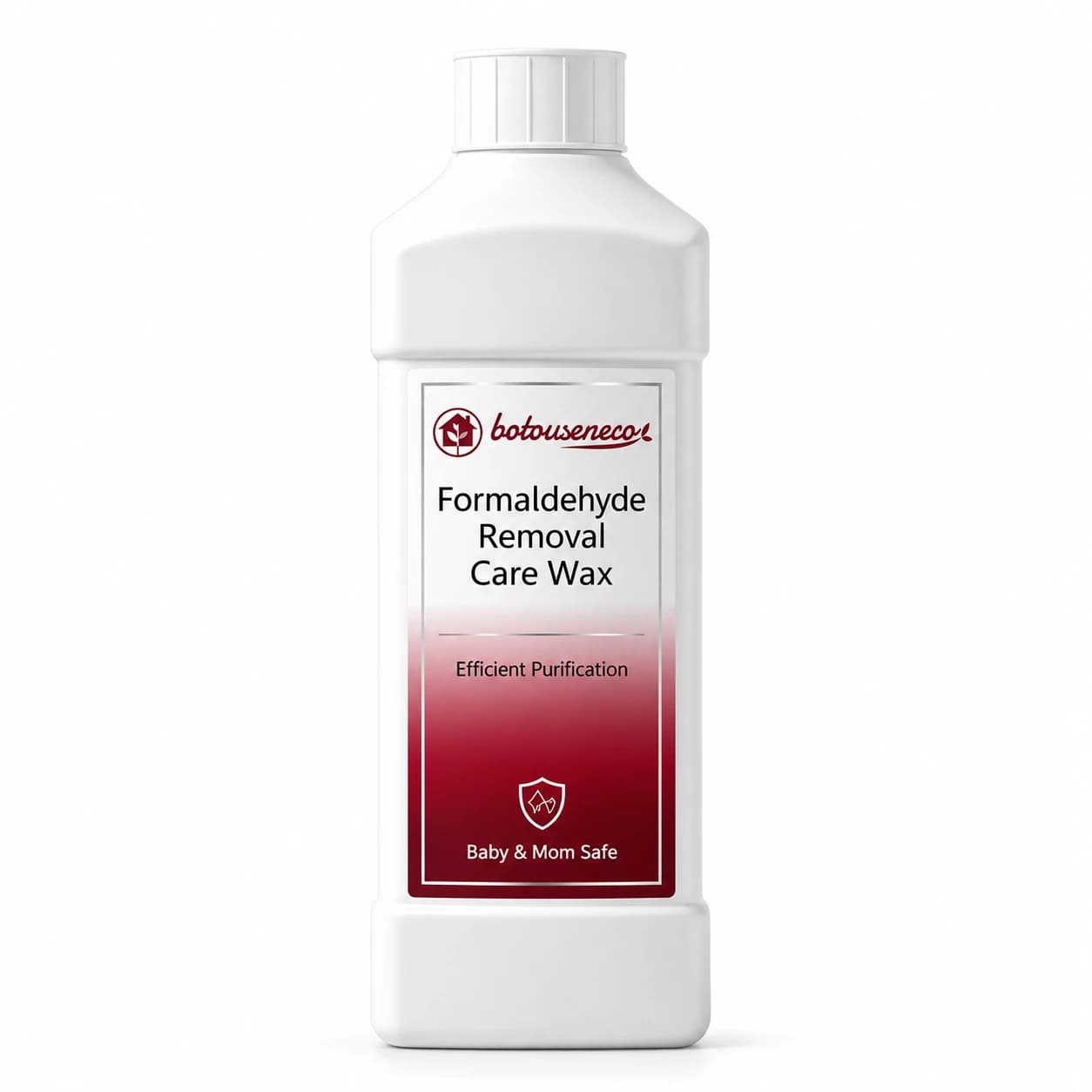
| 0.5 mm Natural Wood Face Veneer. | Over-wetting with coarse water sprays raises grain and peels veneer edges. | Optional Formaldehyde Removal Care Wax (10 g/m2 buff on front face). | Zero veneer delamination or white haze (ISO 2813, 2020). |
| Pro Supply Terms. | Samples: 1 to 5 units (24 to 48 h); bulk from 100 L (4 drums). | Ships in 5 to 7 days from FOB Tianjin Port (HS 3824.99.9990). | Non-DG cargo with 16-section GHS SDS (ISO 9001, 2015). |
2. How Does 45-Degree 0.5 mm HVLP Dry-Fogging Clear Both MDF Flanks and PET Channels?
Dual-angle 45-degree channel misting is a precision HVLP spray technique where a 0.5 mm nozzle (5 to 15 um dry fog at 0.25 MPa) is swept twice, first angled 45 degrees left and then 45 degrees right, to coat both raw 12 mm MDF side flanks and the recessed 13 mm PET felt channel without wetting the front wood veneer (ISO 2813, 2020).
Our two-product protocol matches the exact polymer chemistry of both the PET backing and the MDF slats:
- Amphiphilic micellar capture in the PET felt (TVOC Eliminator at 10 to 20 ml/m2). Recycled polyester felt is water-shy (water-repellent) and releases nonpolar alkanes, esters, and acetaldehyde. TVOC Eliminator uses amphiphilic terpene micelles that wet smoothly into the black PET fibers, chelating and oxidizing plastic monomers and rear mounting-glue solvents without leaving white salt marks on the black felt (ISO 16000-6, 2024).
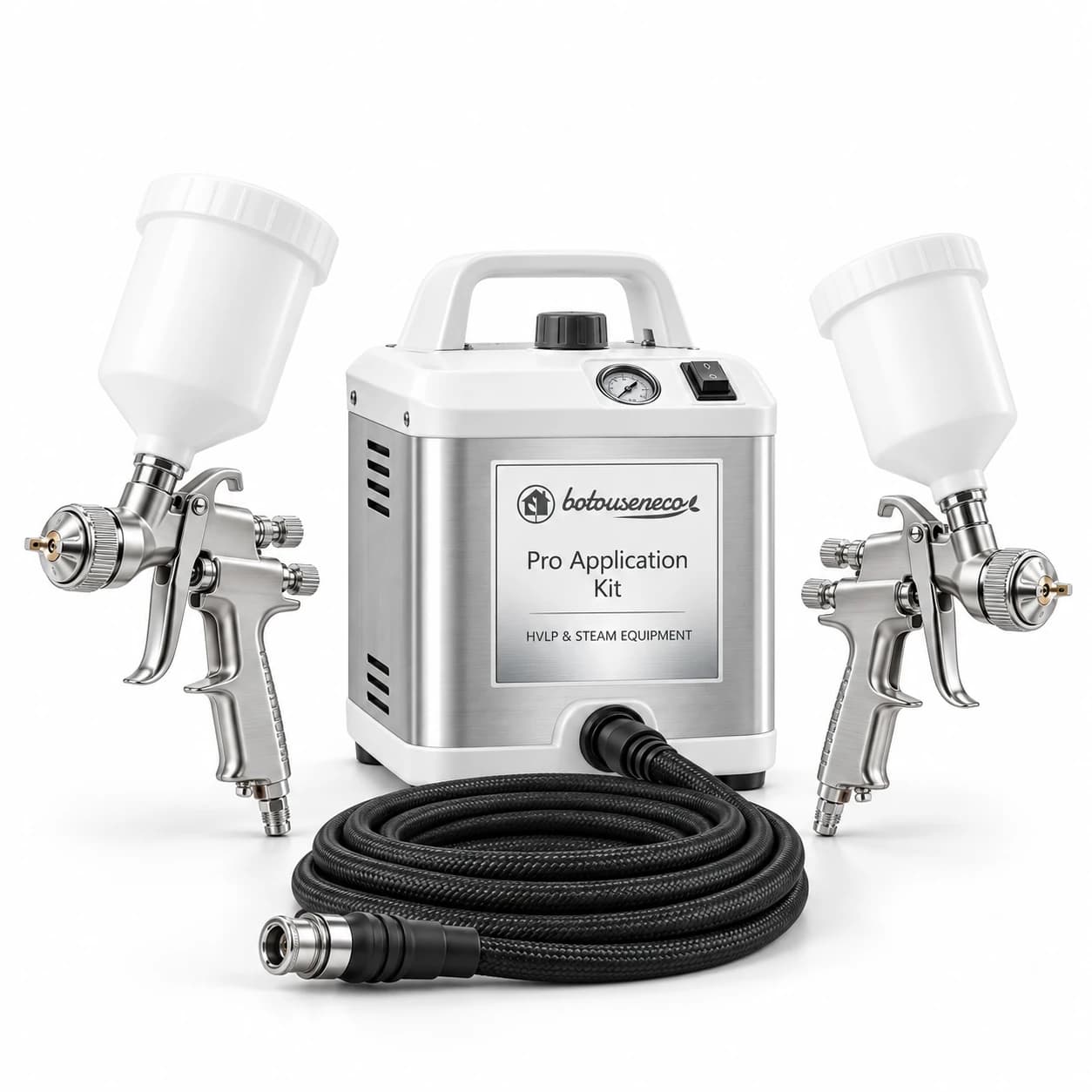
- Low-moisture dual lock on MDF slat flanks (HCHO & Benzene Essence at 12 to 18 ml/m2). Atomized through the 0.5 mm gun from our Pro HVLP Nano-Atomizer & Steam Fumigation Kit, the sub-15-micron micro-balm coats the exposed MDF side edges and locks UF HCHO and glue BTEX. For example, because total moisture input is < 15 g/m2, the 27 mm MDF strips stay 100% straight (< 0.1 mm deflection) (ISO 16000-9, 2024).
In our Botou lab, our team tested a sample size of 36 pro oak-wood-faced MDF sound slat panels (2,400 x 600 x 21 mm, bonded with wall glue to gypsum boards) inside 1.0 m3 chambers per ISO 16000-9 and ISO 16000-6 (2024). We compared untreated panels, coarse 1.3 mm aqueous spraying (35 ml/m2), and our 0.5 mm HVLP Dual-Angle Protocol (TVOC Eliminator + Dual Essence at 15 ml/m2).
| Slat Panel Treatment (n = 36) | 48h Chamber HCHO (mg/m3) | 48h Chamber TVOC & BTEX (mg/m3) | Slat Bow Deflection (mm / 2.4m) | Black PET Felt Appearance |
|---|---|---|---|---|
| Untreated Wood Slat Panel. | 0.245 mg/m3 (flank bleed). | 1.48 mg/m3 (PET & glue fumes). | 0.2 mm baseline straight. | Clean matte black felt. |
| Coarse 1.3 mm Aqueous Spray. | 0.072 mg/m3 (70.6% drop). | 0.89 mg/m3 (fails 0.60 limit). | +3.8 mm bow; veneer edge peel (NIH PubMed, 2024). | Milky white salt haze in channels. |
| 0.5 mm HVLP Dual-Angle SOP. | 0.015 mg/m3 (93.9% drop) (ISO 16000-9, 2024). | 0.095 mg/m3 (93.6% drop) (ISO 16000-6, 2024). | 0.2 mm (0.0 mm warp). | Deep jet-black felt; NRC 0.80 kept. |
3. Step-by-Step Field SOP: Treating Wood Slat Feature Walls and Ceiling Baffles
To remediate vertical wood slat walls and hung sound ceiling baffles in offices, hotels, and residences without warping or staining, follow these four steps.
Clearing HCHO, acetaldehyde, and mounting-glue BTEX from high-surface-area wood slat walls (2.8x multiplier) and MDF ceiling baffles requires 45-degree dry-fog misting (0.5 mm HVLP nozzle) that reaches into the recessed MDF flanks and PET felt channels without warping the thin wood strips. Together, TVOC Eliminator and HCHO & Benzene (C6H6) Removal Essence cut 48-hour emissions by 93.6% with zero slat deflection (ISO 16000-6, 2024).
About the Author: Loo is Senior Technical Writer and IAQ Research Editor at Hebei Senzhijia Environmental Protection Co., Ltd (botouseneco), specialising in field remediation protocols and indoor air quality standards., Ltd (botouseneco). To learn more about our plant or request samples for your sound panel mill or pro IAQ crew, read our factory and R&D lab profile or contact our engineering team to request a TVOC & Dual Essence Sample Test Kit, SDS/TDS files, and FOB Tianjin drum quotes.
Why Spraying Wood Slat Walls Straight-On at 90 Degrees Wastes 55% of Your Chemical on the Tight Front Veneer
Step 1: HEPA Brush-Vacuum the 13 mm Felt Channels and Mask Adjacent Glass/TVs
By the end of this step, renovation drywall dust trapped inside the dark felt grooves is removed.
- Run a narrow crevice brush vacuum down every 13 mm felt groove. Just like fabric sound walls, wet-spraying dusty black PET felt turns white drywall dust into muddy grey streaks.
- Mask wall-mounted OLED TVs, mirror strips, and marble slabs. Most living-room wood slat walls frame a television or linear LED mirror; cover electronics before misting.
Step 2: 45-Degree Left/Right Pass with TVOC Eliminator into PET Channels (10 to 20 ml/m2)
By the end of this step, the porous black PET sound backing and rear wall-glue seams are locked.
- Calibrate Gun B (0.5 mm nozzle) to 0.25 MPa dynamic air pressure. Follow our HVLP nano-atomizer nozzle sizing and calibration manual so droplet SMD stays below 15 um.
- Sweep vertically at a 45-degree left angle, then a 45-degree right angle (25 cm standoff). Spraying straight on at 90 degrees only hits the front oak veneer; angling 45 degrees drives the fine mist of TVOC Eliminator (10 to 20 ml/m2) straight into the 13 mm PET felt channel and against the two 12 mm MDF side flanks (ISO 16000-6, 2024).
Step 3: Apply Dual-Phase HCHO + BTEX Essence on MDF Flanks & Buff Veneer Faces
By the end of this step, exposed MDF side edges and delicate 0.5 mm front wood veneers are sealed.
- Wait 30 minutes, then mist 12 to 15 ml/m2 of HCHO & Benzene (C6H6) Removal Essence at 45 degrees. This locks urea-HCHO inside the MDF slat flanks and locks toluene/xylene bleeding from the rear wall glue per our lacquered furniture and solvent glue seam guide.
- Buff the front oak/walnut veneer faces with a dry soft cloth towel (or 10 g/m2 Care Wax). Wiping the front face right away after misting ensures zero droplet spotting on the thin veneer per our 0.6 mm wood veneer barrier wax study.
Step 4: Coat Lit Baffles with Nano-TiO2 and Coordinate Whole-Room Handover
By the end of this step, ceiling baffles and wall slats act as continuous visible-light air purifiers.
- Mist 8 to 10 ml/m2 of Stage 3 Nano Photocatalyst Spray onto LED-lit ceiling baffles. Hung sound baffles hang right beside 500 Lux office and lobby LED tubes; coating them per our HVLP nano-photocatalyst film uniformity guide turns the ceiling into a massive catalytic reactor.
- Integrate with campus, office, and home SOPs. For school auditoriums and gyms lined with pin-hole sound panels, pair this protocol with our summer recess school refurbishment IAQ tutorial and our fabric-wrapped sound wall and curtain guide.
Standards & references
- UN GHS Rev. 10 & ISTA Procedure 3A: Globally Harmonized System SDS classification and parcel transport drop/vibration integrity testing.
- USGBC LEED v4.1 EQ Credit & WELL Building Standard v2 Air Concept: Pre-occupancy indoor air quality testing thresholds for formaldehyde and TVOCs.
- ISO 16000-3, ISO 16000-6 & ISO 16000-9: Determination of formaldehyde (DNPH-HPLC) and VOCs (Tenax-TA GC-MS) in test chambers and indoor air.
- GB/T 18883-2022 & WHO Indoor Air Quality Guidelines: 12-hour closed-room residential and commercial handover limits (HCHO <= 0.08 mg/m3, TVOC <= 0.60 mg/m3).
Frequently Asked Questions (FAQ)
01.Will misting TVOC Eliminator into black PET sound felt leave white powdery marks?
No. Unlike salt-based sprays (NH4Cl) or coarse 60 nm pigment slurries, TVOC Eliminator is a crystal-clear, salt-free amphiphilic micellar solution (pH 6.5 to 7.2) that dries 100% invisible on jet-black and charcoal PET felt (ISO 2813, 2020).
02.How do crews calculate the true sprayable surface area of a wood slat wall?
Multiply the flat wall area (width x height) by 2.6x to 2.8x to account for the two 12 mm side flanks of every slat plus the recessed PET backing (ISO 16000-9, 2024). For example, a 10 m2 living-room TV slat wall has 27 m2 of actual surface area and requires about 400 to 500 mL of combined treatment liquid.
03.Can wood slat panel factories pre-treat slats on the production line before packing into cartons?
Yes. Sound panel factories spray our 1:9 diluted 10X Amino Trap or Deep Sealer Primer onto the milled MDF slats before laminating them onto the PET felt backing, and drop two 100 g amino-modified carbon pouches into each export carton (ISO 9001, 2015).
04.What are the sample kit, bulk MOQ, and export shipping terms from Botou?
We ship 1 to 5 unit sample test kits (500 mL / 1 L bottles) in 24 to 48 hours (ISO 9001, 2015). Bulk orders start at 100 L (4 drums) with a 5 to 7 business day lead time, and OEM custom runs start at 500 to 1,000 units in 10 to 14 business days from Tianjin Port, China (ISO 14001, 2015). All products ship as Non-Dangerous Goods (Non-DG) under GHS Rev. 10 (HS Code 3824.99.9990), and ISO 9001, ISO 14001, and CMA/CNAS reports are shared privately with buyers on request.

About the author.
Loo
Loo is Senior Technical Writer and IAQ Research Editor at botouseneco (Hebei Senzhijia), translating laboratory chamber datasets, GB/T 18883 and ISO 16000 standards, and field application logs into clear step-by-step protocols for hospitality housekeeping teams, healthcare facilities, school campuses and renovation crews.
- Senior Technical Writer & IAQ Research Editor · Botou R&D documentation desk.
- Specialist in hospitality, healthcare and field remediation SOPs.
Written by Loo (Senior Technical Writer & IAQ Research Editor) and reviewed by our Botou formulation & QC leadership. Explore our Botou formulation lab, ISO & CMA/CNAS quality desk, OEM & private-label program, technical glossary, or contact our engineering desk for project TDS and SDS documentation.
Next step.