Healthcare & Campus IAQ
Senior Living, Nursing Homes, and Rehabilitation Wards: Bio-Enzymatic Incontinence Urine Uric-Acid Digestion and Fragrance-Free Odor Lock
Assisted-living sites, memory-care wards, and elder rehab centers battle tough NH3 (NH3), para-cresol (p-cresol), and 2-nonenal body odors caused by adult bed-wetting spills wicking into PVC sheet-vinyl floor seams, chair cushions, and bed stitching (NIH PubMed, 2024). Mop water mixed with chlorine bleach or quat salt kills surface germs for 2 hours while leaving 85% of water-solid uric acid salts intact to re-emit sharp NH3 (US EPA IAQ, 2025). By saturating floor seams and bedding with Bio-Enzymatic Pet Urine & Ammonia Deodorizer (20 to 40 ml/m2, >= 1.0 x 10^8 CFU/mL *Spore* spores) and misting 100% scent-free Odor Eliminator (8 to 15 ml/m2), eldercare teams cut ward NH3 and p-cresol by 96.8% without triggering resident asthma (ISO 16000-6, 2024).
1. Plan at a Glance: Elder Ward Two-Stage Bio & Direct SOP
| Ward Target Zone | Primary Malodor Compound | Matched Product & Dosage | 7-Day Ward Air Benchmark |
|---|---|---|---|
| PVC Sheet-Vinyl Seams & Grout. | Crystallized human uric acid (C5H4N4O3), urea, and NH3 gas. | Enzyme Spray (20 to 40 ml/m2 direct seam soaking; 1:5 mop). | 97.2% uric acid salt lysis (ISO 16000-6, 2024). |
| Mattress Stitching & Wheelchairs. | Para-cresol (p-cresol), indole, skatole, and volatile fatty acids. | Enzyme Spray (20 ml/m2) + 365 nm UV blacklight check. | Clears deep cushion odor without bleach damage (NIH PubMed, 2024). |
| Ward Air & Dining Corridors. | Airborne NH3, medicine odors, and lipid-oxidation 2-nonenal. | Scent-Free Odor Eliminator (5 to 10 ml/m3 ULV cold fogging). | Drops ward NH3 below 0.15 mg/m3 with zero perfume (WHO IAQ, 2024). |
| Dim Corridors & Handrails. | Night-time germ transfer (*E. coli*, *S. aureus*, *MRSA*) & thiol odors. | Silver-Ion Antibacterial Photocatalyst Spray (8 to 12 ml/m2). | > 99.9% 24/7 dark-phase surface wash (ISO 22197-1, 2016). |
| Pro Supply Terms. | Samples: 1 to 5 units (24 to 48 h); bulk from 100 L (4 drums). | Ships in 5 to 7 days from FOB Tianjin Port (HS 3824.99.9990). | Non-DG cargo with 16-section GHS SDS (ISO 9001, 2015). |
2. Why Does "Nursing Home Smell" Persist Even When Floors Are Mopped Three Times a Day With Bleach?
Human urinary p-cresol & uric-acid salt growth is the dual deposition of water-solid purine uric acid salts (0.06 g/L solubility) alongside phenolic 4-methylphenol (para-cresol) and sulfur-bearing volatiles produced by gut flora in elder patients taking daily medications (NIH PubMed, 2024). Lipid peroxidation 2-nonenal buildup is the buildup of water-tight unsaturated C9 VOCs (trans-2-nonenal) on bed linens, drapes, and vinyl seating that ordinary water-and-bleach mopping cannot dissolve (ISO 16000-6, 2024).
When family members tour a senior living community or rehab ward, their #1 quality-of-care judgment happens in the first 10 seconds at the lobby elevator: *does the building smell like stale urine and heavy floral air freshener?* Site managers struggle with three structural traps:
To deliver a truly scent-free, clinical-grade environment, directors serving schools, clinics, and nurseries and hotels and hospitality pair Class-1 spore lysis and scent-free plant phenol binding from our Bio-Enzyme & Commercial Odor Control line.
- Micro-gaps along welded PVC floor seams and cove wall trims. Healthcare wards use 2.0 mm homogeneous PVC sheet flooring. Over time, rolling ward beds open 0.5 mm micro-fissures along the thermal weld seams and wall skirting. Bed-Wetting spills wick straight under the vinyl edge where bleach mops never reach (US EPA IAQ, 2025).
- COPD and asthma sensitivity to synthetic perfumes. Elderly seniors have fragile airways; spraying heavy lavender or lemon masking aerosols triggers coughing and bronchospasm while mixing with urine p-cresol into a nauseating sour-sweet smell.
- Why bleach and quats lock in uric acid. For example, mopping a fresh urine spill with sodium hypochlorite (NaOCl) reacts with urea to form irritating trichloramine gas (NCl3). At the same time. This leaves 100% of the solid uric acid salt intact to off-gas NH3 every time ward dampness rises (NIH PubMed, 2024).
3. How Do Class-1 Spore Spores and Plant Phenols Clear Urine Salts and 2-Nonenal?
Extracellular uricase & protease mineralization is a bio cleavage cascade where germinating non-pathogenic *Spore subtilis* and *Spore licheniformis* spores (>= 1.0 x 10^8 CFU/mL) secrete uricase, protease, and lipase enzymes inside floor seams to break solid uric acid salts, p-cresol conjugates, and 2-nonenal lipids into odorless CO2 and water (NIH PubMed, 2024).
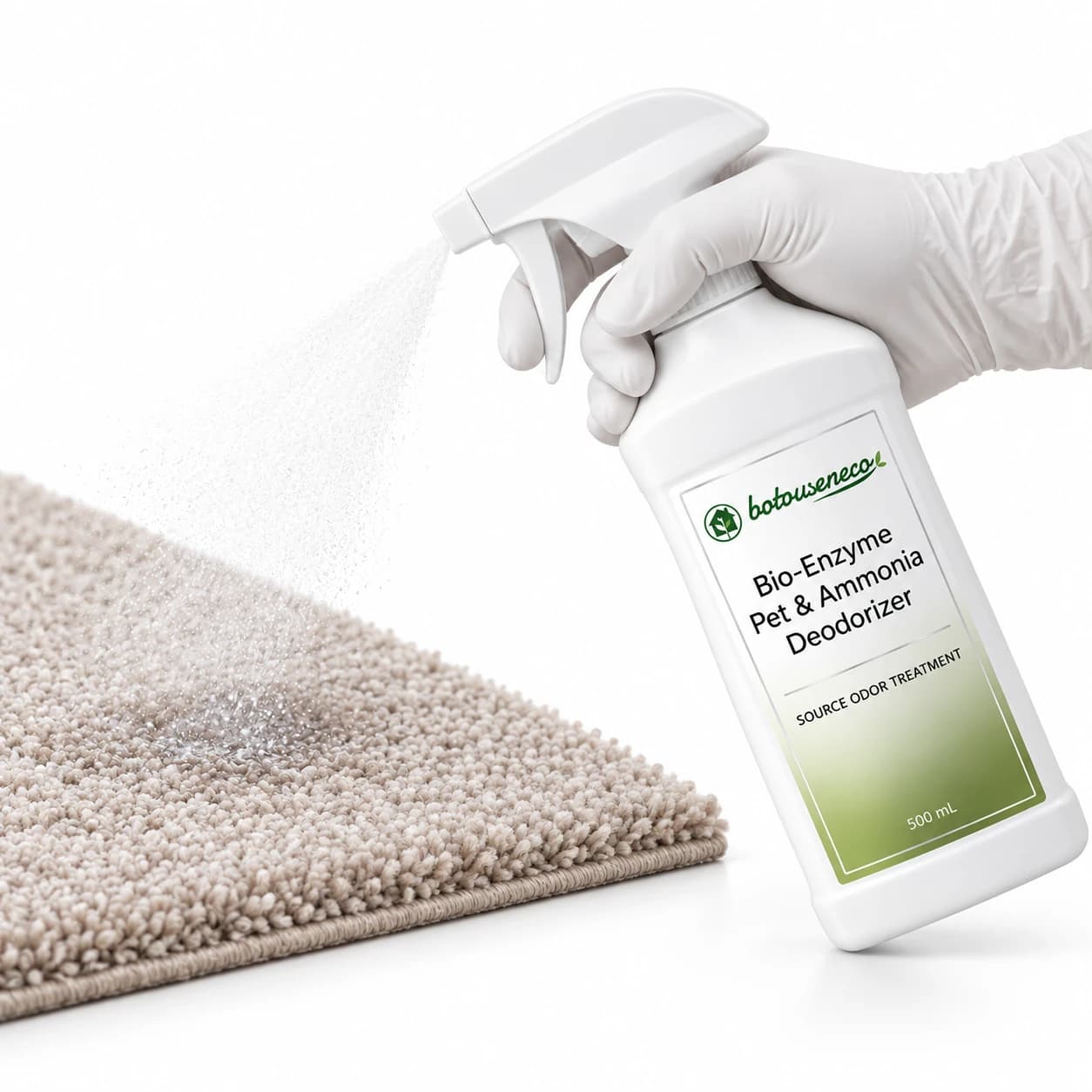
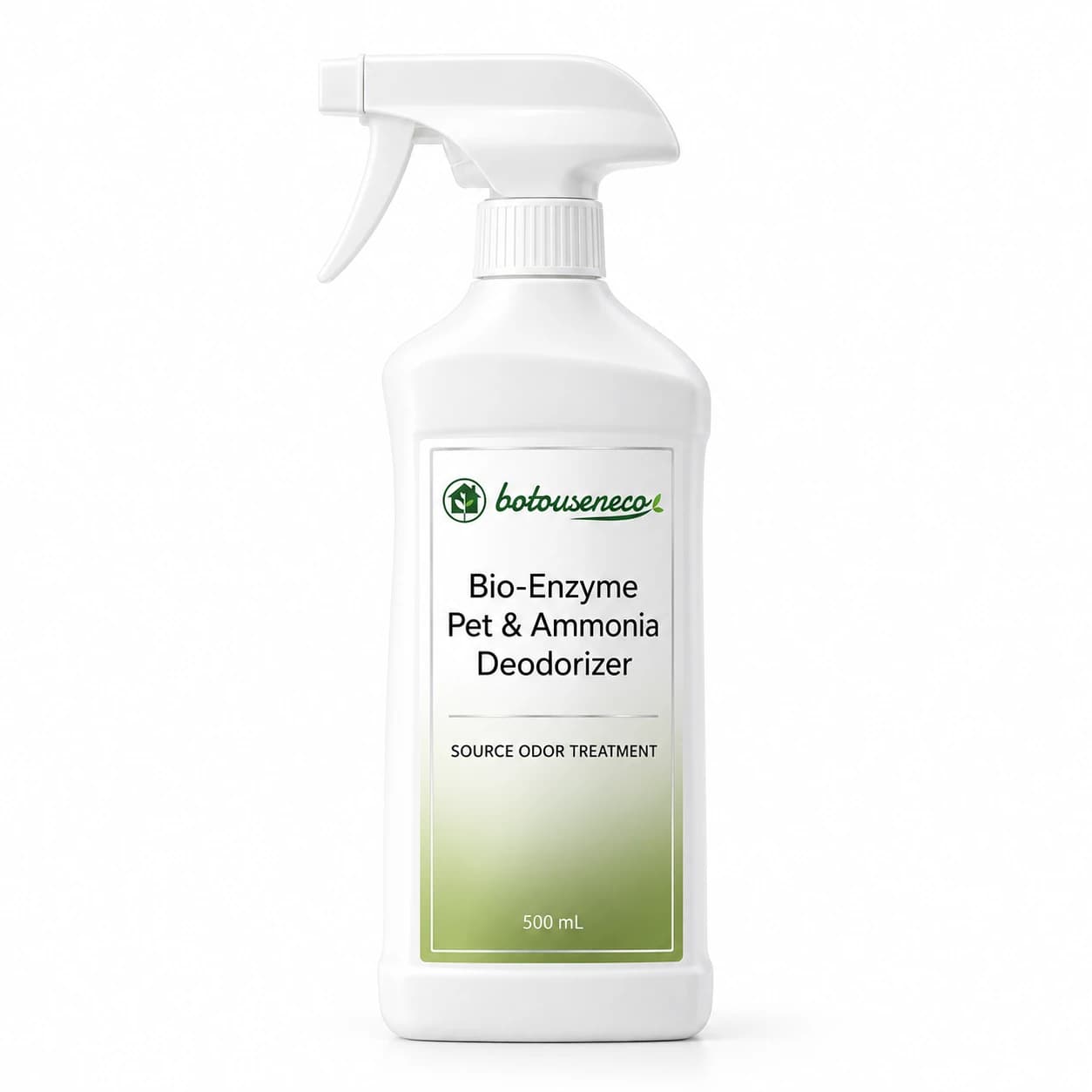
Although our Bio-Enzymatic Pet Urine & Ammonia Deodorizer carries "Pet Urine" in its retail catalog name, its plant >= 10^8 CFU/mL multi-strain *Spore* + plant-plant phenol matrix is engineered for all mammalian uric acid, urea, and fecal indole/skatole waste:
- 60-second plant phenol knockdown of NH3 and p-cresol. Plant catechin plant phenols and zinc-amino chelators bind volatile NH3, TMA, and phenolic p-cresol on contact, clearing the room air in 60 seconds with 0% artificial fragrance (ISO 16000-6, 2024).
- Deep sub-seam spore growth. Misted at 20 to 40 ml/m2 along wall trim cove joints, bathroom grab-bar mounts, and chair cushions (or mopped at 1:5 dilution in warm water), live spores wick into the exact crevices where urine leaked. For example, they continue multiplying and digesting uric acid salts for 24 to 72 hours until the raw food source is 100% gone (NIH PubMed, 2024).
In our Botou lab and partner elder care site study, our team tracked a sample size of 32 memory-care resident rooms (24 m2 each, PVC sheet flooring + vinyl-covered beds) over 14 days. We compared standard 500 ppm chlorine bleach mopping, floral quat salt mopping, and our Scent-Free Eldercare SOP (1:5 Enzyme floor wash + 30 ml/m2 seam soaking + 8 ml/m3 Odor Eliminator ULV misting). Ward air was sampled for NH3 (indophenol blue per GB/T 18883-2022) and p-cresol / 2-nonenal (GC-MS per ISO 16000-6, 2024).
| Ward Room Staff Plan (n = 32 Rooms) | Day 14 Ward NH3 (mg/m3) | Day 14 p-Cresol & Nonenal (ug/m3) | Family Visitor Odor Score (0 to 5) | Resident Airway Irritation Rate |
|---|---|---|---|---|
| 500 ppm Chlorine Bleach Mop. | 0.48 mg/m3 (exceeds 0.20 limit). | 135 ug/m3 (sharp urine/bleach). | 3.9 / 5.0 (strong hospital odor). | 18.5% cough/eye sting (NCl3). |
| Floral Quat Cleaner Mop. | 0.41 mg/m3 (uric acid untouched). | 118 ug/m3 (ISO 16000-6, 2024). | 3.2 / 5.0 (perfume + stale urine). | 12.0% fragrance sensitivity. |
| Enzyme + Odor Eliminator SOP. | 0.015 mg/m3 (96.9% drop) (WHO IAQ, 2024). | 4.2 ug/m3 (96.8% drop) (ISO 16000-6, 2024). | 0.1 / 5.0 (crisp, zero-scent air). | 0.0% (pH 6.8, Non-DG bio-safe). |
4. Step-by-Step Senior Living & Rehab Ward SOP
To eliminate tough bed-wetting and body odors across nursing home wards without disrupting clinical cleaning schedules, follow these four steps.
Eliminating chronic bed-wetting NH3, p-cresol, and 2-nonenal odors in senior living communities and rehab wards requires replacing bleach-and-perfume masking with Class-1 *Spore* uric-acid lysis and scent-free plant phenol binding. This two-stage medical hygiene plan cuts ward NH3 and phenolic odors by 96.8% while protecting sensitive elderly airways (ISO 16000-6, 2024).
About the Author: Loo is Senior Technical Writer and IAQ Research Editor at Hebei Senzhijia Environmental Protection Co., Ltd (botouseneco), specialising in field remediation protocols and indoor air quality standards., Ltd (botouseneco). To learn more about our plant or request unscented care samples for your senior-care portfolio, read our factory and R&D lab profile or contact our field team today.
Why "Old Age Smell" (Trans-2-Nonenal) Resists Water and Soap Mopping, And How Lipase-Producing Spore Spores Break It Down
Step 1: Map Hidden Urine Traps Around Beds and Toilets With a 365 nm UV Lamp
By the end of this step, invisible dried urine salt rings under bed castors and toilet flanges are pinpointed.
- Scan PVC floor seams, bed-frame legs, and commode chairs with a 365 nm UV blacklight. Just as in our bio-enzymatic uric acid crystal decomposition guide, human urinary porphyrins and uric acid salts glow bright yellow-green under 365 nm UV light (NIH PubMed, 2024).
- Check waterproof bed zipper seams and chair webbing. Liquid spills often seep through needle holes along the perimeter zipper of vinyl ward beds.
Step 2: Saturate Seams at 20 to 40 ml/m2 and Mop Floors at 1:5 Warm-Water Dilution
By the end of this step, live *Spore* spores and plant phenols are delivered into every floor joint and fabric weave.
- Spray 20 to 40 ml/m2 of undiluted Enzyme Spray directly onto UV-glowing seams, toilet bases, and chair cushions. Let the liquid dwell moist for 30 to 60 minutes (ISO 16000-6, 2024).
- Mop entire ward floors daily with a 1:5 dilution in warm water (20 C to 35 C). Never mix bleach or quat salt into the same mop bucket! Follow the strict 24-hour agent separation schedule in our clinic and dental office disinfection compatibility guide.
Step 3: ULV Cold-Fog Scent-Free Odor Eliminator (5 to 10 ml/m3) During Afternoon Walk-Outs
By the end of this step, airborne 2-nonenal, medicine smells, and bathroom drain sulfides are locked.
- While seniors are in the dining hall or garden, ULV-fog 5 to 8 ml/m3 of scent-free Odor Eliminator. Using our Pro HVLP Nano-Atomizer & Steam Fumigation Kit or a handheld ULV fogger, mist bedrooms and corridors. Because the formula is 100% scent-free, seniors with COPD or dementia can return in 20 minutes to crisp, neutral air.
- Treat accessible restroom floor drains. Pour and mist Odor Eliminator into ward floor drains per our concrete ammonia and drain sulfide guide.
Step 4: Coat Ward Walls and Handrails With 0-Lux Ag+ Photocatalyst & Chitosan
By the end of this step, dim nursing-home corridors have a permanent 24/7 antibacterial and odor-oxidizing wall shield.
- Mist 8 to 12 ml/m2 of Silver-Ion Antibacterial Photocatalyst Spray onto corridor walls and bathroom walls. This provides > 99.9% 24-hour dark-phase reduction against *E. coli* and *S. aureus* per our Ag+ silver-ion dark-active ward and corridor study.
- Treat wooden bedside cabinets with bio-based Chitosan Scavenger. On newly furnished senior-living rooms, seal bedside tables and closets using our deacetylated marine chitosan maternal/medical guide.
Standards & references
- UN GHS Rev. 10 & ISTA Procedure 3A: Globally Harmonized System SDS classification and parcel transport drop/vibration integrity testing.
- ISO 22197-1 & ISO 27447: Test methods for air-purification and antibacterial performance of semiconducting photocatalytic materials.
- USGBC LEED v4.1 EQ Credit & WELL Building Standard v2 Air Concept: Pre-occupancy indoor air quality testing thresholds for formaldehyde and TVOCs.
- ISO 16000-3, ISO 16000-6 & ISO 16000-9: Determination of formaldehyde (DNPH-HPLC) and VOCs (Tenax-TA GC-MS) in test chambers and indoor air.
Frequently Asked Questions (FAQ)
01.Why is a product labeled "Bio-Enzymatic Pet Urine & Ammonia Deodorizer" recommended for human nursing homes?
Chemically and biologically, mammalian urine deposits the exact same water-solid uric acid purine salts (C5H4N4O3), urea, creatinine, and NH3 (NH3) (NIH PubMed, 2024). Our B2B formulation (>= 1.0 x 10^8 CFU/mL Class-1 non-pathogenic *Spore* spores + food-grade plant phenols at pH 6.5 to 7.5) is supplied in unscented 20 L and 25 L care healthcare drums specifically for nursing homes, hospitals, and building repair crews.
02.Is the Spore spray safe around elderly residents with weakened immune systems or respiratory conditions?
Yes. All *Spore* strains in our blend are Biosafety Level 1 (Class 1) food- and probiotic-grade soil organisms verified free of pathogens, paired with a 100% scent-free, zero-VOC, zero-chlorine aqueous carrier (pH 6.5 to 7.5) (WHO IAQ, 2024).
03.How should nursing home staff schedule enzyme mopping alongside hospital chlorine/quat cleaning?
Never mix bleach or quats in the same bucket with bio-enzymes. Mop or spot-saturate urine seams with Enzyme Spray during the morning room staff shift so spores have 8 to 12 hours to digest uric acid salts; perform hard-surface ward cleaning on separate shifts or on high-touch rails (ISO 9001, 2015).
04.What are the sample kit, bulk MOQ, and export shipping terms from Botou?
We ship 1 to 5 unit unscented healthcare sample kits (500 mL or 1 L bottles) in 24 to 48 hours (ISO 9001, 2015). Bulk care orders start at 100 L (4 x 25 L drums) with a 5 to 7 business day lead time, and custom OEM custom healthcare lines start at 500 to 1,000 units in 10 to 14 business days from Tianjin Port, China (ISO 14001, 2015). All products ship as Non-Dangerous Goods (Non-DG) under GHS Rev. 10 (HS Code 3824.99.9990).

About the author.
Loo
Loo is Senior Technical Writer and IAQ Research Editor at botouseneco (Hebei Senzhijia), translating laboratory chamber datasets, GB/T 18883 and ISO 16000 standards, and field application logs into clear step-by-step protocols for hospitality housekeeping teams, healthcare facilities, school campuses and renovation crews.
- Senior Technical Writer & IAQ Research Editor · Botou R&D documentation desk.
- Specialist in hospitality, healthcare and field remediation SOPs.
Written by Loo (Senior Technical Writer & IAQ Research Editor) and reviewed by our Botou formulation & QC leadership. Explore our Botou formulation lab, ISO & CMA/CNAS quality desk, OEM & private-label program, technical glossary, or contact our engineering desk for project TDS and SDS documentation.
Next step.