TVOC & Photocatalytic Ceiling Abatement
Open-Plenum Commercial Ceilings: Treating Spray Polyurethane Foam (SPF) Amine Odors, Exposed Duct Sealants and PET Acoustic Baffles
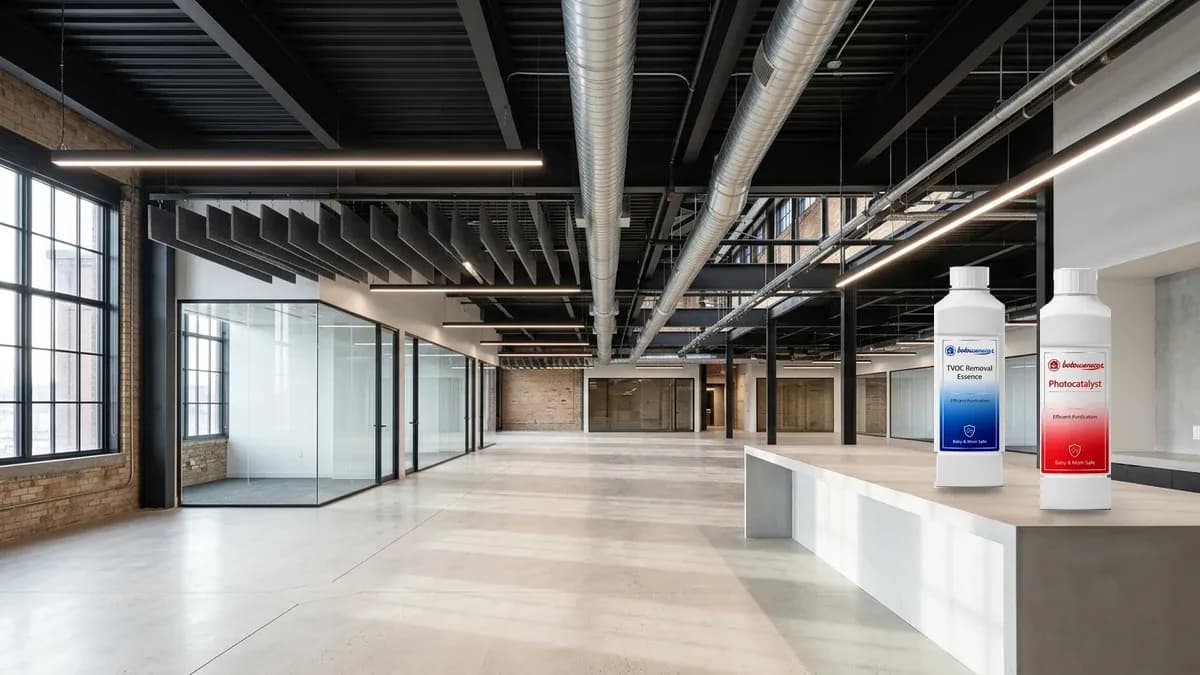
Open-plenum industrial offices drop suspended ceiling grids and expose 1.5x to 2.4x more overhead surface area directly into occupied air. That layout turns spray polyurethane foam (SPF) amine catalysts, acrylic HVAC duct mastics, dry-fall ceiling paint, and PET acoustic felt baffles into persistent TVOC reservoirs. Effective open ceiling spray foam and acoustic baffle VOC control pairs Carpet, Latex Paint & Wallpaper VOC Neutralizer (12 to 15 ml/m2) on steel decks with TVOC Eliminator (10 to 20 ml/m2) on cured SPF and baffles. A clear Nano Photocatalyst Spray (8 to 12 ml/m2) topcoat then sustains indoor LED oxidation with zero dark-ceiling whitening.
Key Takeaways
- 1.5x to 2.4x Surface Multiplier: Removing drop ceilings exposes corrugated decks, steel I-beams, spiral HVAC ducts, and double-sided PET baffles directly into occupied office air.
- Three-Substrate Chemistry Match: Mist Carpet & Paint VOC Neutralizer (12-15 ml/m2) on dry-fall steel paint and acrylic duct mastics, TVOC Eliminator (10-20 ml/m2) on cured SPF bays and PET felt baffles, and Nano Photocatalyst Spray (8-12 ml/m2) via a 0.5 mm HVLP gun.
- Strict Off-Ratio SPF Scope Limit: Liquid sprays neutralize properly cured SPF amine odors cleanly, but soft, wet, or crumbling off-ratio Side A/B foam must be scraped out mechanically before IAQ remediation.
- 1,600 m2 Tech Office Takeoff (100 L Bulk MOQ): Zone 1 painted deck/ducts (2,400 m2 -> 2 x 25 L) + Zone 2 SPF & 400 PET baffles (1,400 m2 -> 1 x 25 L) + Zone 3 LED-lit TiO2 zones (2,000 m2 -> 1 x 25 L) total 4 x 25 L pails (100 L) in one 5-7 business day dispatch.
Why Exposed Ceilings Trigger Handover TVOC Failures Without Formaldehyde
Modern tech offices, creative lofts, and coworking spaces favor exposed industrial ceilings over flat mineral-fiber grids. Yet stripping away a drop ceiling removes the physical plenum barrier between mechanical utilities and office desks. As a result, workers sit directly beneath spray-insulated steel decks, freshly sealed spiral ducts, matte-black dry-fall paint, and hundreds of hanging felt baffles.
On handover week, these spaces often pass basic formaldehyde checks while failing LEED v4.1 and WELL v2 TVOC ceilings (<= 0.50 mg/m3) or China GB/T 18883-2022 limits (<= 0.60 mg/m3, 8-hour average). Worse, employees report sharp fishy, plastic, or stale-paint odors whenever ceiling diffusers warm up. Solving overhead VOC plumes demands matching surface chemistry to three completely different ceiling materials without staining dark finishes.
| Overhead Plenum Source | Dominant Emitted VOCs | Key Failure Risk | Matched Botou Chemistry & Rate |
|---|---|---|---|
| Cured SPF roof deck | Tertiary amines (DMCHA, TEDA), TCPP | Fishy odor + slow semi-volatile bleed | TVOC Eliminator (10 to 20 ml/m2) |
| Painted steel & duct mastic | Acrylates, Texanol, glycol ethers | Heavy paint haze across 1.5x deck area | Carpet & Paint VOC Neutralizer (12 to 15 ml/m2) |
| PET felt acoustic baffles | Re-emitted fumes, trace acetaldehyde | Porous sink traps upstream amine odors | TVOC Eliminator (10 to 20 ml/m2) |
| LED-lit beams & upper zones | Residual background TVOCs | Long-term off-gassing under warm HVAC | Nano Photocatalyst Spray (8 to 12 ml/m2) |
Why Open-Plenum Ceilings Multiply VOC Loading: SPF Amines, Duct Mastics and PET Baffles
Indoor VOC levels regularly measure two to five times higher indoors than outdoors, according to the US EPA Indoor Air Quality VOC Overview. In open-plenum interiors, folded steel decking, I-beams, round spiral ducts, and double-sided hanging baffles expand actual emitting area well beyond floor square meterage. For precise takeoff multipliers across complex ceilings, review our commercial IAQ surface-area multiplier and chemical calculator.
Three overhead assemblies drive the bulk of open ceiling spray foam and acoustic baffle VOC failures.
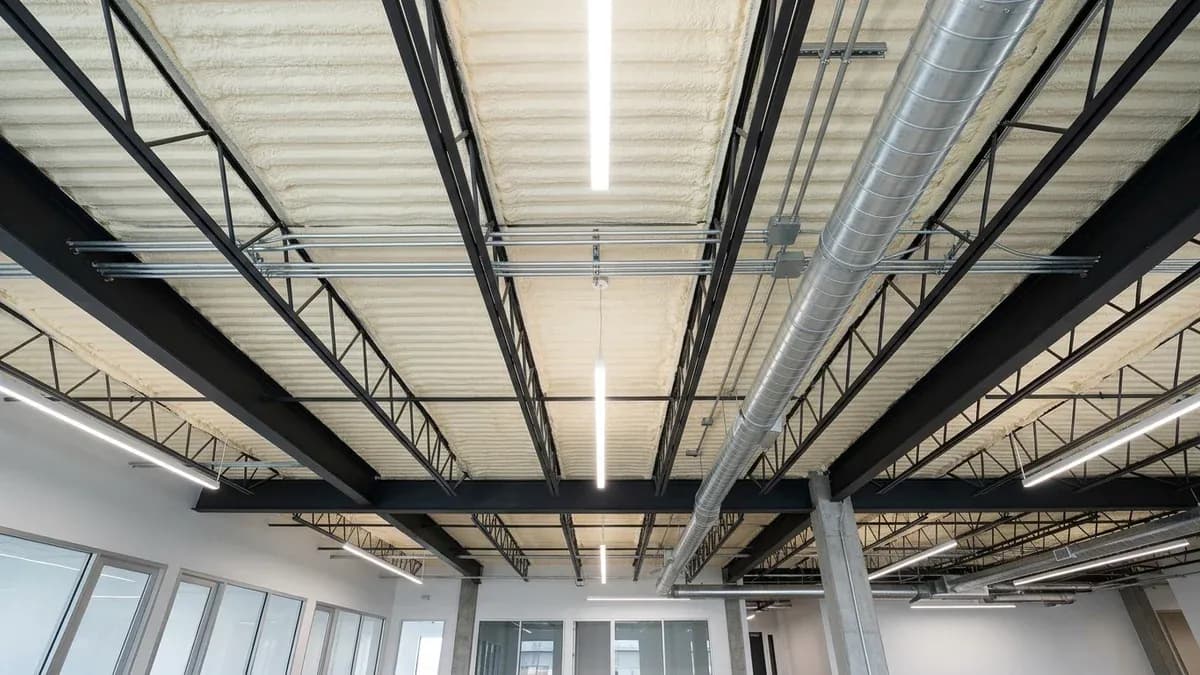
1. Spray Polyurethane Foam (SPF): Tertiary Amine Catalysts and TCPP
Spray Polyurethane Foam (SPF) is a two-component site-foamed thermal and acoustic insulation formed by reacting polymeric MDI isocyanate (Side A) with a polyol resin blend (Side B). To control foam rise and cure speed on cold overhead steel, formulators add tertiary amine catalysts and organophosphate flame retardants into Side B.
Two catalysts explain the notorious fishy ceiling smell. N,N-Dimethylcyclohexylamine (DMCHA) (profiled in the NIH PubChem DMCHA Reference) and Triethylenediamine (TEDA) (listed in the NIH PubChem Triethylenediamine Profile) carry strong ammoniacal or fishy odors even at trace levels. When sprayers work over cold steel trusses or slightly Side B-rich ratios, excess catalyst migrates slowly out of foam pores into occupied office air.
Flame retardants add a second semi-volatile burden. Tris(1-chloro-2-propyl) phosphate (TCPP) is an additive organophosphate flame retardant detailed in the NIH PubChem TCPP Reference that sits unbound inside cured foam cells. A 2019 field study in the Journal of Occupational and Environmental Hygiene (PMC6659107) measured cured bulk SPF samples and found 9.23% by weight TCPP in open-cell foam versus 1.68% by weight in closed-cell foam. In addition, a 2021 US EPA IECCU modeling study in Building and Environment (PMC10947393) tracked SPF TCPP levels over five years (2013 to 2018). Those data prove warm plenums and porous building sinks sustain long-term vapor release.
2. Exposed HVAC Duct Mastics and Matte Dry-Fall Ceiling Paints
Mechanical trades seal sheet-metal duct joints using water-based acrylic mastics or solvent elastomeric sealants to meet energy leakage codes. Painters then spray thousands of square meters of raw deck, trusses, and ducts with matte black or gray dry-fall acrylic coating.
As detailed in the US EPA Technical Overview of Volatile Organic Compounds, slow-evaporating coalescing esters (Texanol), butyl acrylate monomers, and glycol ethers continue bleeding from fresh acrylic films for 14 to 30 days. Because warm HVAC supply ducts sit right against mastic seams, heating cycles accelerate vapor release straight into ceiling supply jets.
3. Suspended PET Polyester Felt Acoustic Baffles
PET Acoustic Felt Baffles are rigid sound-absorbing panels made by thermally needle-punching recycled polyethylene terephthalate fibers without urea-formaldehyde glue. Pure thermally bonded PET felt emits minimal formaldehyde, though high-heat fiber recycling can leave trace acetaldehyde, documented in the NIH PubChem Acetaldehyde Profile.
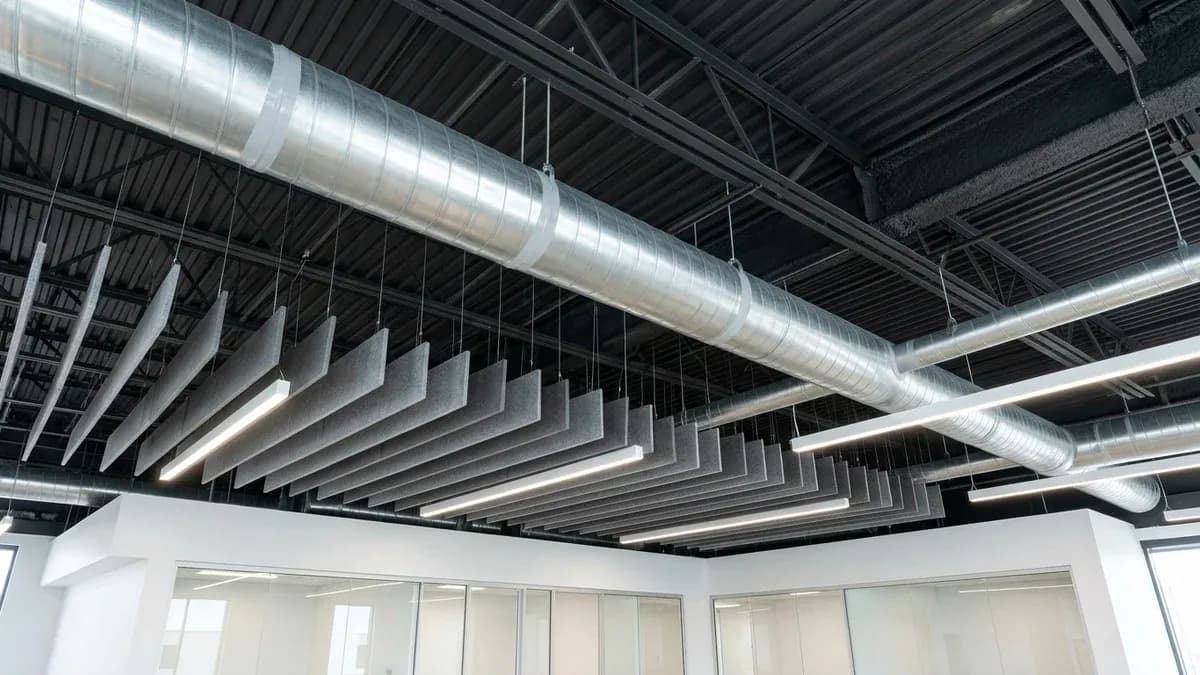
However, PET baffles still cause severe odor callbacks in open ceilings for two practical reasons. First, multi-layer laminated baffles or edge-wrapped acoustic clouds often use secondary contact adhesives that release aromatic and ester VOCs. Second, open-pore polyester felt acts like a giant overhead sponge. Hanging right beneath freshly sprayed SPF and dry-fall paint, baffles absorb drifting amine catalysts and coalescents, then re-emit stale fumes for weeks after ventilation stops. For ceilings combining felt with veneered MDF or timber slats, pair this protocol with our guide on acoustic wood-slat wall and veneered MDF ceiling baffle VOC remediation.
| Overhead Material | Primary VOC / Odor Signature | Porosity & Sink Role | Optical Sensitivity |
|---|---|---|---|
| Open-cell SPF (9.23% wt TCPP) | Fishy DMCHA/TEDA amines + TCPP | Very high open-pore reservoir | Matte texture; watch wetting |
| Closed-cell SPF (1.68% wt TCPP) | Surface amine catalyst + blowing agents | Low bulk porosity; surface skin | Usually over-painted matte black |
| Duct mastic & dry-fall paint | Butyl acrylate, Texanol, glycol ethers | Continuous coated steel film | High chalking risk on black paint |
| PET felt acoustic baffles | Secondary absorbed amines, glue, acetaldehyde | High fiber sink; dual-sided area | Water rings if flooded |
How Do Contractors Treat Exposed Duct Sealants, SPF and PET Acoustic Baffles?
Standard ceiling fogging fails on open plenums because heavy droplets drip off steel ducts onto desks, while coarse white TiO2 powder slurries leave chalky streaks on matte-black ceilings. Follow this three-stage scissor-lift workflow designed for IAQ and commercial renovation contractors.
Stage 1: Cure Verification, Off-Ratio Triage and Plenum Masking
Start by inspecting the spray foam before loading any spray gun. Press several cured SPF bays on the roof deck with a gloved hand. Properly cured open-cell foam feels crisp and dry, while closed-cell foam feels rigid and hard. If foam feels spongy, greasy, wet, or crumbles with an overpowering raw amine stench, stop immediately and report off-ratio Side A/B spraying.
Next, shut down all air handling units (AHUs) and exhaust fans so mist does not pull into return ducts. Mask live fire sprinklers, optical smoke sensors, pendant LED lenses, and finished workstations below with light poly sheeting. Maintain ambient room heat between 18 C and 30 C so fine mists flash off cleanly.
Stage 2: Targeted Liquid Knockdown (Paint/Mastic + SPF/PET Baffles)
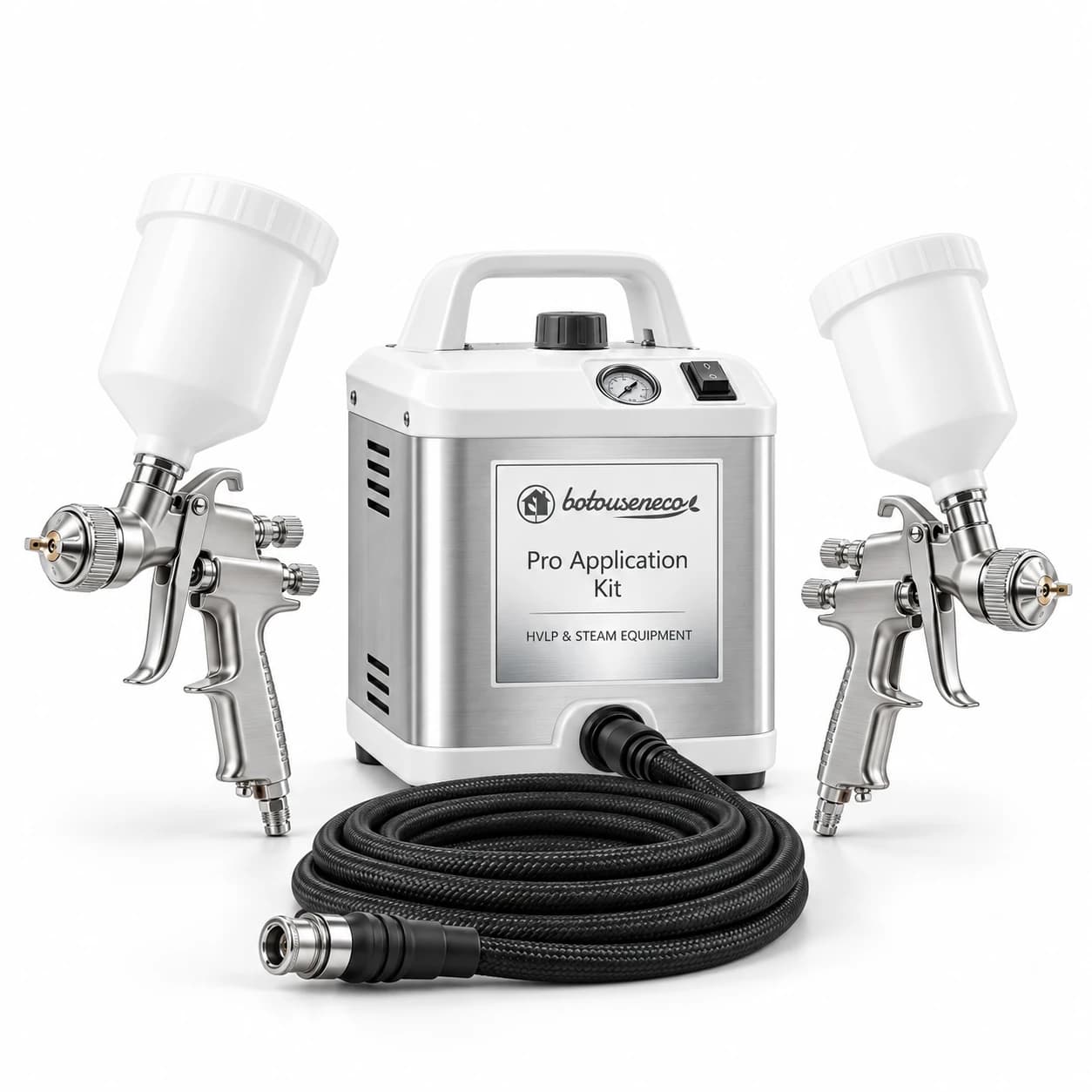
Deploy calibrated HVLP spray guns from mobile scissor lifts (0.20 to 0.30 MPa air cap pressure) to control overspray cleanly around overhead piping:
Let the neutralized plenum rest with HVAC off for 12 to 16 hours overnight so amphiphilic micelles and chelating polymers complete surface capture across foam cells, mastic seams, and felt fibers.
- Coated Steel Deck, Beams & Acrylic Duct Mastics (12 to 15 ml/m2 light pass within 12-20 ml/m2 spec): Fill a 0.5 to 0.8 mm HVLP gun with Carpet, Latex Paint & Wallpaper VOC Neutralizer. Hold 30 to 40 cm from painted steel and cured mastic (12 to 24 hours post-coat) to trap solvents and cleave acrylates with zero sheen shift on matte-black paint.
- Cured SPF Bays & PET Acoustic Baffles (10 to 20 ml/m2): Apply neutral TVOC Eliminator (pH 6.5 to 7.5) as your spray foam insulation amine odor neutralizer and PET felt ceiling baffle TVOC spray. Sweep both sides of each baffle at 30 to 40 cm so clear mist wets outer fibers without soaking the felt core or leaving rings.
Stage 3: Permanent Visible-Light Open-Plenum HVLP Photocatalyst Coating and Purge
Once Stage 2 surfaces dry fully, apply an open plenum HVLP photocatalyst coating onto lit upper walls, exposed trusses, and light-facing PET baffles. Spray at 8 to 12 ml/m2 using a dedicated 0.5 mm stainless-steel HVLP nozzle.
Why does particle chemistry matter here? A 2022 peer-reviewed study in Materials (PMC8781013) confirms that lattice-doped TiO2 shifts activation into the indoor visible-light spectrum to degrade aromatic VOCs and NOx. Crucially, the same study warns that mixing TiO2 with organic resin binders creates secondary formaldehyde byproducts as radicals attack the organic matrix. Using a 5 to 10 nm binder-free colloidal anatase sol avoids both binder chalking and secondary aldehydes while staying invisible on dark architectural finishes.
After coating dries (30 to 60 minutes), run building AHUs on full outdoor-air purge (>= 3 ACH) for 24 hours. Then close windows and HVAC recirculation per your target standard:
- LEED v4.1 EQ & WELL v2 Air A01: Verify TVOC <= 0.50 mg/m3 (500 ug/m3).
- China GB/T 18883-2022 (12-hour closed room): Verify TVOC <= 0.60 mg/m3 (8-hour average), alongside 1-hour averages for formaldehyde (<= 0.08 mg/m3), benzene (<= 0.03 mg/m3), toluene (<= 0.20 mg/m3), and xylenes (<= 0.20 mg/m3).
- WHO Health Benchmark: Cross-check aldehydes and aromatics against the World Health Organization Indoor Air Quality Guidelines (0.1 mg/m3 30-minute formaldehyde limit; zero safe level for benzene).
Engineering Scope Limits: When Off-Ratio SPF Must Be Removed Mechanically
In our Botou technical lab and contractor site reviews, we set strict limits on chemical ceiling abatement. Surface neutralizers and visible-light TiO2 coatings work cleanly on properly cured SPF skins, dry acrylic duct mastics, and odor-loaded PET felt. However, no liquid spray can cure uncured, off-ratio spray polyurethane foam.
If Side A/B proportioning pumps failed during installation and left soft, wet, or crumbling foam pockets dripping unreacted amine catalyst, surface spraying only masks the smell briefly. Those defective bays must be scraped out mechanically and re-sprayed to manufacturer spec before final IAQ remediation starts.
Botou Open-Plenum VOC and Photocatalyst Product Selection
For full commercial coating-stack design across open-plan offices, see our pillar guide on visible-light photocatalyst coatings and commercial TVOC abatement. Within our TVOC and photocatalytic coating product line, Hebei Senzhijia Environmental Protection Co., Ltd (botouseneco) builds three targeted liquids for exposed ceilings. Learn more about us and our Botou plant, founded in 2015 in Cangzhou, Hebei:
Every batch is produced under our ISO 9001:2015 Quality Management System and ISO 14001:2015 Environmental Management System, supported by CMA / CNAS-accredited chamber verification per ISO 16000-9 and GB/T 18883-2022. Official certificate copies and third-party chamber reports are shared privately with B2B buyers on request. Private-label OEM runs start at 500 to 1,000 units with a 10 to 14 business day lead time.
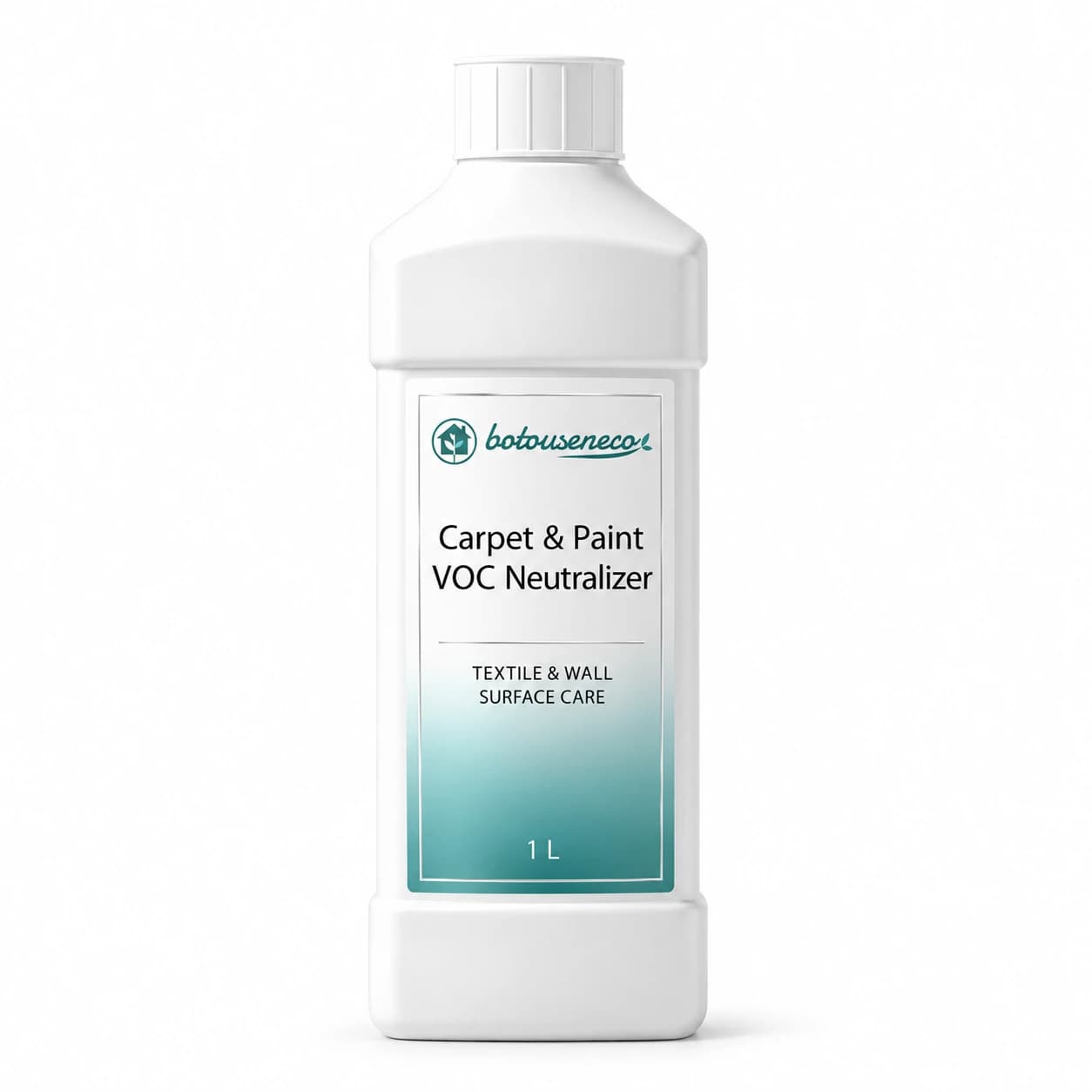
- 1. Carpet, Latex Paint & Wallpaper VOC Neutralizer: Combines modified beta-cyclodextrin inclusion polymers with alkene cleavage catalysts (pH 6.5 to 7.2). Sprayed at 12 to 15 ml/m2 (light non-porous pass within its 12 to 20 ml/m2 spec) on cured matte-black dry-fall ceiling paint and water-based acrylic duct mastics, it clears Texanol and acrylate monomers with zero streaking or gloss shift.
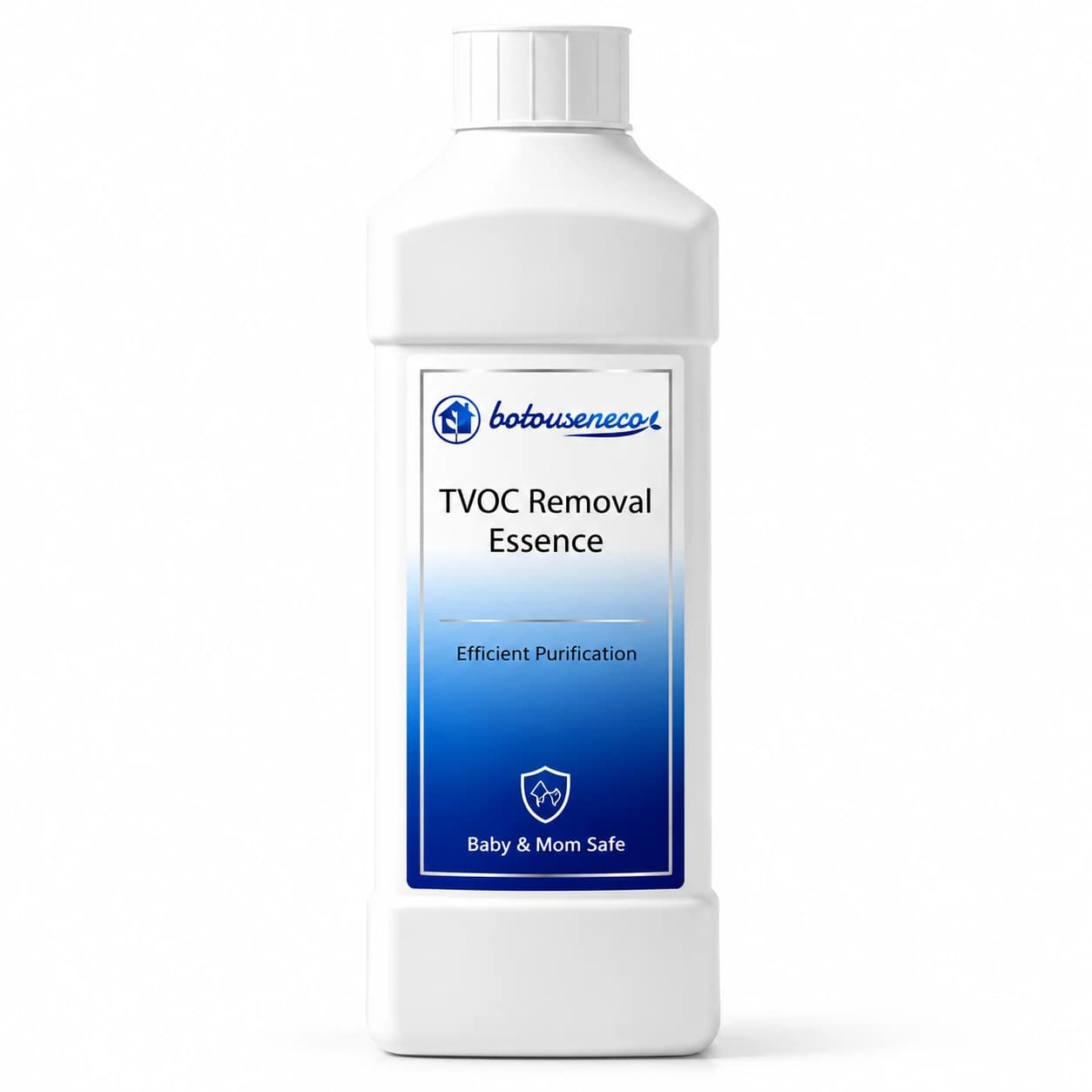
- 2. TVOC Eliminator: Neutral (pH 6.5 to 7.5) plant-terpene chelators, amphiphilic micelles, and micro-catalytic oxidizers. Sprayed at 10 to 20 ml/m2 (0.5 to 0.8 mm HVLP, 30 to 40 cm), it neutralizes surface SPF amine odors and absorbed VOCs on hanging PET felt baffles with crystal-clear drying.
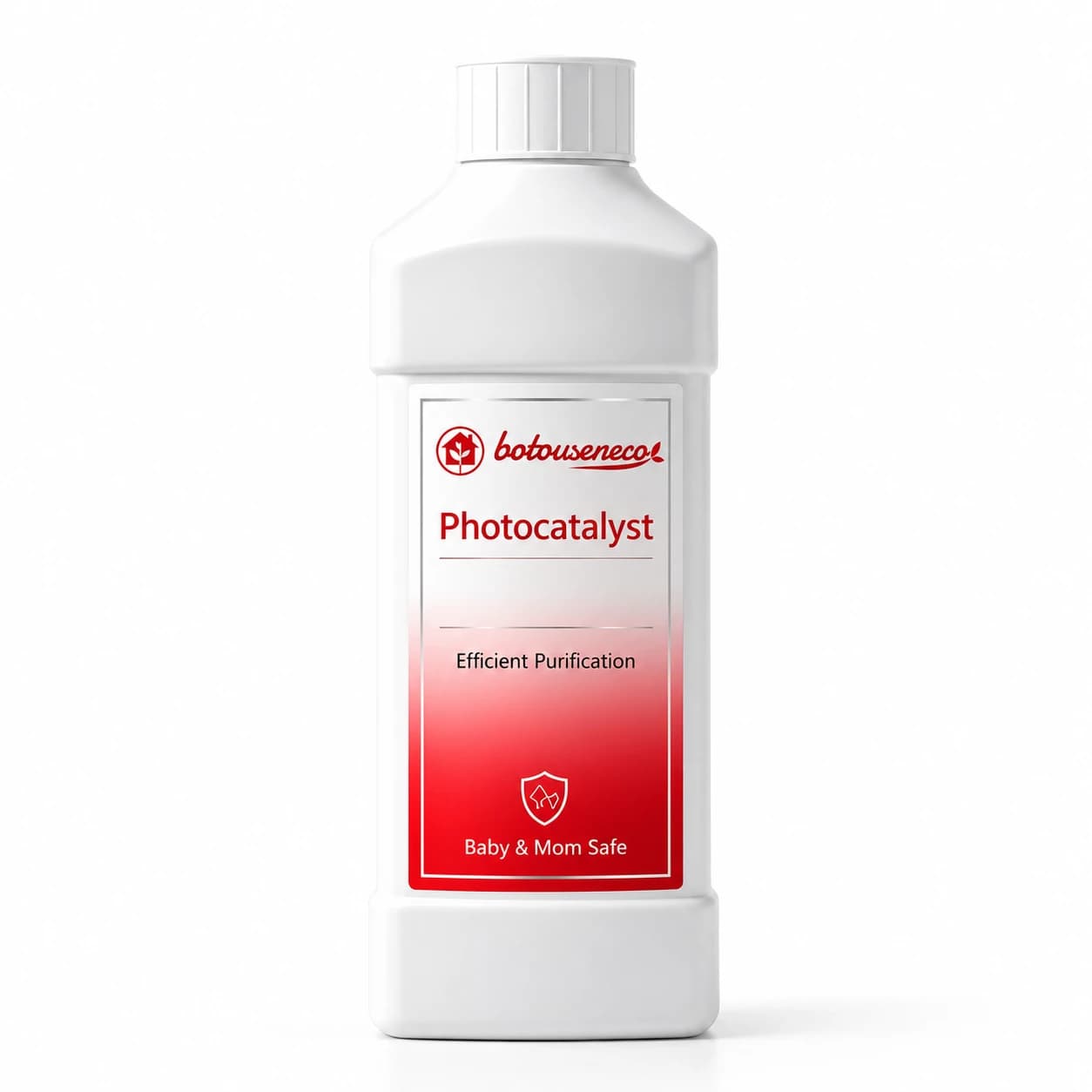
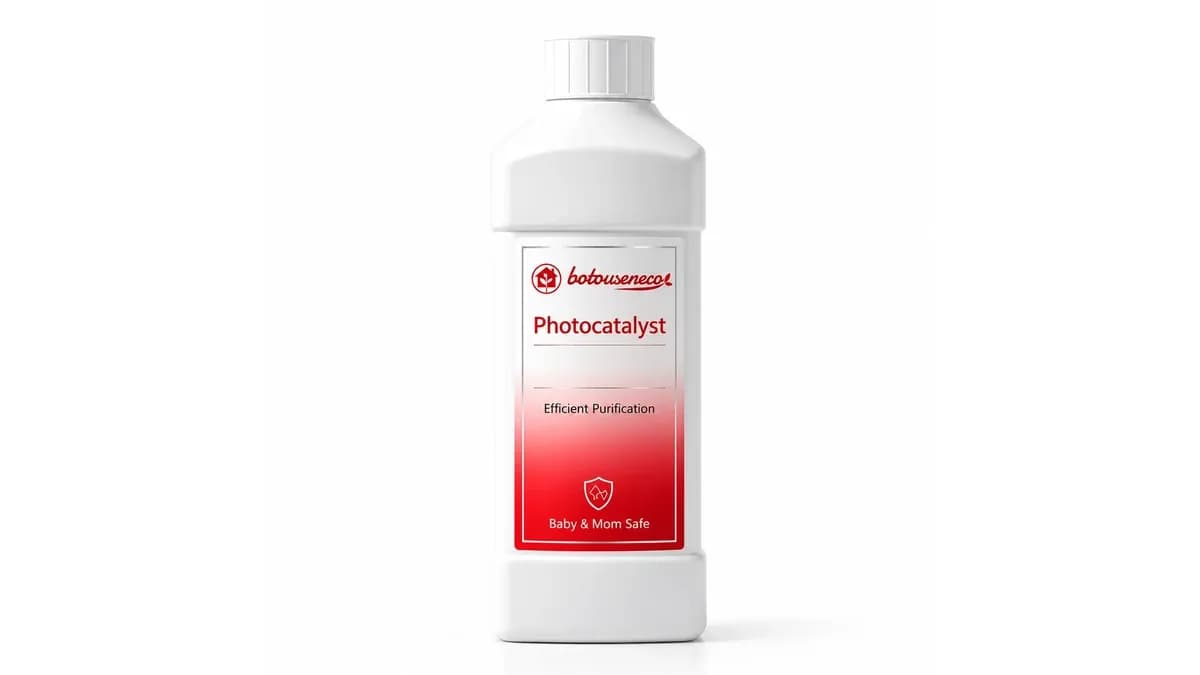
- 3. Nano Photocatalyst Spray: Ready-to-use 1.0% wt (10,000 ppm, Botou Technical Datasheet, 2026) visible-light doped 5 to 10 nm colloidal anatase TiO2 sol (pH 6.5 to 7.5). Spray 8 to 12 ml/m2 with a 0.5 mm HVLP tip for a 100% inorganic (Botou Technical Datasheet, 2026) self-bonding film active under 380 to 550 nm LEDs with zero dark-wall whitening.
| Product / Term | Active Chemistry & pH | Open-Plenum Target Surface | Dosage & Packaging |
|---|---|---|---|
| Carpet & Paint VOC Neutralizer | Beta-cyclodextrin + alkene cleavage catalysts (pH 6.5-7.2) | Dry-fall ceiling paint & acrylic duct mastic | 12-15 ml/m2 (12-20 ml/m2 spec); 1 L, 5 L, 25 L, 200 L |
| TVOC Eliminator | Terpene chelators + micelles (pH 6.5-7.5) | Cured SPF bays & PET felt acoustic baffles | 10-20 ml/m2; 1 L, 5 L, 25 L, 200 L |
| Nano Photocatalyst Spray | 5-10 nm doped anatase TiO2 sol (pH 6.5-7.5) | LED-lit beams, upper walls & light-facing baffles | 8-12 ml/m2; 1 L, 5 L, 25 L, 200 L |
| Botou MOQ, SDS & Export | Non-DG GHS Rev. 10 / ISO 11014 SDS, REACH SVHC-free | Air & sea freight via Tianjin Port (~180 km) | Sample 1-5 units (24-48 h); Bulk 100 L (5-7 d) |
Worked Open-Plenum Takeoff: 1,600 m2 Exposed-Ceiling Tech Office
Estimators who multiply flat floor area alone consistently under-order chemicals on open-ceiling tenders. Consider a 1,600 m2 industrial-loft tech office (4.2 m exposed deck height) with matte-black painted trusses and sealed spiral ducts. The plenum also contains 800 m2 of cured SPF roof-deck bays and 400 suspended double-sided PET acoustic baffles (1.5 m x 0.5 m per face):
Total factory order comes to 100 L (4 x 25 L pails), clearing our 100 L bulk MOQ in one pallet dispatch ready within 5 to 7 business days. Two scissor-lift crews complete Stage 2 spraying in one 5-hour evening shift, followed by overnight dwell, 3 hours of Stage 3 TiO2 misting, and a 24-hour full outdoor-air purge ahead of handover sampling.
Do not let SPF amine odors, duct mastics, or odor-soaked PET baffles delay your commercial office handover. Contact our Botou engineering team with your floorplate size, deck height, SPF type, and baffle count. We dispatch 1 L evaluation kits within 24 to 48 hours, complete with GHS Rev. 10 SDS files and a tailored open ceiling spray foam and acoustic baffle VOC drum plan.
- Zone 1 (Painted Deck, Beams & Duct Mastic = 1,600 m2 x 1.50 = 2,400 m2): Applying Carpet, Latex Paint & Wallpaper VOC Neutralizer at 12 ml/m2 takes 28.8 L net (2,400 x 0.012). Multiplying by a 1.10 overhead HVLP transfer factor yields 31.68 L, so procurement orders 2 x 25 L pails (50 L, keeping reserve for touch-ups).
- Zone 2 (Cured SPF 800 m2 + 400 Dual-Face PET Baffles 600 m2 = 1,400 m2): Applying TVOC Eliminator at 15 ml/m2 takes 21.0 L net (1,400 x 0.015). Multiplying by the 1.10 transfer factor yields 23.10 L, so procurement orders 1 x 25 L pail (25 L).
- Zone 3 (LED-Lit Beams, Upper Perimeter Walls & Light-Facing Baffles = 2,000 m2): Applying Nano Photocatalyst Spray at 10 ml/m2 (8 to 12 ml/m2 spec) requires 20.0 L net (2,000 x 0.010). Multiplying by the 1.10 transfer factor yields 22.00 L, so procurement orders 1 x 25 L pail (25 L).
Standards & references
- LEED v4.1 EQ & WELL v2 Air A01 (TVOC <= 0.50 mg/m3) & China GB/T 18883-2022 (TVOC <= 0.60 mg/m3 8h avg; HCHO <= 0.08 mg/m3).
- Peer-Reviewed SPF & TiO2 Studies: Journal of Occupational and Environmental Hygiene 2019 (PMC6659107), Building and Environment 2021 US EPA IECCU (PMC10947393), and Materials 2022 (PMC8781013).
- US EPA Indoor Air Quality VOC Overviews, World Health Organization (WHO) IAQ Guidelines & NIH PubChem Profiles (DMCHA, TEDA, TCPP, Acetaldehyde).
- UN GHS Rev. 10 / ISO 11014 Non-DG SDS, EU REACH SVHC-Free, ISO 9001:2015, ISO 14001:2015 & CMA / CNAS Chamber Verification (ISO 16000-9).
Frequently Asked Questions (FAQ)
01.Why does newly sprayed open-cell ceiling foam smell like fish weeks after curing?
The fishy smell comes from volatile tertiary amine catalysts such as DMCHA or TEDA blended into the Side B resin to speed foam rise. Cold steel decking, high humidity, or slightly Side B-rich spraying leaves free amine migrating slowly out of porous foam cells. If foam is firm and cured, neutral TVOC Eliminator (10 to 20 ml/m2) clears surface amine odors cleanly; soft, uncured foam must be removed first.
02.Will spraying a photocatalyst on a matte-black open ceiling leave white chalk streaks?
Milled P25 powder slurries (200 to 800 nm clumps) scatter visible light and leave white haze on black steel decks. In contrast, Botou Nano Photocatalyst Spray uses a 5 to 10 nm colloidal anatase sol applied at 8 to 12 ml/m2 through a 0.5 mm HVLP tip. Its crystal size sits far below visible light wavelengths, drying optically invisible with zero chalking.
03.Can crews spray PET felt acoustic baffles without warping or water-spotting the panels?
Yes, when crews keep dosage within 10 to 20 ml/m2 using a 0.5 to 0.8 mm HVLP gun held 30 to 40 cm away. Fine misting coats only the outer polyester fibers where absorbed SPF amines and paint VOCs sit, drying fast and evenly without saturating the felt core or staining light gray or colored baffles.
04.Why do exposed ceilings need a 1.5x surface-area multiplier when bidding IAQ chemicals?
Flat drywall or drop-grid ceilings match floor area roughly 1:1. Removing the grid exposes corrugated steel flutes, deep I-beam webs, round HVAC spiral ducts, and double-sided vertical acoustic baffles. Measuring actual unfolded ceiling area prevents under-dosing and protects your handover pass rate.

About the author.
Loo
Loo is Senior Technical Writer and IAQ Research Editor at botouseneco (Hebei Senzhijia), translating laboratory chamber datasets, GB/T 18883 and ISO 16000 standards, and field application logs into clear step-by-step protocols for hospitality housekeeping teams, healthcare facilities, school campuses and renovation crews.
- Senior Technical Writer & IAQ Research Editor · Botou R&D documentation desk.
- Specialist in hospitality, healthcare and field remediation SOPs.
Written by Loo (Senior Technical Writer & IAQ Research Editor) and reviewed by our Botou formulation & QC leadership. Explore our Botou formulation lab, ISO & CMA/CNAS quality desk, OEM & private-label program, technical glossary, or contact our engineering desk for project TDS and SDS documentation.
Next step.