Photocatalyst Material Science Comparison
5-10 nm Colloidal Anatase TiO2 Sol vs. 25-60 nm P25 Powder Suspensions: Wall Whitening, Binder Chalking and 450 nm LED Quantum Yield
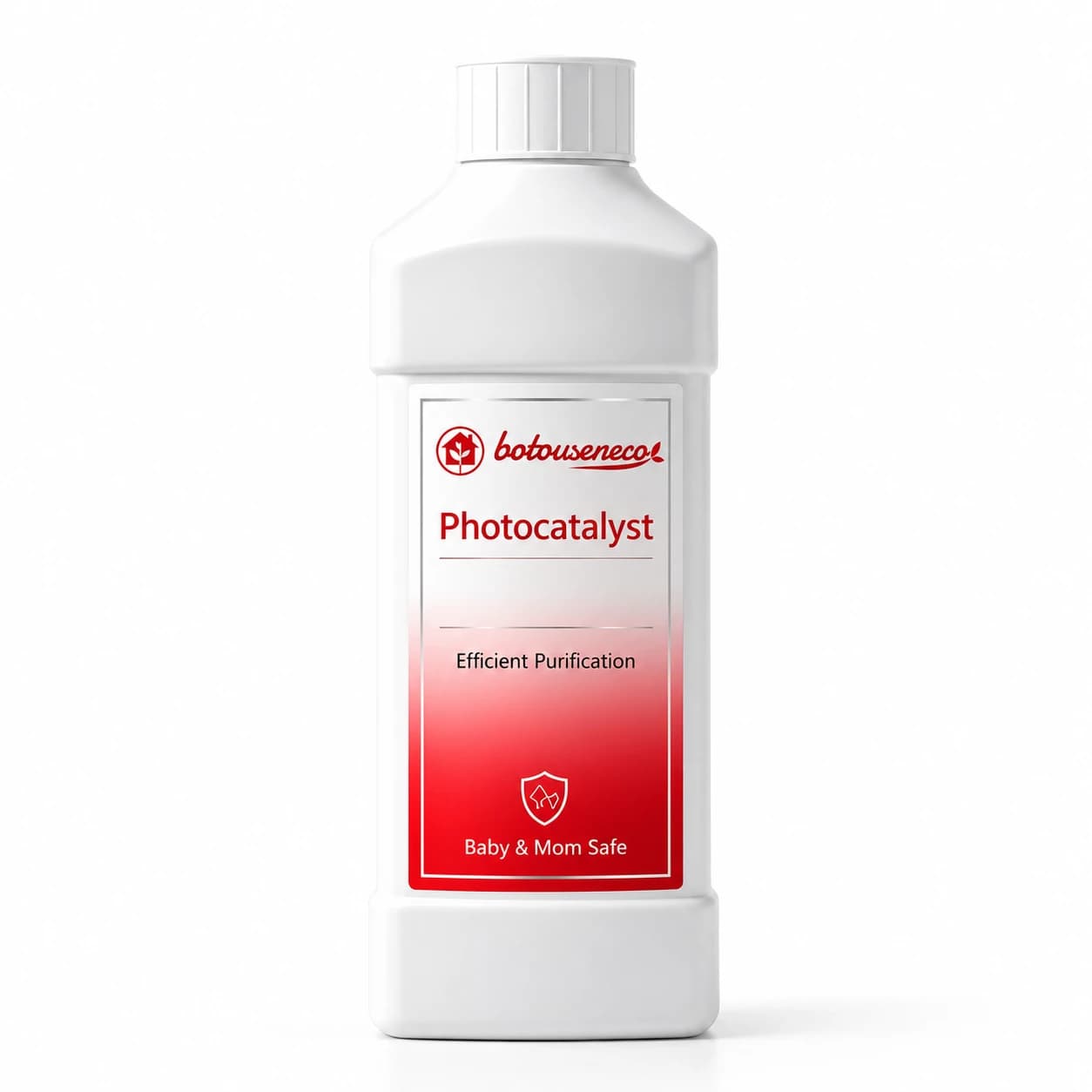
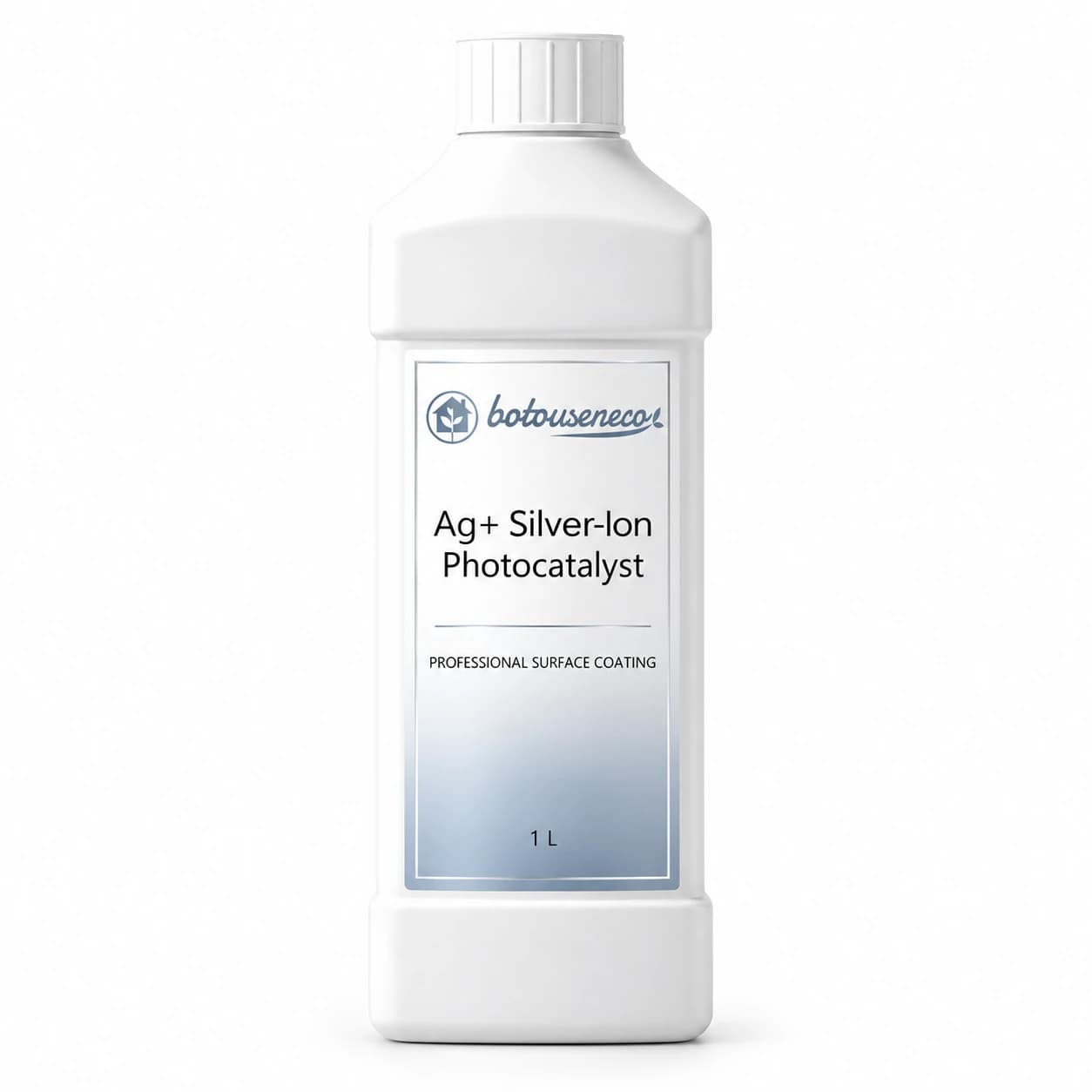
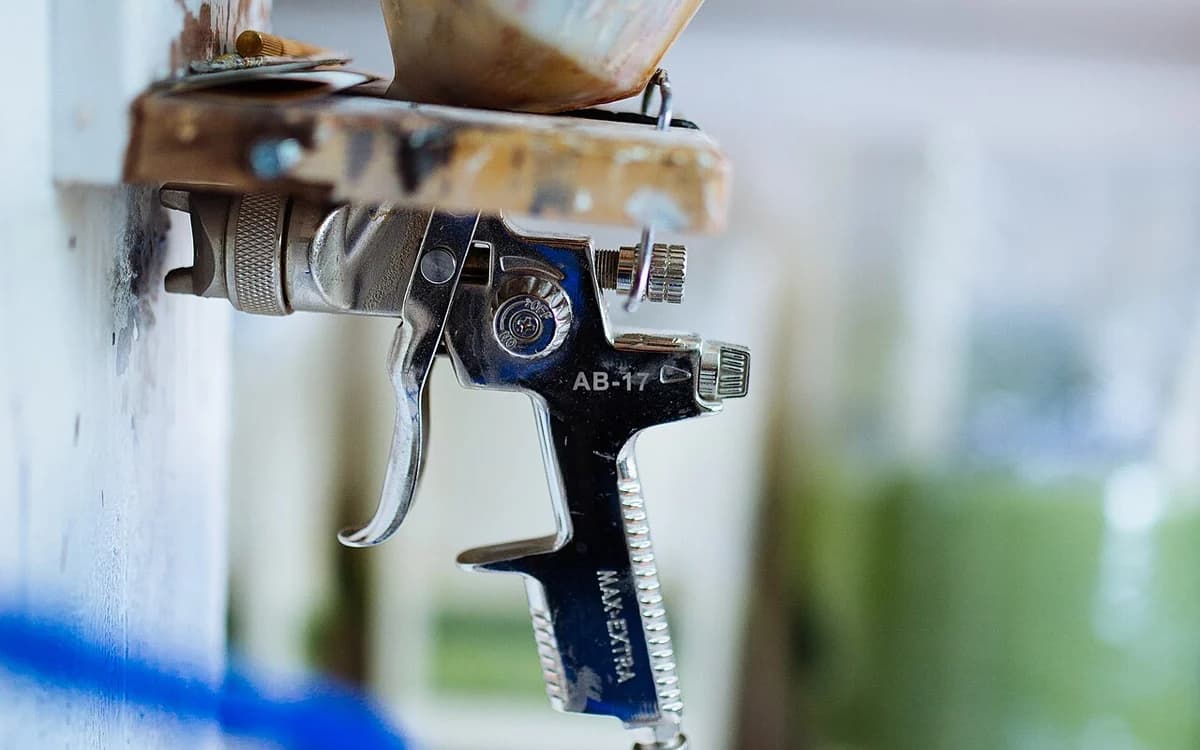
Colloidal 5-10 nm anatase TiO2 sol is a bottom-up hydrothermal, Zeta-stabilized clear liquid (99% pure anatase, Botou QC Spec, 2026) that dries into an invisible, self-bonding 50 nm catalyst film. In contrast, P25 powder suspensions are milled slurries of 25-60 nm fumed TiO2 powders that form 200-800 nm clumps in water. Those clumps dry into white chalk on dark walls and need acrylic glue that degrades under photocatalytic oxidation. Using our 5-10 nm Spray Nano Photocatalyseur (8 à 12 ml/m2 via 0.5 mm HVLP gun) or 1:4 mixed 5X Sol Concentrate stops wall whitening, gun clogs, and chalking while boosting 450 nm LED active area by 6x.
Points clés à retenir
- Zero Wall Whitening (Rayleigh Regime): True 5 to 10 nm hydrothermal crystals are 50x smaller than green room light (550 nm), curing 100% invisible on dark matte drywall unlike 200-800 nm P25 powder clumps.
- Zero Organic Resin Chalking: High-density surface Ti-OH groups self-crosslink into an inorganic Ti-O-Wall network without acrylic binders that yellow and shed dust.
- 6x Higher Active Surface Area: Shrinking primary grain size from 50 nm (35 m2/g) down to 6 nm (240 m2/g) expands catalytic surface area by 600% per gram under 450 nm indoor LEDs.
- 60-Second Incoming QC Check: Verify genuine 5-10 nm sols on site with a 10-second laser Tyndall beam check, a 30-minute dark paint card test, and a pH 6.5-7.5 neutrality strip.
1. Crystallite Size and Rayleigh Scattering: 5-10 nm Colloidal Sol vs. 25-60 nm P25 Slurries
Rayleigh vs. Mie optical scattering is the optical rule explaining why crystals smaller than one-tenth the wavelength of light (under 40 nm, such as 5-10 nm sols) let visible light pass cleanly with a faint sky-blue Tyndall glow, whereas 200-800 nm powder clumps scatter all colors (Mie scattering) and look white like chalk.
Many low-cost blenders buy dry fumed titanium dioxide powder (such as 25-60 nm P25 or 200 nm pigment TiO2). Next, they stir 1% powder into water with dispersants and call the milky jug Nano Photocatalyst. When dry TiO2 powder forms inside a hot flame reactor (over 1,000 C), primary 25-60 nm grains fuse into 200 to 800 nm hard sinter clumps. Normal water mixing or bead mills cannot break those fused necks. Because 400-700 nm room light matches the size of those clumps, the dried coat scatters white light across dark walls, leaving a dusty white haze that requires full repainting.
How Bottom-Up Hydrothermal Peptization Builds True 5-10 nm Monodisperse Sols
At our Botou synthesis plant, our TiO2 never turns into dry hot powder. Instead, titanium precursors grow by low-heat hydrothermal peptization right inside pure water:
- Primary Crystal Control (5-10 nm): Electron microscopy (TEM) and X-ray diffraction (XRD) verify over 99% (Botou QC Spec, 2026) pure anatase phase with a crystal size of 5 to 10 nm (50 times smaller than 550 nm green room light).
- 6x Specific Surface Area Gain: Catalytic breakdown under ISO 22197-1 Fine Ceramics Air Purification Testing (2024) happens only on outer crystal faces. Shrinking grain size from 50 nm (35 m2/g) down to 6 nm (240 m2/g) boosts active catalytic area by 600% per gram of TiO2.
- 18-Month Zero-Cake Zeta Charge: Surface charge (pH 6.8-7.5) keeps every 5-10 nm crystal floating apart for 18 months with zero thickeners.
| Material & Engineering Metric | True 5-10 nm Colloidal Anatase Sol (botouseneco) | Milled 25-60 nm P25 / Pigment Powder Slurry | Direct Field Impact for IAQ Contractors & OEMs |
|---|---|---|---|
| Synthesis Pathway | Bottom-up hydrothermal peptization & lattice doping | Top-down bead milling of dry TiO2 powder | Sol stops hard sinter clumps before they form |
| Hydrodynamic Size in Bottle | 5 to 10 nm single primary crystals | 200 to 800 nm clumped powder flocks | Powder slurries cake hard at the bottom in 14-30 days |
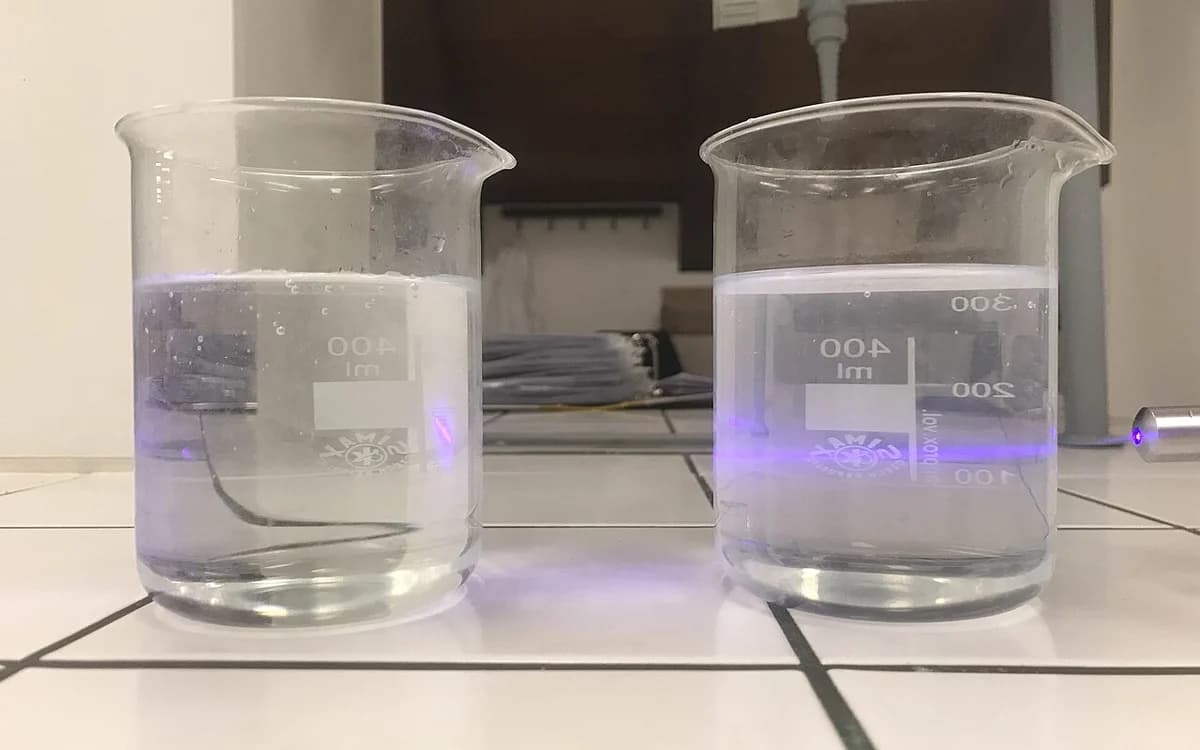
| Liquid Optical Appearance | Translucent liquid with sky-blue Tyndall beam | Opaque, milky-white paint slurry | Fast 5-second green laser QC check on site |
| Appearance on Dark Matte Walls | 100% invisible at 8-12 ml/m2 (0.5 mm tip) | Leaves chalky white haze, streaks, and spots | Stops costly wall repainting warranty claims |
| Wall Adhesion Mechanism | Inorganic Ti-O-Si / H-bond self-adhesion (Zero resin) | Needs 3% to 8% organic acrylic glue | Organic glue yellows, chalks, and blocks active sites |
| Indoor 450 nm LED Activity | Active (380-550 nm doped) under white office LEDs | Idle indoors (3.2 eV UV-only undoped powder) | Runs 365 days/year without UV lamps |
2. Why Organic Acrylic Binders Chalk Under Oxidation While Inorganic Sols Self-Adhere
Photocatalytic binder chalking is the breakdown of organic acrylic, PU, or vinyl glue on nearby TiO2 crystal faces, causing powder coatings to turn yellow, crack, and shed white dust within 3 to 6 months. Big 300 nm powder clumps have zero natural grip on cured wall paint; without acrylic glue, dried P25 powder rubs right off onto hands like chalk.
For full building SOPs pairing photocatalysts with rug and desk VOC cleaners, see our pillar guide on visible-light nano-TiO2 photocatalyst coatings and commercial TVOC abatement.
Two Fatal Flaws of Organic-Bound Powder Slurries
Adding organic polymer binders to hold coarse TiO2 powder on drywall creates two operational failures:
- 1. Active-Site Masking (70% Loss on Day 1). Adding 5% acrylic resin into a TiO2 slurry wraps the crystals in plastic glue. Surface catalysis papers on NIH PubMed Photocatalytic Coating Binder Research (2024) show that plastic binders block airborne HCHO and toluene from touching TiO2 sites, dropping Day-1 air cleaning by 65% to 80%.
- 2. Binder Self-Degradation & Dusting. Under window light or office LEDs, active oxygen species cleave carbon-hydrogen (C-H) bonds in the acrylic binder itself, shedding microplastic dust and secondary VOC aldehydes noted in the World Health Organization (WHO) Indoor Air Quality Guidelines (2024) and CDC ATSDR Profiles (2024).
How Inorganic 5-10 nm Colloidal Sols Bond Without Organic Glue
Because our 5-10 nm anatase crystals carry a dense shell of surface hydroxyl groups (Ti-OH), they need zero organic resin glue. Sprayed at 8-12 ml/m2 onto wall paint, plaster, wallpaper, or ceiling tiles, nearby Ti-OH groups condense as water dries into a tough inorganic Ti-O-Ti and Ti-O-Wall network. That 100% inorganic 50 nm film never yellows, never chalks, and keeps every crystal face open to room air.
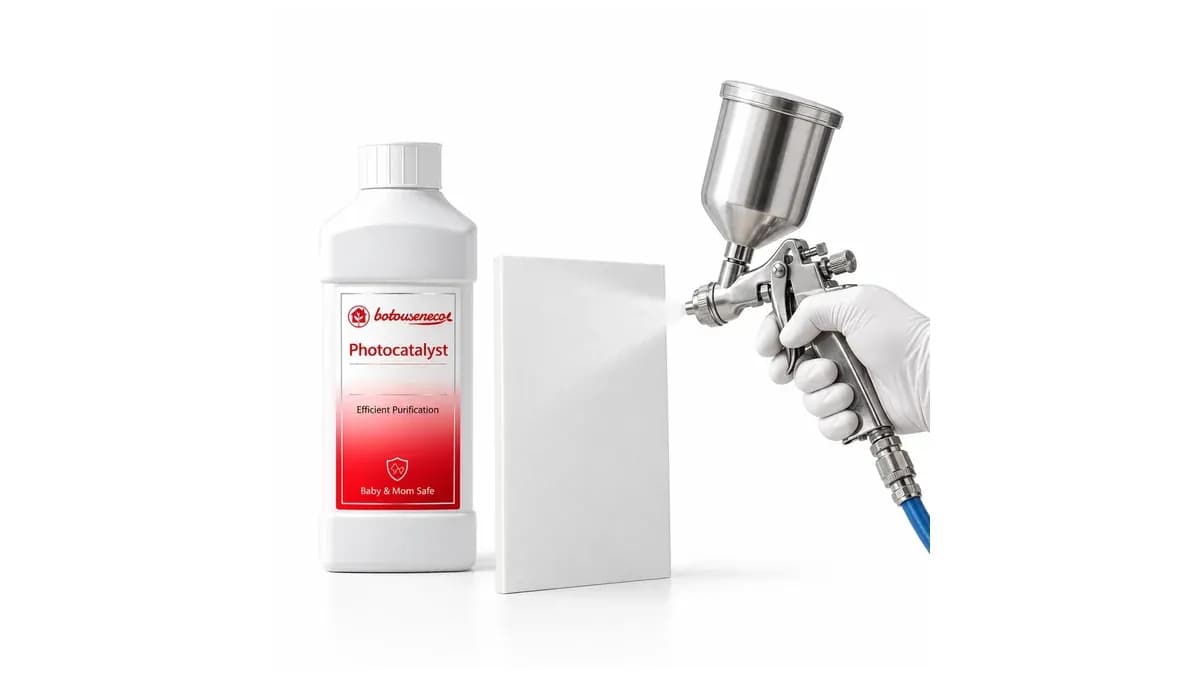
3. Selecting Ready-to-Use Nano Photocatalyst Spray, 5X Mother Sol, and 0.5 mm HVLP Hardware
Whether you run an IAQ crew, an overseas bottling line, or a paint and filter mill, our TVOC and photocatalytic coatings line and IAQ renovation contractor systems offer three matched SKUs.
1. Job-Site Ready Coating: Nano Photocatalyst Spray (1.0% wt, pH 6.5-7.5)
Ready-to-spray 1% wt (10,000 ppm) doped 5-10 nm visible-light anatase TiO2 sol in 1 L bottles, 5 L cans, 20 L / 25 L pails, and 200 L drums. Spray once at 8 à 12 ml/m2 (1 Liter coats 80 to 120 m2 of walls and ceilings) as Stage 3 protection after sealing raw wood boards under US EPA TSCA Title VI Composite Wood Products Regulation (2025) rules. Check drums on our Spray Nano Photocatalyseur page.
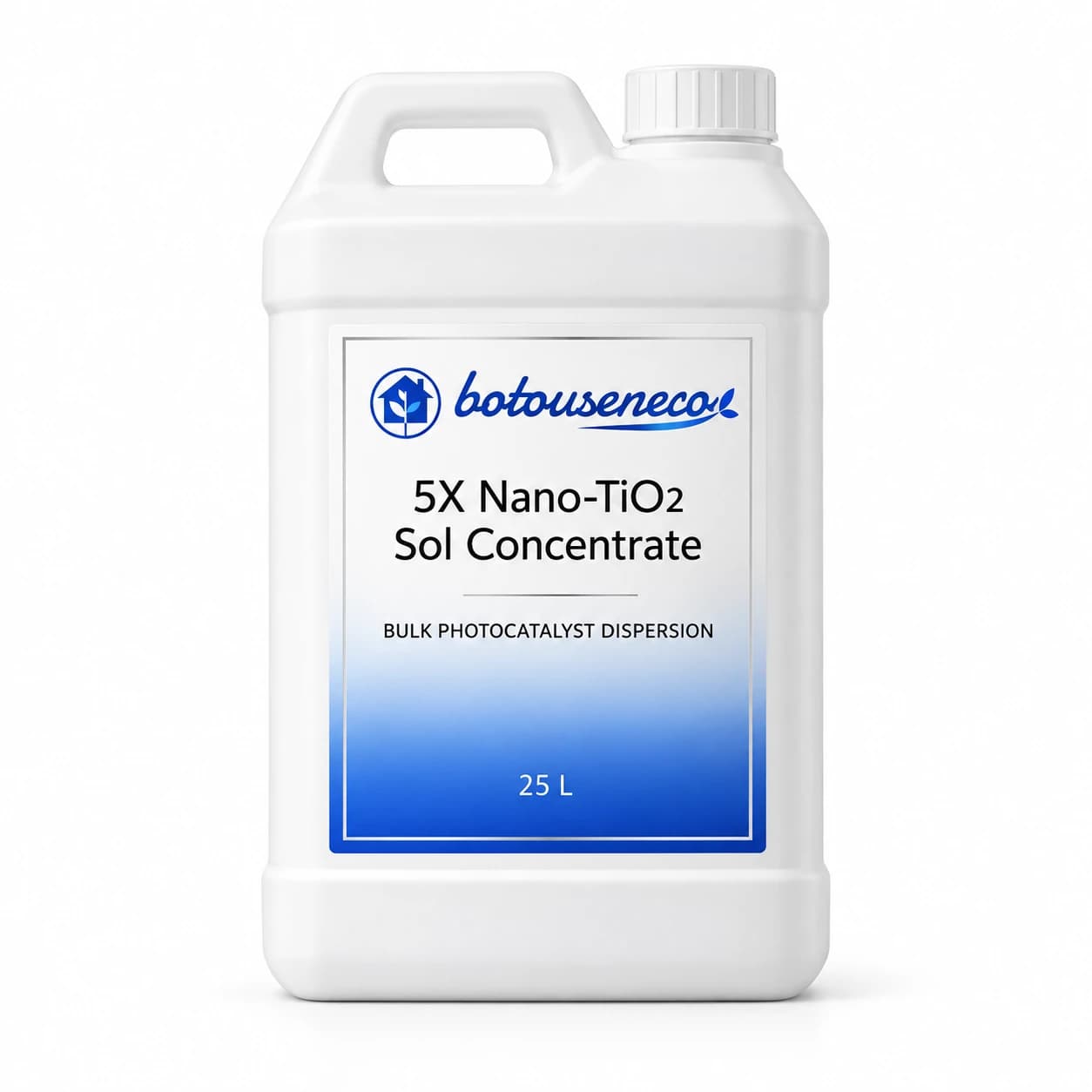
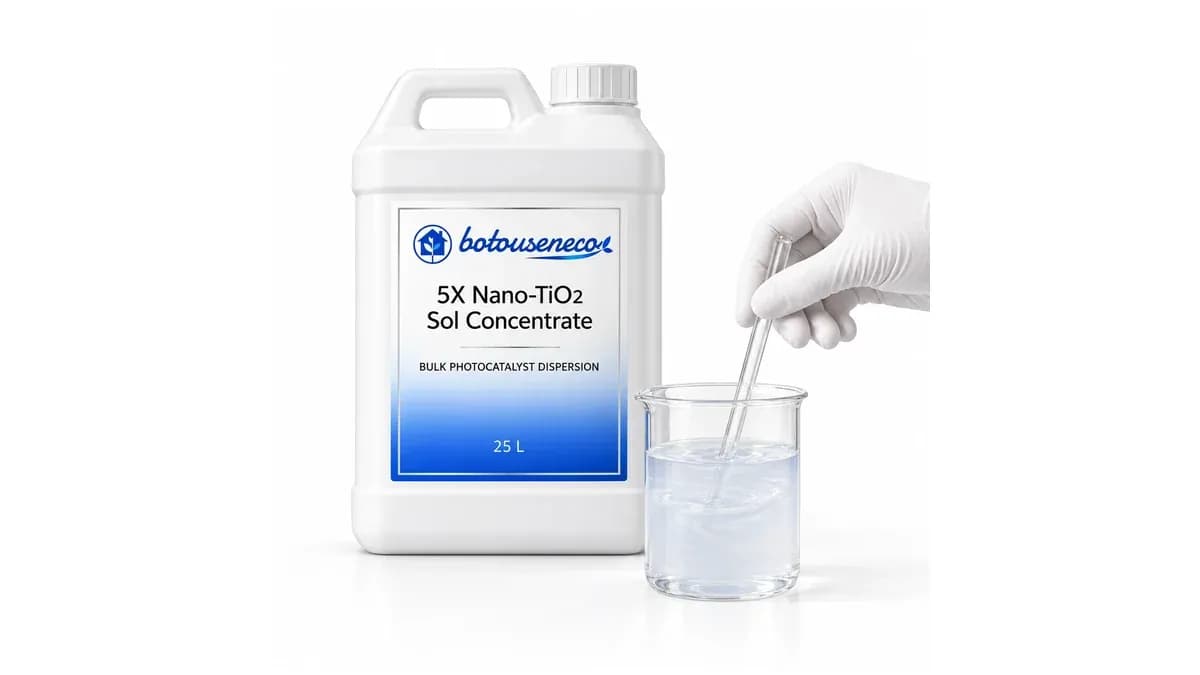
2. Overseas Bottler & Mill Feedstock: 5X Visible-Light Nano-TiO2 Sol Concentrate (5.0% wt, 50,000 ppm)
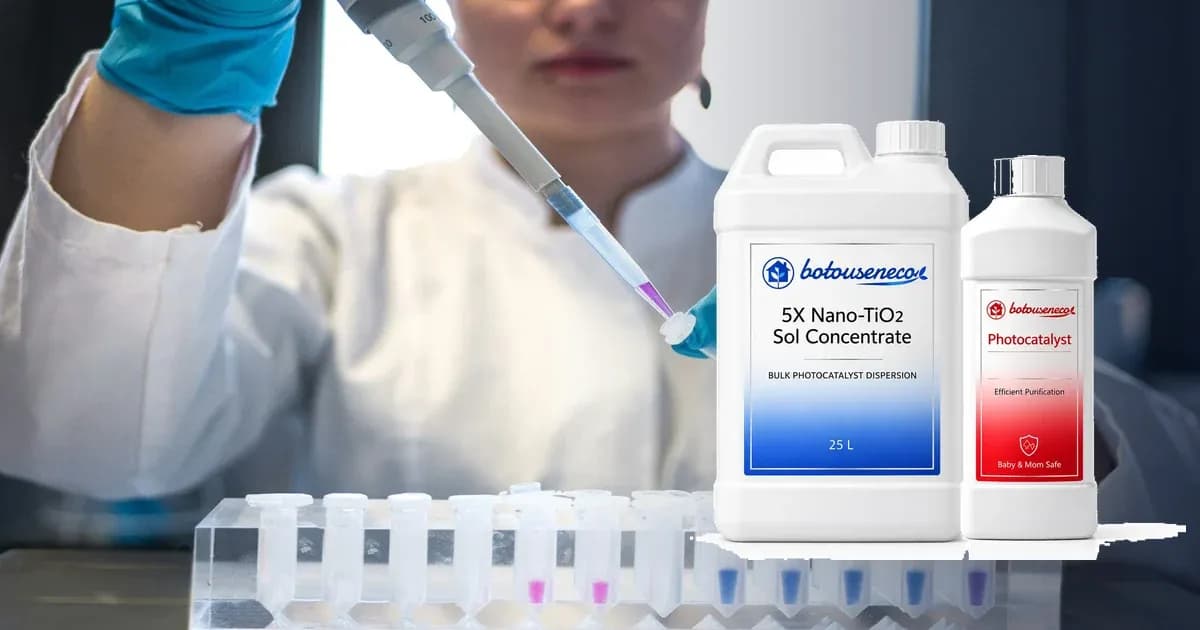
Supplied at 5% wt (50,000 ppm) doped 5-10 nm anatase mother sol (pH 6.8-7.5) in 20 L / 25 L carboys and 200 L drums. Mix 1 part sol : 4 parts pure deionized water (< 20 uS/cm, TDS < 15 ppm) at room heat (40-80 RPM for 10 minutes). One 20 L drum makes 100 Liters of 1% Nano Photocatalyst Spray (8,000-10,000 m2 yield), cutting ocean freight by 80%. See specs on our 5X Visible-Light Nano-TiO2 Sol Concentrate page.
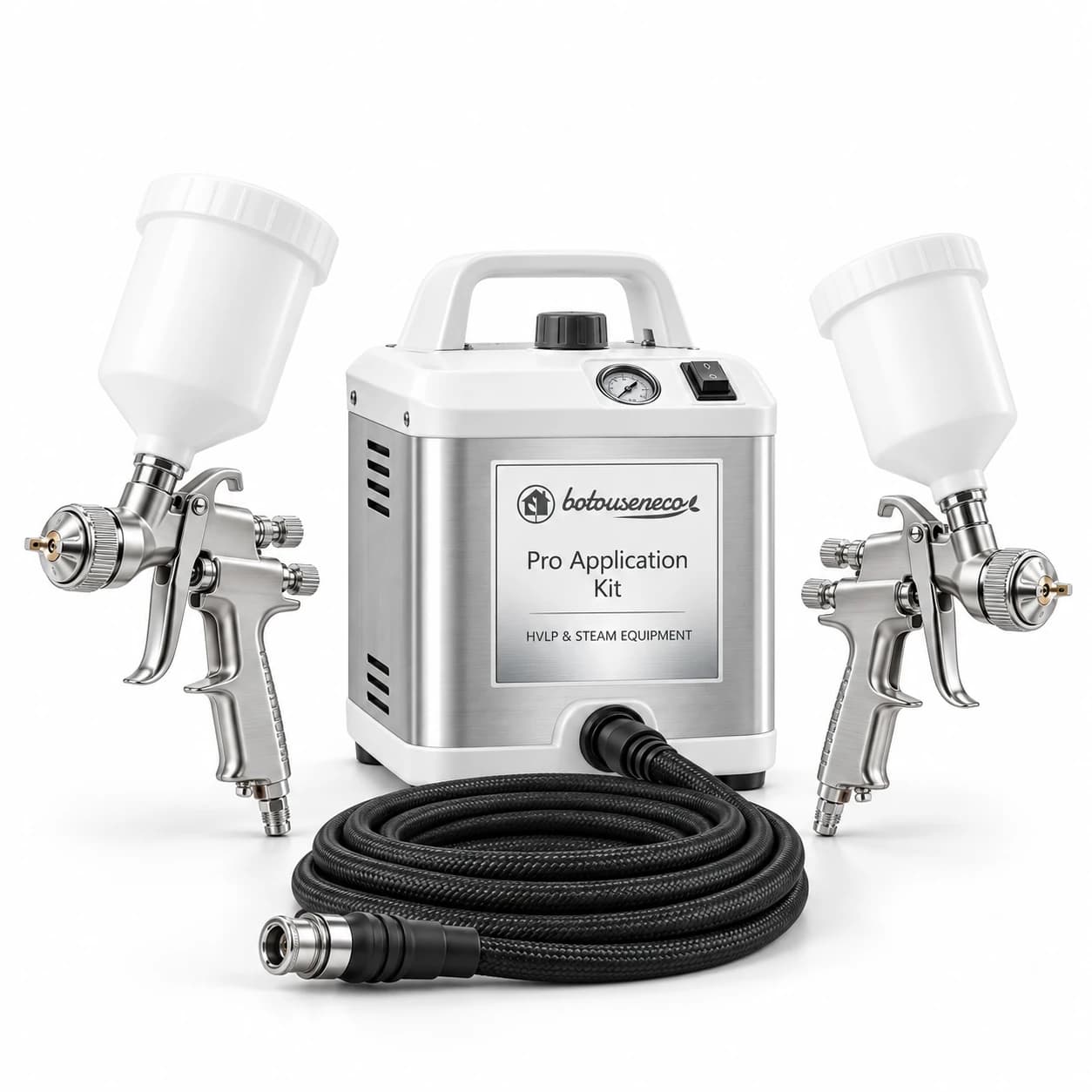
3. Streak-Free Shear Hardware: Pro HVLP Nano-Atomizer & Steam Fumigation Kit
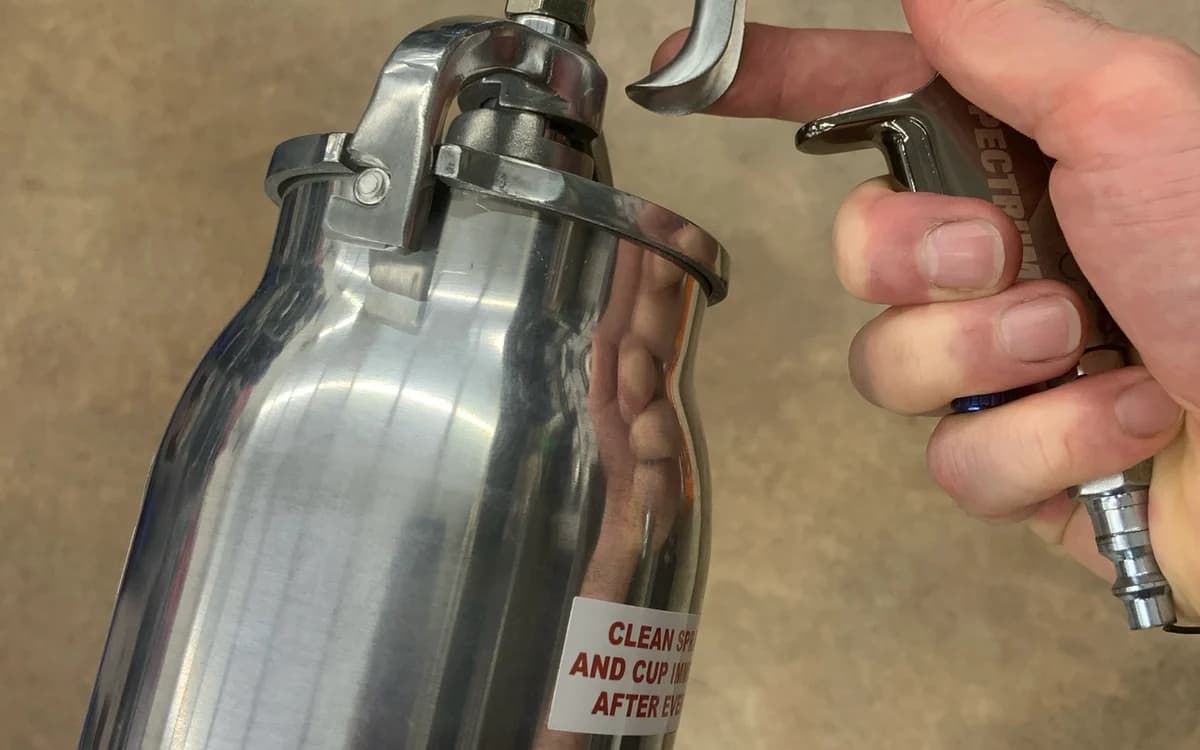
Even a pure 5-10 nm sol can leave water marks on slick satin paint if sprayed with a coarse 1.5 mm tip. Our Pro HVLP Nano-Atomizer and Steam Fumigation Kit equips crews with two dedicated 316 stainless HVLP guns (0.5 mm TiO2 gun at 0.20-0.30 MPa + 0.8 mm scavenger gun) and a 2600 W 95 C steamer, cutting liquid waste by 30%. See spray speed charts in our HVLP nano-photocatalyst coating adhesion and film uniformity guide and photocatalyst technology in modern air treatment.
4. 3-Step Incoming QC Bench Test: Spot Fake Nano Slurries in 60 Seconds
Before signing off on a bulk drum order of photocatalyst from any vendor, run these three fast checks in your shop:
- 1. Green Laser Pointer Tyndall Check (10 Seconds): Pour 100 ml into a clear glass cup. If the liquid looks like white milk that hides text behind the glass, it is a 200 nm powder slurry that will whiten walls. A true 5-10 nm sol is translucent and shows a sharp sky-blue Tyndall beam when a green or blue laser shines through the side.
- 2. Dark Matte Paint Card Dry-Film Test (30 Minutes): Tape half of a dark grey or navy matte drywall card. Mist 10 ml/m2 (0.5 mm HVLP tip) onto the open half, let it dry for 30 minutes, and peel the tape under 4000K LED light. A true 5-10 nm inorganic sol leaves zero edge line and zero white chalk.
- 3. Neutral pH Strip Check (pH 6.5-7.5): Cheap acid-peptized TiO2 sols skip dialysis and ship at pH 1.5-3.0 or pH 10-11, corroding window frames and stone. Verify with a probe or strip that the sol sits at neutral pH 6.5 to 7.5.
5. Verified Botou Factory Supply Terms, MOQs, and Accredited Testing Policy
Made in-house since 2015 by Hebei Senzhijia Environmental Protection Co., Ltd (botouseneco) in Botou, Hebei, China, every batch of RTU Nano Photocatalyst Spray and 5X Sol Concentrate passes laser scattering, Tyndall clarity, and pH checks before shipping. Learn more about us and our Botou hydrothermal nano-synthesis plant before ordering a test bottle.
- Minimum Order Quantities (MOQ): Sample Evaluation Kit: 1-5 units (500 mL / 1 L test bottle of RTU Spray or 5X Sol Concentrate) so your team can run the laser Tyndall and dark-wall spot checks firsthand. Standard Bulk Supply: Orders start from 100 L (4 fûts) in 5 L cans, 20 L / 25 L HDPE carboys, or 200 L lined drums. OEM Private Label: Custom brand runs start from 500-1,000 units.
- Lead Times & Port of Loading: Samples ship in 24-48 hours, bulk drums in 5-7 business days, and custom OEM runs in 10-14 business days from Tianjin Port, China (about 180 km from our plant) as Non-Dangerous Goods (Non-DG) with a 16-section GHS Rev. 10 / ISO 11014 SDS (EU REACH SVHC-free).
- Quality Systems & Private Report Policy: Every batch runs under Système de gestion de la qualité ISO 9001 : 2015 and Système de gestion environnementale ISO 14001 : 2015 rules, backed by Vérification des chambres accréditées CMA/CNAS (ISO 16000-9 / GB/T 18883-2022). Certificate numbers and full lab scans stay private; copies and batch COA sheets are sent straight to buyers when you contact our B2B photocatalyst engineering desk.
Standards & references
- ISO 22197-1:2024: Fine ceramics test method for air-purification performance of semiconducting photocatalytic materials.
- ISO 16000-6 & ISO 16000-9: Determination of indoor VOCs and formaldehyde in test chambers and commercial buildings.
- GB/T 18883-2022 & WHO Indoor Air Quality Guidelines: Indoor formaldehyde (<= 0.08 to 0.10 mg/m3) and TVOC acceptance benchmarks.
- US EPA TSCA Title VI (40 CFR Part 770): Composite wood formaldehyde emission standards.
- UN GHS Rev. 10 / ISO 11014 & ISO 9001:2015 / ISO 14001:2015 : fiche de données de sécurité non-DG en 16 sections et normes de gestion de la qualité des lots COA.
Foire aux questions (FAQ)
01.Why does P25 titanium dioxide powder turn colored walls white while botouseneco 5-10 nm sol dries invisible?
Commercial P25 powder forms 200 to 800 nm clumps in water. Because those clumps match the 400-700 nm wavelength of room light, they scatter white light and dry like chalk. Our hydrothermal 5 to 10 nm anatase sol has crystals 50 times smaller than visible light, drying into a clear 50 nm film with zero whitening.
02.How does an inorganic TiO2 sol stick to painted drywall without an acrylic resin binder?
At 5 to 10 nm grain size, anatase crystals carry a dense ring of surface hydroxyl (Ti-OH) groups. As water dries after 0.5 mm HVLP spraying, those groups form strong hydrogen bonds and Ti-O-Wall links with mineral fillers in wall paint, locking on tight without organic glue.
03.Can we dilute 5X Visible-Light Nano-TiO2 Sol Concentrate with regular tap water on a job site?
No. Tap water holds calcium and magnesium ions (Ca2+, Mg2+) that crush Zeta charge and cause white clumps. Always mix 5X Visible-Light Nano-TiO2 Sol Concentrate at 1:4 with deionized water (under 20 uS/cm, TDS under 15 ppm), or buy our ready-to-use Spray Nano Photocatalyseur for field crews.
04.What surfaces must be masked before spraying 5-10 nm Nano Photocatalyst Spray?
Mask dark high-gloss glass, mirrors, OLED screens, polished stainless steel, and dark gloss lacquer doors. Because inorganic 5-10 nm TiO2 bonds tightly to smooth glass and metal oxides, stray drops left to dry on mirrors can leave faint rainbow rings.

À propos de l'auteur.
NIP
PIN est PDG de botouseneco (Hebei Senzhijia), dirigeant la stratégie de R&D, les lignes de synthèse de polymères et les partenariats de fabrication industrielle de l'usine de formulation de Botou depuis la création de l'entreprise en 2015. PIN est spécialisé dans l'élimination du formaldéhyde des polymères aminés, la photocatalyse nano-TiO₂ à lumière visible, le contrôle des émissions de panneaux de bois d'ingénierie et les médias de chimisorption.
- Directeur Général · Usine de formulation et de fabrication de Botou.
- Plus de 10 ans d'expérience dans la synthèse de polymères pour la qualité de l'air intérieur et la fabrication B2B.
Écrit par NIP (Directeur général (PDG)) and reviewed by our Botou formulation & QC leadership. Explore our Laboratoire de formulation Botou, ISO & CMA/CNAS quality desk, OEM & private-label program, glossaire technique, ou contactez notre bureau d'ingénierie pour la documentation TDS et SDS du projet.
Prochaine étape.